
Research Signal – Source date 2024-02-29
For people with endometrial cancer, meaning cancer of the uterine lining, one tumor test can influence several important questions. It may help identify a treatment option, point toward inherited cancer risk, and reveal biological differences that could affect how a tumor responds. But the same test result does not provide a complete forecast for an individual patient.
A review published on February 29, 2024, examines why. Its focus is a group of tumors described as deficient in DNA mismatch repair or showing high microsatellite instability. The review brings together treatment trials, molecular studies and testing guidance to ask whether different causes of the same repair problem may matter for immunotherapy.
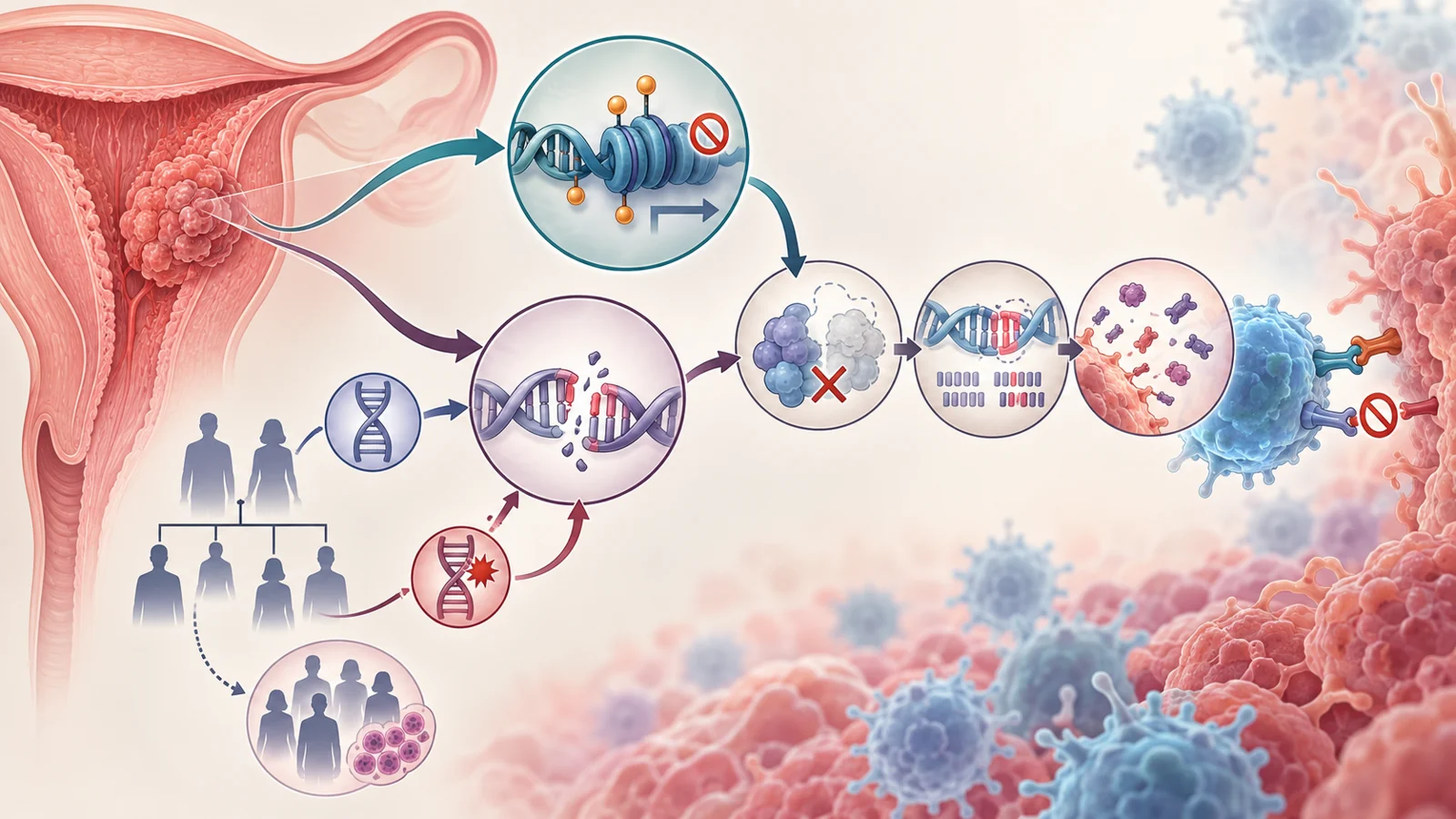
The repair problem starts with copying errors
DNA mismatch repair is a cellular quality-control process. When DNA is copied, the copying machinery can insert the wrong letter or add or remove a small number of letters. Repair proteins identify these mismatches and help remove and replace the affected stretch.
Some errors occur in microsatellites, which are short repeated sequences of DNA. When the repair system is faulty, these sequences can change more often. The resulting pattern is called microsatellite instability, or MSI. Tumors with deficient mismatch repair are often described as MSI-high because they carry many such changes.
Those changes can also create abnormal protein fragments, known as neoantigens, that make a tumor more visible to the immune system. Immune checkpoint inhibitors work by blocking an inhibitory pathway involving PD-1 and PD-L1, helping immune cells maintain an anti-cancer response. A repair-deficient tumor may therefore be a useful setting for immune treatment, but increased immune visibility is not the same as guaranteed tumor control.
The repair failure itself can arise through different routes. MLH1, one of the repair genes, may be switched off by promoter hypermethylation, an epigenetic change within the tumor. Other tumors acquire two damaging mutations in repair genes. A further group carries an inherited alteration in a repair gene or in EPCAM, a pattern associated with Lynch syndrome and increased risks of several cancers, including endometrial and colorectal cancer.
Most repair-deficient tumors are not caused by inherited Lynch syndrome. That is why the molecular label has two meanings at once: it can describe a feature of the tumor relevant to treatment, while also prompting a separate question about whether the patient and relatives may share an inherited predisposition.
What the treatment studies actually measured
The review separates evidence from different treatment settings. In KEYNOTE-158, pembrolizumab was studied in patients whose mismatch repair-deficient or MSI-high cancers had already received treatment. Among 90 patients with previously treated endometrial cancer, the objective response rate was 48%. The median progression-free survival was 13.1 months. Immune-related adverse events occurred in 28% of patients, with 7% experiencing events classified as grade 3 or 4.
An objective response means that tumors shrank by the study’s measured criteria. It is not the same as controlling cancer indefinitely, and it does not describe every patient in the cohort. Progression-free survival is also a different outcome: it measures how long patients remained alive without the cancer worsening or a new progression event being recorded.
GY018 addressed a different question in newly diagnosed advanced or recurrent disease. It compared chemotherapy plus pembrolizumab, followed by pembrolizumab maintenance, with chemotherapy plus placebo and placebo maintenance. In the mismatch repair-deficient group, 12-month progression-free survival was 74% with pembrolizumab and 38% with the placebo regimen. The reported hazard ratio was 0.30, meaning the comparison favored the pembrolizumab-containing regimen during the study period.
RUBY likewise tested chemotherapy combined with an immune checkpoint inhibitor, in this case dostarlimab, followed by maintenance treatment. In its mismatch repair-deficient group, 12-month progression-free survival was 63.5% with dostarlimab compared with 24.4% with placebo. At 24 months, the reported figures were 61.4% and 15.7%, respectively. The review also describes an overall survival benefit reported with the dostarlimab-containing regimen in this group.
These trials support the value of adding checkpoint blockade to chemotherapy for the populations they enrolled. They do not directly compare pembrolizumab with dostarlimab. The studies also differed in important ways: RUBY included a higher-risk population, allowed carcinosarcoma, used a different interval for some recurrent disease, and continued maintenance for three years rather than two years in GY018. The percentages therefore should not be read as a simple ranking of the drugs.
The review also describes postoperative studies as an investigational extension. NRG-GY020 was evaluating radiation with or without pembrolizumab in newly diagnosed early-stage, high-intermediate-risk mismatch repair-deficient disease. Other studies were evaluating adjuvant dostarlimab or durvalumab alongside radiotherapy in selected stages and molecular groups. In the review’s account, the relevant recurrence or progression endpoints were still awaiting maturation or ongoing accrual, so these studies did not yet provide completed evidence of benefit in the postoperative setting.
A tumor test can answer more than one question
Testing for mismatch repair deficiency and MSI involves related but different measurements. Immunohistochemistry, or IHC, uses tissue staining to show whether the four main repair proteins appear to be present in tumor cells. DNA-based tests use PCR or next-generation sequencing to look for instability or broader mutation patterns.
IHC is widely available, relatively inexpensive and does not require a matched normal sample. MSI testing measures the functional pattern of instability more directly, while sequencing can also provide information about mutations and tumor mutational burden. The results do not always match. Some tumors show MSI-high DNA patterns while retaining repair-protein staining, and some show loss of repair proteins without meeting an MSI-high definition.
The review describes IHC as the usual first step for endometrial cancer, followed when appropriate by MLH1 promoter methylation testing. When MLH1 is absent and promoter hypermethylation is not identified, genetic assessment for Lynch syndrome may be considered. Tumor sequencing and additional methods can help clarify ambiguous cases.
This sequence is not a self-diagnosis route. Rare exceptions complicate the interpretation, including the possibility that MLH1 methylation can occur alongside an inherited MLH1-related condition. Constitutional MLH1 methylation is another uncommon mechanism. Family history and genetic counseling or testing therefore remain relevant even when a tumor has a methylation finding that might otherwise suggest a sporadic cause.
The practical value of this testing is broader than selecting an immune treatment. It can help classify the tumor, support staging and prognosis, identify people who may need inherited-risk assessment, and alert relatives who could benefit from appropriate evaluation. Those purposes overlap, but they are not interchangeable.
Does the cause of repair failure predict response
The review examines a plausible subgroup hypothesis: tumors with inherited or acquired repair-gene mutations may have different immune biology from tumors in which MLH1 has been silenced by promoter methylation.
A small phase II pembrolizumab study involving 24 patients reported an objective response rate of 100% in a Lynch-like or mutational group, compared with 44% in the sporadic or epigenetic group. Three-year progression-free survival was reported as 100% and 43%, respectively. The study also described higher tumor mutational burden and different immune-cell patterns in the mutational group. It did not include germline assessments, and its small size limits how broadly the comparison can be applied.
The larger-trial picture was less definitive. Subgroup analyses from GARNET and GY018 did not find a statistically significant difference in response according to methylation status. Both analyses had important gaps in the classification of repair mechanisms and in germline information. A trend in one direction is not enough to turn repair mechanism into a validated rule for choosing or withholding checkpoint treatment.
Observational tumor cohorts add context without resolving the treatment question. In one sequenced cohort described by the review, 184 MSI-high endometrial cancers included 120 with MLH1 promoter hypermethylation, 25 with a germline mutation associated with Lynch syndrome and 39 with somatic mismatch repair mutations. The epigenetic group was diagnosed at an older age and more often had obesity or advanced disease at diagnosis. It also had lower tumor mutational burden and lower tumor-infiltrating lymphocyte scores, along with shorter progression-free survival in the reported analysis.
These characteristics may help explain why the biology is worth studying, but they do not by themselves show that methylation status predicts benefit from a particular immunotherapy. Some tumors progress despite a repair-deficient or MSI-high label. The review discusses possible contributors, including immune suppression by myeloid cells, dysregulated T-cell activity and tumor heterogeneity. If immune-recognized mutations are present only in subclones rather than throughout the tumor, the immune response may be less effective and resistance may emerge.
Eligibility is also shaped by population and access
The implications extend from individual tumor biology to who is likely to qualify for a treatment. The review describes a prospectively sequenced cohort of 1,882 endometrial cancers, including 259 patients who self-identified as Black and 1,623 who self-identified as White. MSI-high tumors were identified in 14% of tumors from Black patients and 25% of tumors from White patients. Tumor mutational burden was also lower in the Black patient group, with 15% meeting a reported threshold of 10 or higher compared with 33% in the White patient group.
In that cohort, the difference in actionable findings was driven largely by features related to checkpoint-inhibitor eligibility. The observation matters because a treatment opportunity based on tumor testing can be distributed unevenly across populations.
It should not be read as evidence that racial identity causes treatment response or serves as an individual eligibility criterion. Self-identified race and genetic ancestry are different kinds of information, and neither substitutes for a patient’s tumor testing. The review points to several possible influences on the observed patterns, including differences in study ascertainment, environmental and social conditions, cancer type and access to testing and care.
The equity question is therefore both biological and practical. Molecular differences may affect the frequency of a qualifying tumor feature, while unequal access to sequencing, genetic assessment, specialist interpretation or treatment may affect whether that feature is found and acted upon. More careful studies are needed to distinguish these influences rather than collapsing them into a single racial explanation.
What more precise immunotherapy could mean for patients
The promise of this research is longer-lasting cancer control for people whose tumors resist or escape existing immune treatment. Better matching of an immune therapy, or a combination of therapies, to the way repair failed and to the surrounding immune environment could eventually help clinicians address forms of resistance that the broad mismatch-repair-deficient label cannot distinguish.
That possibility remains conditional. Prospective studies must establish which molecular distinctions genuinely predict useful treatment choices and which combinations improve outcomes. If those studies succeed, a test that now helps identify treatment eligibility and inherited risk could become part of a more precise approach to choosing and adapting immunotherapy, while preserving the separate responsibility to assess family cancer risk.
Key Sources
- Primary source: A tale of two pathways: Review of immune checkpoint inhibitors in DNA mismatch repair-deficient and microsatellite instability-high endometrial cancers.
DOI or Journal Page · Review or Meta-Analysis · 2024-02-29
Keep exploring