
Research Signal – Source date 2025-07-01
A leukemia treatment can recognize its target correctly and still harm the patient: the same marker may be present on cancer cells and healthy blood-forming cells. A July 2025 review describes an approach to this problem in acute myeloid leukemia (AML): edit donor cells so they lack the marker, then use a drug aimed at it.
The strategy is not a new leukemia drug. It changes the cells being transplanted, with the aim of making a later treatment more compatible with the new blood system. The review describes promising early observations, but they concern graft behavior and blood-cell recovery, not proven long-term control of leukemia.
The target is shared with healthy blood cells
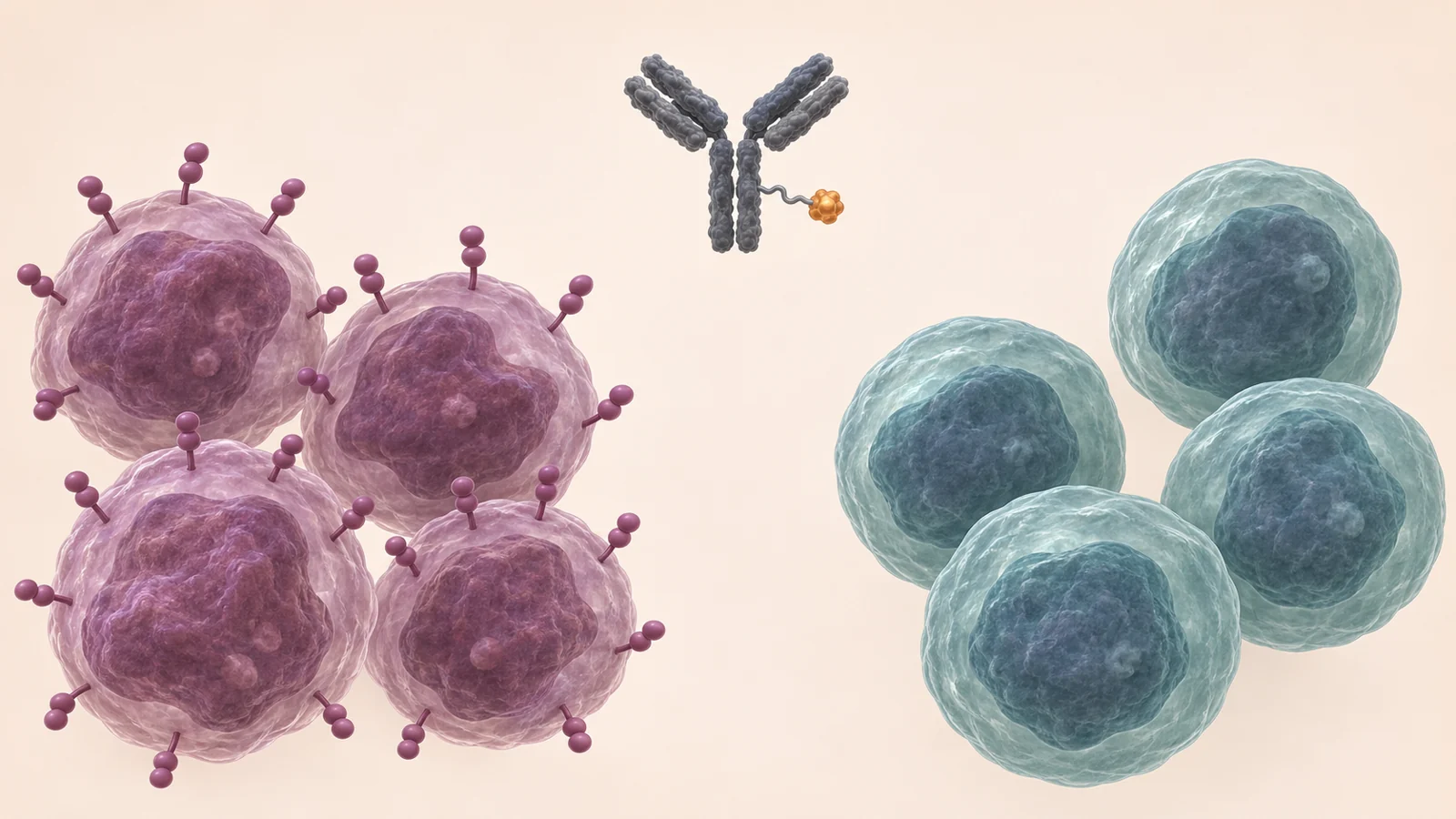
CD33 is found on many AML cells and on normal myeloid cells, including blood-forming stem cells. Gemtuzumab ozogamicin (GO), a drug that targets CD33, can therefore affect healthy blood-forming cells as well as leukemia. This “on-target, off-tumor” toxicity is a central obstacle: the drug reaches the marker it is meant to find, but that marker is not unique to cancer.
The proposed sequence is to edit donor stem and progenitor cells to remove CD33, transplant those cells, and then give the CD33-directed drug. In principle, leukemia cells that retain CD33 could remain targets while the edited donor cells are less vulnerable to the same treatment. The drug already exists; the proposed new capability is a graft that can tolerate it.
The edited product, tremtelectogene empogeditemcel (trem-cel), is made from donor cells matched to a recipient by human leukocyte antigen. In the reported manufacturing work, CRISPR-Cas9 gene editing disrupted CD33 in more than 70% of cells. In mice, edited cells remained in blood-forming tissue, produced multiple blood-cell types, and resisted GO. Editing was still detected in bone marrow 16 weeks after transplant. These animal findings support the biological idea, while the first patient observations address a separate question: whether the edited graft can establish itself and support blood production in people.
What the first patient observations show
A phase I/II trial began testing trem-cel as an allogeneic transplant followed by GO maintenance in people with CD33-positive AML or myelodysplastic syndrome (MDS) at high risk of relapse. The review reports rapid engraftment—the donor cells taking hold—and sustained blood-cell production. CD33-positive myeloid cells were consistently depleted, and the review reports no prolonged low blood counts of the kind associated with GO in unedited blood-forming cells.
Patients receiving trem-cel had GO exposure similar to that reported with higher doses in people with relapsed or refractory AML. This raises the possibility that editing could allow a lower dose while maintaining drug exposure. These early observations are about engraftment, blood production, and drug exposure. They do not show that the approach reduces relapse or improves long-term survival compared with an unedited transplant.
Editing a graft differs from redesigning a drug
The graft strategy changes which cells carry a drug’s target. Other approaches in the review change how a drug acts when cancer cells adapt. Revumenib, for example, blocks menin, a protein that helps sustain leukemia-driving gene activity in certain AML. In the reported study, 63% of patients had an overall response, and 23% achieved complete remission or complete remission with partial blood-count recovery. Among those in remission, 70% had no measurable residual disease by the study’s assessment.
The review also describes MEN1 mutations appearing within two treatment cycles. These changes affect the region where revumenib binds menin and can interfere with the drug’s fit. Balamenib was designed to bind differently and avoid a key site associated with those mutations. A phase I study in healthy volunteers reported no significant cardiotoxicity; that finding does not establish how the drug will work in people with leukemia.
A different drug strategy is to degrade a protein rather than block it. BGB-16673 is designed to bring Bruton’s tyrosine kinase (BTK), a protein involved in B-cell signaling, to a cellular disposal system. In an early phase I/II study of people with relapsed or refractory chronic lymphocytic leukemia or small lymphocytic lymphoma, the review reports a 72% overall response rate after a median follow-up of 4.6 months. Yet it also describes a patient who initially improved and then developed progressive disease linked to a BTK mutation. Changing how a drug handles its target may address some resistance, but it does not rule out new ways for cancer to escape.
These examples address a different problem from the edited graft. Drug redesign responds to changes in cancer or its target; graft editing aims to protect healthy donor-derived blood-forming cells from a treatment directed at a shared marker.
The evidence comes from different stages
The review also reports a phase III comparison in a distinct setting: people with lymphoma received either glofitamab plus gemcitabine and oxaliplatin, or rituximab with the same chemotherapy. Median overall survival was 25.5 months with the glofitamab combination and 12.9 months with the rituximab combination. Cytokine release syndrome, an immune reaction to treatment, occurred in 44% of patients receiving glofitamab with chemotherapy, mostly at low grade.
That trial offers a later-stage comparison of two regimens in lymphoma. The edited-graft findings are initial transplant observations, and the BTK-degrader result comes from an early study with shorter follow-up. Their figures answer different questions in different diseases; the lymphoma survival comparison does not measure whether edited grafts or BTK degraders work.
Where this research could lead
For someone receiving a donor-cell transplant for high-risk CD33-positive leukemia, a dependable edited graft could make it possible to use a CD33-directed drug while donor cells rebuild healthy blood. The potential advance is not the drug itself, but a graft able to tolerate it. That possibility follows from the shared-target problem and the early trem-cel observations, while durable benefit would depend on further clinical evidence and other treatment advances.
A meaningful milestone would be longer follow-up showing that edited cells continue to engraft, blood counts recover without prolonged cytopenias, and leukemia control can be measured. Such evidence would clarify whether the graft can keep rebuilding blood while CD33-positive leukemia remains treatable.
Key Sources
- Primary source: JCMM Annual Review on Advances in Biotechnology for the Treatment of Haematological Malignancies: A Review of the Latest In-Patient Developments 2024-2025.
DOI or Journal Page · Review or Meta-Analysis · 2025-07-01
Keep exploring