
Research Signal – Source date 2026-02-27
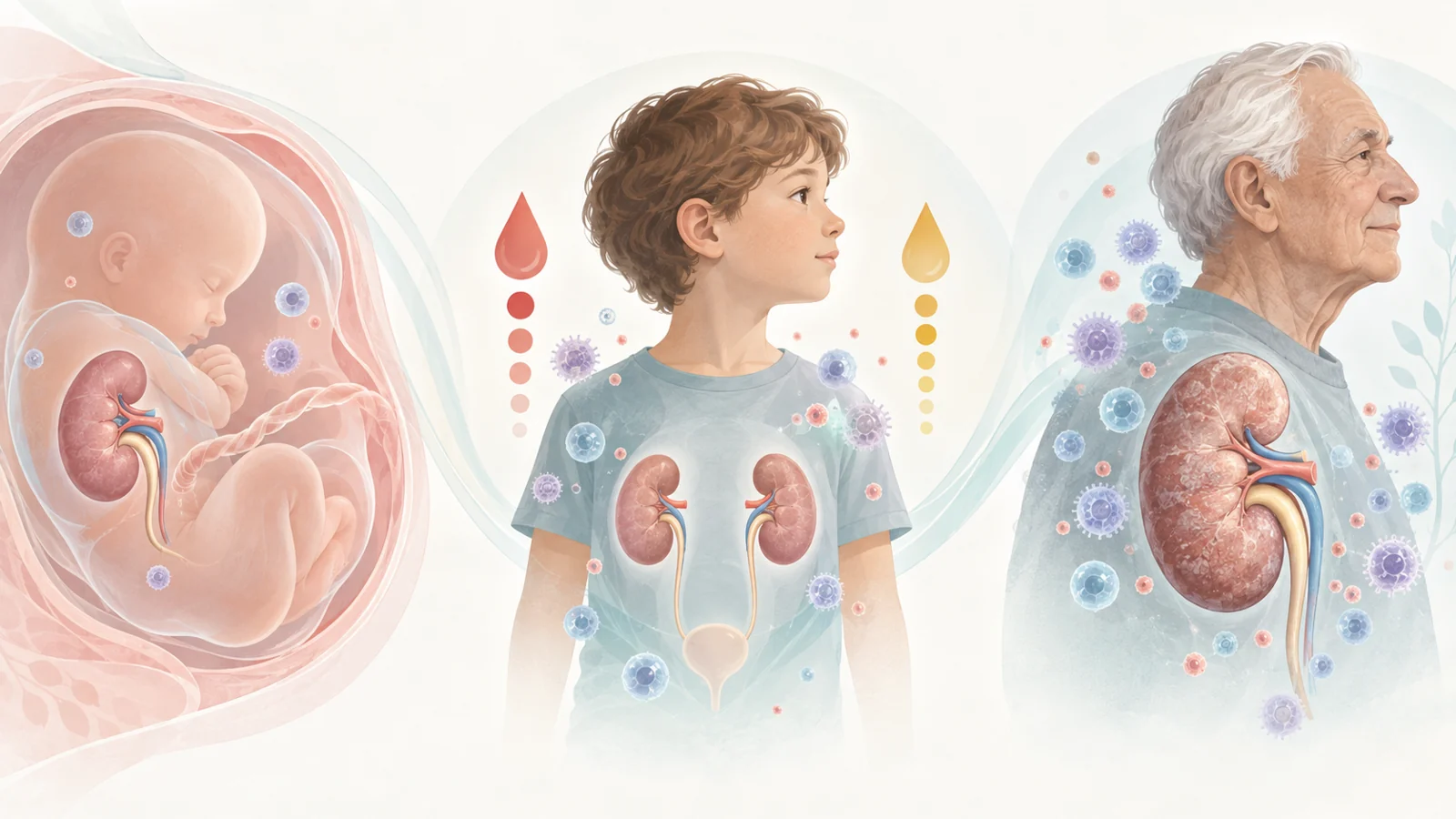
Kidney disease is often understood through what happens in adulthood: high blood pressure, diabetes, or the gradual loss of filtering capacity. But kidney development begins before birth, and the conditions surrounding that development may influence how much reserve the organs have decades later.
A February 2026 review brings inflammation into that longer story. Its central idea is not that inflammation is always harmful. Immune activity helps build a kidney; when its timing or intensity is disrupted, it may also help program lasting vulnerability. The review connects evidence from pregnancy, childhood, adult disease, and aging, while those parts of the story rest on different kinds of research.
A developing kidney needs carefully timed immune activity
Kidney formation starts early in pregnancy and continues until about 36 weeks of gestation. During this period, structures that will become the filtering units and collecting ducts grow in a tightly coordinated sequence.
Some immune cells are part of that construction process. The review describes macrophages in the developing kidney supporting growth and differentiation: they release growth factors, interact with nephron progenitor cells, clear cells that are no longer needed, and help coordinate branching of the ureteric bud. In this setting, a measured inflammatory environment is part of normal development, not evidence of disease.
The concern is a shift in balance during a sensitive window. Inflammation that is excessive or mistimed may disrupt kidney architecture or reduce the number of nephrons—the kidney’s filtering units. The review proposes that early insults can also leave lasting changes in immune and epigenetic regulation, potentially lowering functional reserve and making later injury harder to withstand.
That proposal links early conditions to later risk; it does not make an individual outcome inevitable. Human studies associate some prenatal exposures with kidney outcomes in offspring, while experimental models help examine how those exposures may act on developing kidneys. The two kinds of evidence contribute different pieces to the account.
Pregnancy exposures may converge on inflammatory pathways
The review discusses maternal nutrition and metabolic health as possible influences on the environment in which fetal kidneys form. Both too little and too much nutrient intake can be associated with inflammatory responses. It cites human research on the Dutch famine birth cohort and on deficiencies in nutrients such as vitamin A and folate, alongside experimental work involving protein or calorie restriction, vitamin deficiency, high sugar or fat intake, and high salt consumption.
Those examples should not be read as a single proven pathway from a particular diet to chronic kidney disease. The human evidence connects prenatal circumstances with later outcomes; experimental studies offer more direct ways to investigate kidney development and inflammatory signaling. The review brings these strands together around a possible mechanism: inflammation may help connect diverse maternal exposures with changes in nephron formation, oxidative stress, gene regulation, and other processes involved in kidney vulnerability.
Maternal diabetes and obesity are also discussed as conditions involving chronic low-grade inflammation. Hypertensive disorders, preeclampsia, pre-existing kidney disease, and systemic inflammation may further alter the conditions around development. Across these examples, timing matters because the developing kidney is still forming its structure and reserve.
The practical possibility raised is early prevention, including attention to maternal health and nutrition. But the review does not test a pregnancy intervention or show that reducing inflammation during pregnancy prevents kidney disease in children. Turning a developmental mechanism into a safe prevention strategy would require evidence about which pathway to target, when to act, and whether doing so improves outcomes without disrupting normal development.
In children, markers may help distinguish risks
The review also shifts from developmental origins to children who already have chronic kidney disease. In the CKiD study, several blood and urine markers associated with inflammation were linked to faster decline in kidney function. These included MCP-1, TNF receptors, suPAR, and YKL-40; urinary MCP-1 and YKL-40 may also reflect activity within kidney tissue.
For clinicians and researchers, such measurements could add information beyond conventional measures such as protein in the urine and serum creatinine. They may help identify children whose disease is more likely to progress, even when standard measures alone do not tell the whole story. An association that helps predict risk, however, does not show that lowering a marker—or blocking the pathway it represents—will improve a child’s health.
The stakes in childhood reach beyond kidney filtration. The review describes how persistent inflammation may interfere with growth hormone and IGF-1 signaling, slow growth at the growth plate, increase muscle breakdown, and reduce appetite. It also links inflammation with metabolic acidosis, anemia, and insulin resistance, which can compound problems with growth and nutrition.
Vascular complications are another concern. The review connects inflammatory mediators and oxidative stress with endothelial dysfunction, arterial stiffness, and changes in the heart and blood vessels. These are mechanistic explanations for why cardiovascular problems can arise early in pediatric kidney disease; they are not a single estimate of a child’s future risk. The human biomarker findings and the proposed pathways help describe different aspects of a complex illness.
Adult injury can become a self-reinforcing cycle
In adulthood and aging, the review focuses on mechanisms that can sustain kidney injury after disease is present. One example is the relationship between mitochondrial quality control and inflammation.
Cells use autophagy to break down damaged components, and mitophagy is the process that removes damaged mitochondria. In kidney cells, those systems help manage metabolic strain. When they falter, damaged mitochondria can accumulate and produce more reactive oxygen species, molecules that contribute to cellular stress. The review describes this stress activating inflammatory signaling, including NF-κB and the NLRP3 inflammasome. In turn, inflammation and further mitochondrial damage may reinforce one another, contributing to injury and fibrosis.
This feedback loop describes ongoing disease biology. It is distinct from the prenatal programming proposal, which concerns how an early environment might shape later vulnerability. The review also discusses aging-related inflammation, senescent cells that release inflammatory signals, and immune-cell aggregates in older kidneys as processes that may impair repair and accompany progression.
Existing treatments and early prevention are different claims
SGLT2 inhibitors have reduced the onset or progression of kidney complications in large human outcome trials, including among people with and without diabetes. The review describes a well-supported physiological explanation involving tubuloglomerular feedback: changes in sodium delivery to the macula densa prompt a response that lowers pressure inside the kidney’s filtering units.
The proposed anti-inflammatory effects sit on a different evidentiary footing. In experimental and translational research, SGLT2 inhibitors have been associated with reduced oxidative stress and inflammatory signaling, including effects on the NLRP3 inflammasome and cellular recycling systems. Direct confirmation of these molecular effects in human kidney tissue remains limited, according to the review.
Human evidence that a drug class improves kidney outcomes does not establish every proposed mechanism, and it does not establish that the drugs should be used to prevent developmental programming. The review also notes broader challenges for anti-inflammatory treatment, including safe targeting, patient selection, and avoiding harms from suppressing immune activity too widely. A strategy suitable for an adult with established disease cannot simply be carried over to pregnancy or childhood.
The paper is a narrative synthesis of epidemiological, clinical, and experimental work, based on a stated literature search covering January 2000 through December 2025. That approach can connect questions across fields and life stages, but it does not provide formal grading of all the evidence or test an early-life prevention program. The proposed links are useful for shaping research; they are not yet an individual prediction rule or a routine-care intervention.
What earlier kidney protection could change
If researchers can identify which inflammatory changes are harmful at particular developmental stages—and safely modify them—prevention might eventually begin before kidney disease becomes visible. That could mean better risk stratification for children and, if future trials support it, fewer people carrying reduced kidney reserve into adulthood. Reaching that possibility will depend on demonstrating that a targeted intervention improves real outcomes without interrupting the immune functions a developing kidney needs.
Key Sources
- Primary source: Developmental Programming of Kidney Disease Across the Life Course: A Narrative Review Focused on Inflammation.
DOI or Journal Page · Review or Meta-Analysis · 2026-02-27
Keep exploring