
Research Signal – Source date 2025-06-06
After a half-matched family donor stem cell transplant, extra donor immune cells might help keep leukemia from returning. But donor cells can also attack the child’s healthy tissues. Leuk-001, a Phase I/II trial described in a June 2025 paper, tests whether donor T cells prepared to recognize a child’s leukemia can be given after transplant while carefully monitoring that risk.
The paper reports a trial design and earlier laboratory work, not outcomes in children treated in Leuk-001. Its central question is whether these prepared cells can be given safely; the planned study will also track leukemia relapse.
A more directed way to use donor cells
A stem cell transplant from a half-matched relative can offer a treatment option when a fully matched donor is unavailable or a transplant is needed urgently. Yet children with high-risk acute leukemia can still face a substantial chance of relapse after transplant. The trial authors cite a poor prognosis for children transplanted with advanced disease, measurable residual leukemia, or unfavorable chromosome changes. Intensifying treatment before transplant can also bring added toxicity, so researchers are exploring ways to direct immune activity against leukemia after transplant.
Donor lymphocyte infusion, or DLI, is one existing way to give a transplant recipient mature immune cells from the donor. Those cells may attack leukemia, but they may also recognize the recipient’s healthy tissues as foreign and cause graft-versus-host disease (GVHD). The proposed alternative is to stimulate donor T cells outside the body with material from the individual child’s leukemia, aiming to enrich the cells for anti-leukemia activity while reducing unwanted reactions.
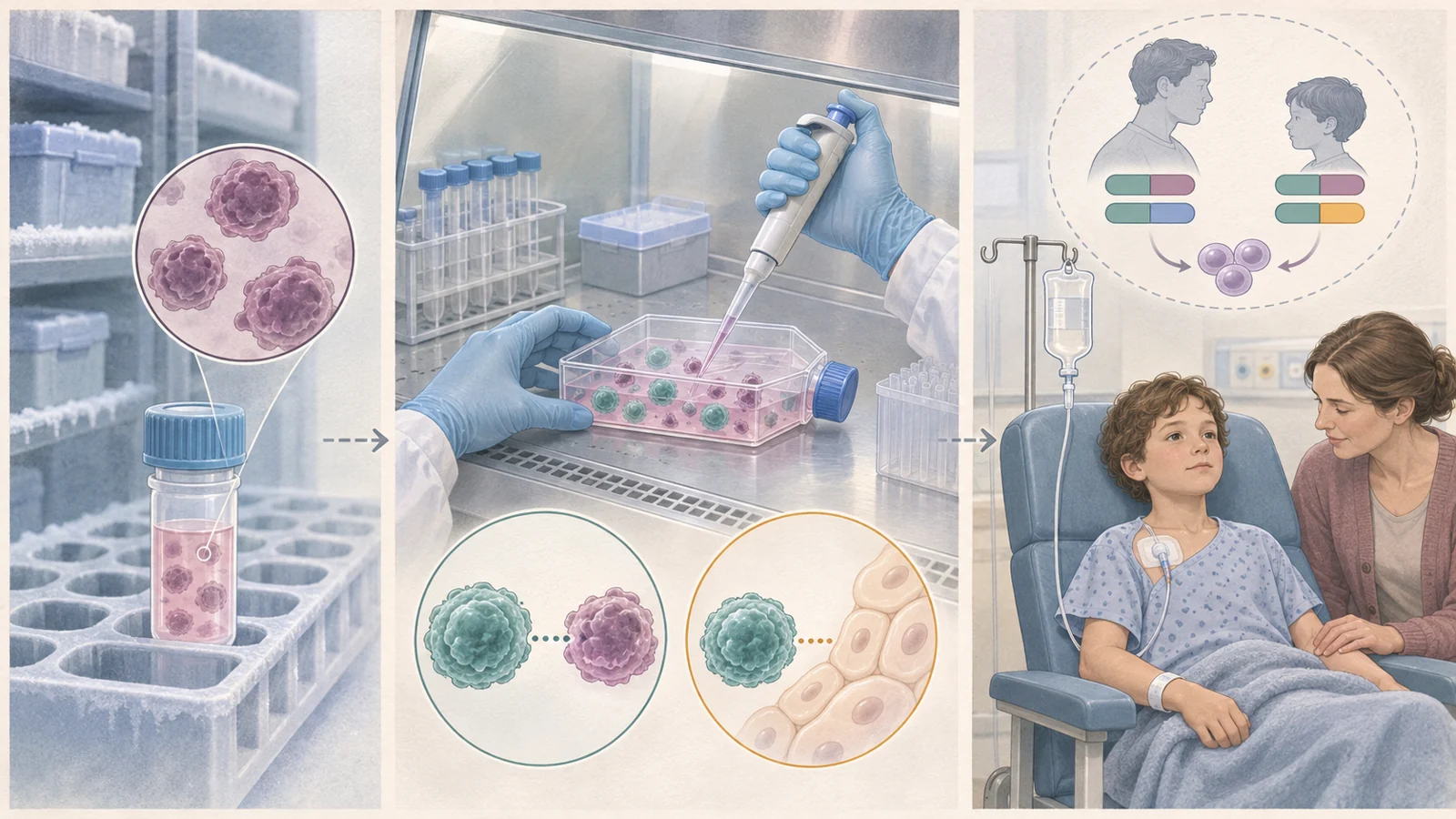
The researchers’ preparation begins with a stored sample of leukemia cells collected from the child at diagnosis or relapse. In the laboratory, donor immune cells are exposed to dendritic cells—immune cells used to present material from the leukemia sample. This stimulation is followed by further expansion of the responsive T cells. Because the leukemia sample contains multiple leukemia-associated targets, the researchers’ rationale is that the resulting cells may recognize a broader set of targets than cells trained against just one. That breadth is a reason to test the approach; it has not been shown to prevent leukemia from escaping immune recognition in children.
Laboratory batches supply a starting point
Before the clinical trial, the research group reported manufacturing and testing 51 batches of these cells. The batches met defined quality checks for cell identity, viability, phenotype, and activity. In laboratory tests, many batches killed the patient’s leukemia cells and released immune signaling proteins in response. Most of the cells were a type of T cell associated with direct killing, alongside features the authors describe as memory and activation.
Those results show that the team could produce cells with measurable anti-leukemia activity under laboratory conditions. The tests do not show that infused cells will reach or control leukemia in a child, persist long enough to matter, or avoid GVHD. In earlier laboratory comparisons, most tested cell lines were less reactive to patient-derived cells used to test unwanted immune attack than to leukemia cells, but that difference cannot establish safety after infusion. The trial is the step designed to observe what happens in patients.
A stored sample determines who receives which treatment
Leuk-001 is a non-randomized study at one center for children and teenagers with high-risk acute lymphoblastic or acute myeloid leukemia who receive a half-matched transplant. The plan is to enroll 15 patients whose expected risk of relapse after transplant is at least 50 percent. The study compares children receiving the prepared anti-leukemia T cells with a control group of children with similar disease characteristics and prognosis who receive unmanipulated donor lymphocyte infusions.
The availability of a viable, cryopreserved sample of the child’s leukemia determines assignment. The sample is needed to prepare that child’s targeted cells. When it is available, the child can enter the experimental arm; without it, the planned treatment is DLI. This practical requirement makes the comparison non-random: the groups are not formed by chance, and the stored sample itself separates them. Differences between groups therefore may not reflect the cell treatment alone.
The small study is intended to give experience for planning later clinical development. With 15 children and non-random assignment, any future comparison will be preliminary and cannot by itself establish broad effectiveness across children with leukemia.
Doses rise gradually, with GVHD shaping the schedule
The planned infusions begin within 60 days after transplant. Children are to receive progressively increasing doses every three weeks, with at least eight infusions planned if there are no complications. Depending on clinical judgment, additional monthly infusions may continue through 12 months after transplant.
The schedule includes responses to GVHD. If a child develops mild acute GVHD, the next infusion is delayed and the dose reduced; more serious acute GVHD pauses treatment until it resolves, after which clinicians may decide whether to resume at a lower dose. The protocol lists severe acute GVHD in two of the first four treated patients as a stopping rule. Safety is built into the schedule, not treated as a side issue.
Acute GVHD is the primary safety endpoint. The researchers will also assess chronic GVHD. The key secondary question is relapse: the protocol plans to calculate cumulative relapse incidence at several points through 24 months after transplant. These are separate measures. A relapse outcome cannot substitute for evidence about GVHD risk, and a safety result alone cannot show whether relapse was prevented.
The protocol’s sample-size calculation assumes a GVHD rate of 40 percent for standard DLI and sets 10 percent as the maximum rate for the study treatment to count as a preliminary success under its design. These figures are planning assumptions, not observed rates in children receiving the prepared cells. Reported acute GVHD and relapse outcomes will be needed to see how the treatment performed in this small group and how the comparison should be interpreted.
What this could make possible
A child recovering from a half-matched family donor transplant could one day receive immune cells prepared against that child’s own leukemia as an additional way to limit relapse. If the cells can be manufactured reliably, control leukemia without an unacceptable rise in attacks on healthy tissue, and show clinical benefit, they could become a more dependable targeted option alongside donor lymphocyte infusions already used after transplant.
The evidence bridge so far is practical but early: the team has described a way to make the cells and reported batches that passed quality checks and responded to leukemia cells in laboratory tests. Leuk-001 is designed to move that work into a small, safety-first clinical evaluation. Its reported GVHD and relapse outcomes in treated children, considered alongside the non-randomized comparison group, would be the nearer milestone. Demonstrating benefit and safety would still require further development beyond this study.
Key Sources
- Primary source: Phase I/II clinical trial on the safety and preliminary efficacy of donor-derived anti-leukemia cytotoxic T lymphocytes for the prevention of leukemia relapse in children given haploidentical hematopoietic stem cell transplantation: study rational and design.
DOI or Journal Page · Clinical Trial · 2025-06-06
Keep exploring