
Research Signal – Source date 2021-03-19
Diffuse large B-cell lymphoma (DLBCL) is the most common type of non-Hodgkin lymphoma, but the name covers tumors with different biology and treatment prospects. In the 2021 evidence summarized by a review published March 19, the standard first treatment, R-CHOP, could bring long-term disease control to nearly 90% of people with limited-stage disease and up to 60% of those with advanced-stage disease. Those figures describe different patient groups; they are not predictions for an individual.
The gap was that researchers could identify some tumors more likely to resist this treatment, yet tests that grouped tumors by biology had not reliably shown which different first regimen would improve outcomes. When lymphoma returned after treatment, engineered immune cells and other therapies offered new possibilities, though results from separate studies could not be read as a direct contest.
One diagnosis, several biological patterns
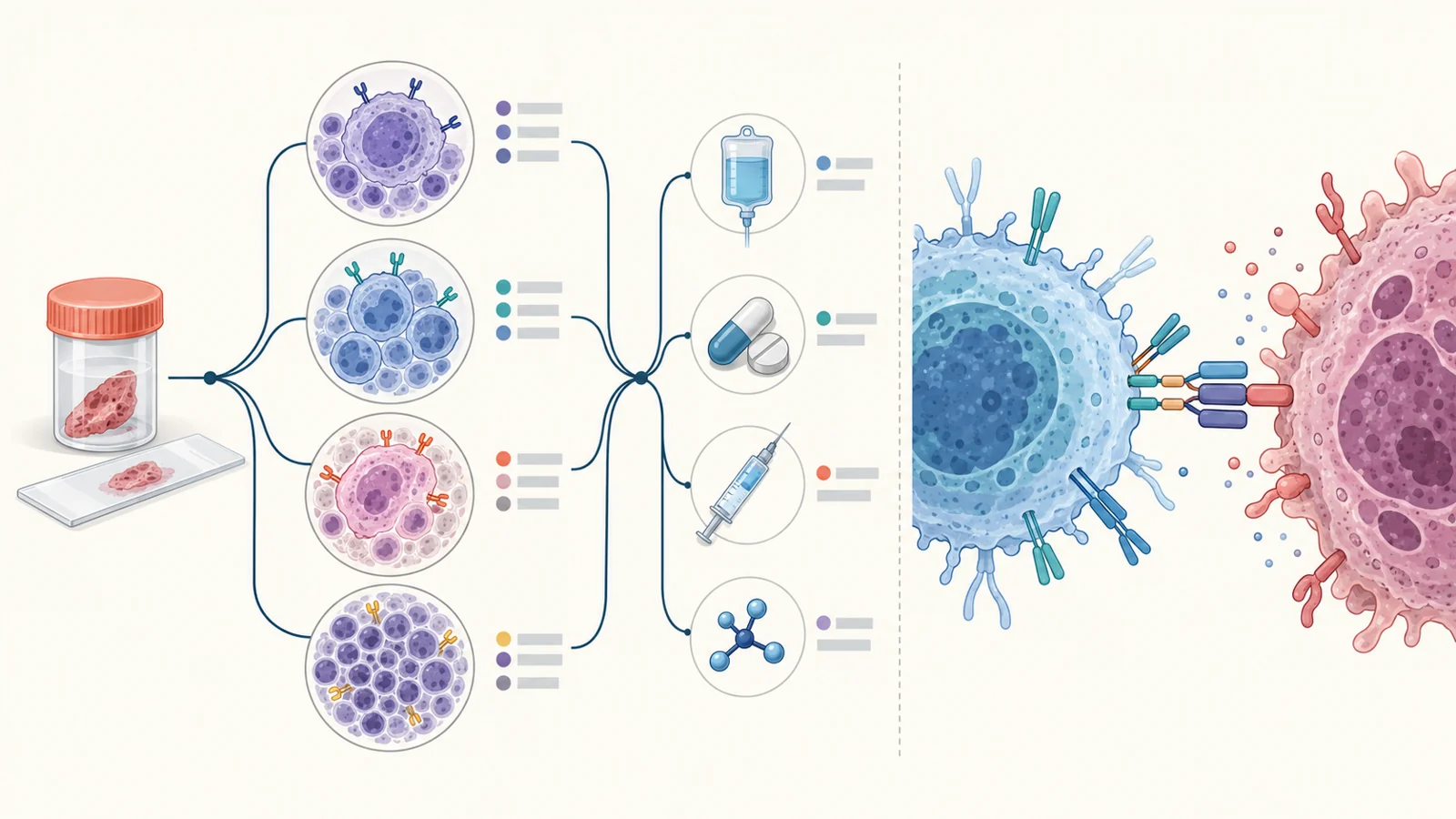
Doctors classify DLBCL in part by cell of origin: whether the tumor’s gene activity resembles B cells from a germinal center, where these immune cells mature, or more activated B cells. The broad groups are called germinal center B-cell-like (GCB) and activated B-cell-like (ABC); some cases are unclassified. A tissue test can estimate this pattern, but the review noted that commonly used protein-staining methods do not match gene-expression profiling as closely as newer digital approaches do.
Sequencing studies grouped tumors by recurring changes in their DNA. In one classification, MCD and N1 were linked to poorer outcomes after first treatment than BN2 and EZB. These names describe patterns of risk; the review did not show that any one of those groups would benefit from a specific added drug.
A different example shows why the details matter. About 8%–10% of newly diagnosed cases were described as high-grade lymphoma with rearrangements involving MYC and BCL2 and/or BCL6. These rearrangements can drive cell survival and growth. This group generally had more aggressive disease and worse outcomes with R-CHOP, especially when disease was advanced. Yet even tumors with the same rearrangement-based label varied: a gene-expression signature identified a higher-risk subset among GCB cases, and only about half of that subset had the BCL2 rearrangement used in the familiar double-hit classification.
So a broad cell-of-origin label and a specific genetic feature answer different questions. Neither makes every tumor within a category identical, and recognizing higher risk is not the same as knowing which additional drug will help.
Why the usual first regimen held its place
For advanced-stage DLBCL, which accounts for about 60%–70% of cases, R-CHOP had remained the standard initial treatment for two decades by the time of the review. It could cure up to 60% of newly diagnosed cases, but efforts to improve results had not yielded a clear replacement. Attempts to intensify treatment or change how it was delivered did not improve outcomes, especially for people with high-risk disease.
Researchers also tested drugs aimed at pathways thought to matter in ABC or non-GCB lymphoma. Two large randomized phase III studies compared R-CHOP plus an added drug with R-CHOP alone. PHOENIX tested ibrutinib; ROBUST tested lenalidomide. Neither showed a significant overall improvement for its broad molecular group. The review described possible benefits in some narrower groups, including younger patients in analyses of PHOENIX, and people with higher clinical risk in analyses of lenalidomide studies. But these findings did not erase the overall results: toxicity and reduced delivery of R-CHOP in some older patients complicated interpretation, while another phase II lenalidomide study found a significant reduction in the risk of progression or death.
The mixed results left an important practical problem. Broad molecular groups contain varied tumors, and a marker associated with poorer outcomes does not automatically tell clinicians whether a particular added drug changes those outcomes. In 2021, trials of risk-adapted treatment were still under way.
Finding disease is different from knowing what to do
Scans and blood tests can add information about disease activity, but each measures something different. PET/CT can help establish the disease’s extent. When used to assess response, however, inflammation or infection may look like lymphoma, while microscopic disease can be missed. In one retrospective analysis of older patients in the REMARC trial, a high baseline total metabolic tumor volume on PET was associated with worse event-free and overall survival, even after adjustment for several clinical risk measures. That association helped identify risk; it did not show which treatment change would improve outcomes for people with a high measurement.
Circulating tumor DNA (ctDNA) offers another kind of view. Tumor cells can release DNA into the blood, where sequencing methods can look for tumor-specific genetic material. Because blood samples can be collected over time, researchers can track whether detectable tumor DNA returns during surveillance.
The review described a retrospective analysis of 126 patients enrolled in three trials. After treatment, serial blood tests detected ctDNA before clinical progression in some patients, with a median lead time of 3.5 months. During surveillance, a positive result had an 88.2% positive predictive value for relapse and a negative result had a 97.8% negative predictive value in that study. Those figures describe how the test performed in that group; they do not show that treating earlier based on a positive test improves survival. A warning can arrive before symptoms or scans reveal progression, while the best action to take on that warning remains a separate question.
When lymphoma returned, treatment could recruit the immune system
For people whose DLBCL relapsed or resisted treatment, the review described a difficult setting: transplant-eligible patients with chemotherapy-sensitive disease could receive salvage chemotherapy followed by an autologous stem-cell transplant, using their own collected stem cells. But outcomes after relapse remained challenging. In the CORAL study, the three-year progression-free survival rate was 21% among patients previously treated with rituximab who received one of two salvage regimens before transplant.
CAR T-cell therapy offered a different approach. A patient’s T cells are genetically modified to carry a receptor that recognizes a target on cancer cells. When the engineered cells encounter that target, they can activate and attack without relying on the usual tissue-matching signal. The review described three approved CAR T-cell products for relapsed or refractory large B-cell lymphoma after at least two lines of systemic treatment.
In the ZUMA-1 trial, axi-cel produced an overall response rate of 83% and a complete response rate of 54%; ongoing responses were observed in 42% of patients. The JULIET trial of tisa-cel reported a 52% overall response rate and 40% complete response rate. In TRANSCEND NHL 001, liso-cel produced a 73% overall response rate and a 53% complete response rate among heavily pretreated patients. At a median follow-up of 12 months, median duration of response had not yet been reached. A response means the cancer shrank or otherwise improved by the study’s criteria; a complete response is a deeper response, and neither statistic alone says how long every patient benefited.
These were different trials with different patients and follow-up, so their percentages do not rank the treatments or forecast an individual result. CAR T therapy also carries immune risks, including cytokine release syndrome and neurologic effects known as immune effector cell-associated neurotoxicity syndrome. The review noted real-world reports of durable responses in roughly 30%–40% of patients. It separately described CAR T-cell therapy as generally tolerable for a broad range of patients, including some traditionally considered unfit for transplant because of age.
Other immune approaches work differently. Bispecific antibodies can bind both a cancer-cell target and CD3 on T cells, bringing the T cell close enough to attack. In an early-phase study of 28 people with aggressive non-Hodgkin lymphoma, 60.7% responded to the bispecific antibody glofitamab. The study covered a broader disease group than DLBCL and had no randomized comparator, so its result was an early activity signal rather than a DLBCL-specific treatment estimate.
An antibody-drug conjugate instead attaches a toxic drug payload to an antibody aimed at a cancer-cell target. In a randomized phase II study of 80 transplant-ineligible patients with relapsed or refractory DLBCL, polatuzumab vedotin plus rituximab and bendamustine was compared with rituximab and bendamustine alone. The combination group had a 45% overall response rate and 40% complete response rate, compared with 17.5% and 15% in the control group. Median duration of response was 12.6 months versus 7.7 months. The study’s population and design define what those results can answer; they do not establish how the combination compares with CAR T cells or other options.
Could better risk tests bring effective treatment forward?
The possibility raised in the 2021 review was to use better risk tests to find people likely to do poorly with R-CHOP, then test whether therapies that had shown activity after relapse could help during first treatment, when immune health might be better preserved. If prospective trials showed better outcomes without unacceptable harm, some patients at high risk might avoid a relapse that would otherwise bring them to those therapies later. The review did not establish which test-and-treatment combination could deliver that benefit.
Key Sources
- Primary source: 2021 Update on Diffuse large B cell lymphoma: A review of current data and potential applications on risk stratification and management.
DOI or Journal Page · Review or Meta-Analysis · 2021-03-19
Keep exploring