
Research Signal – Source date 2026-01-01
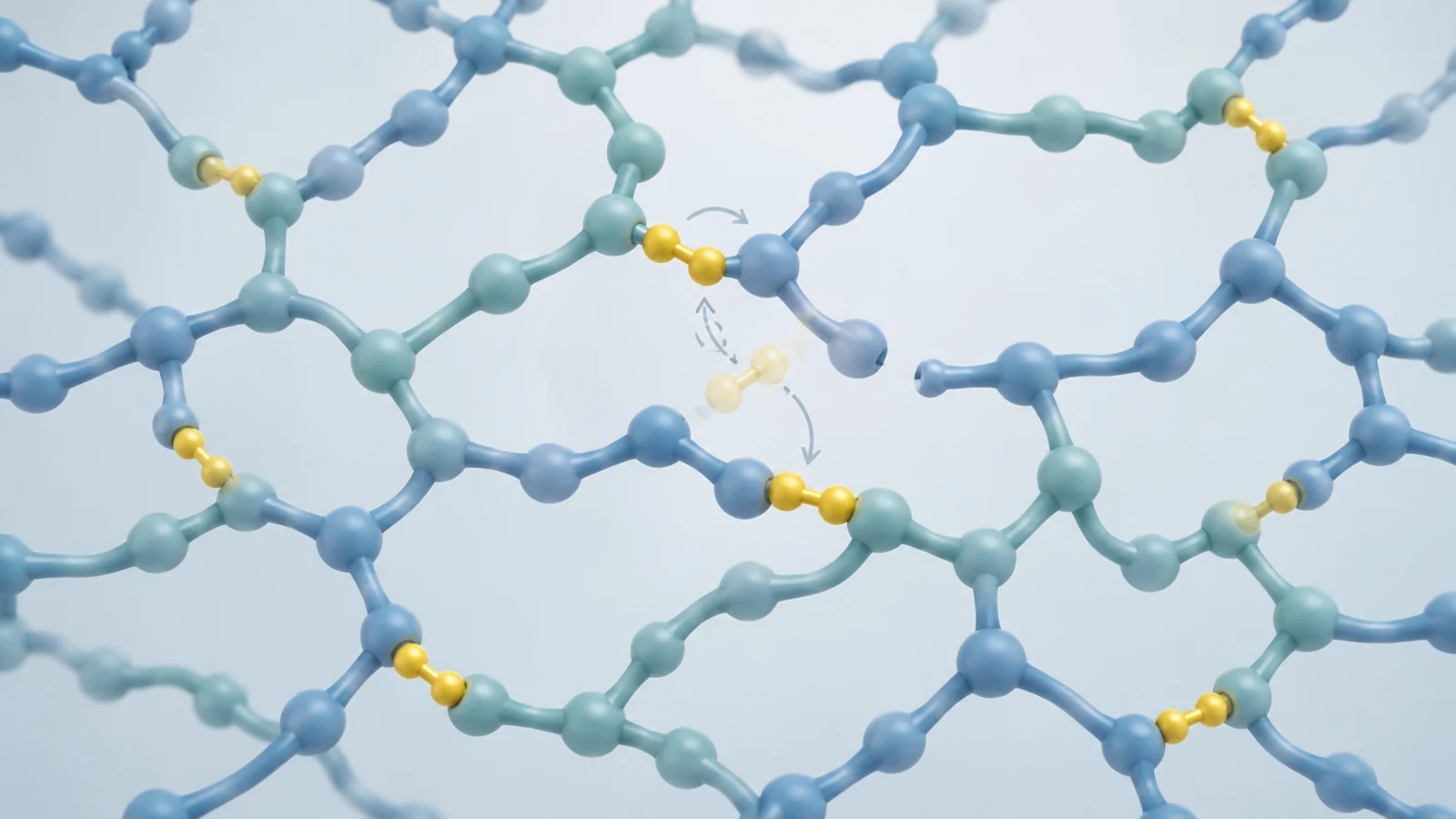
A polymer network can be strong because its molecules are tied together in many places. But those same links can make damage difficult to repair: once the network is broken, its shape and function may not readily return. Dynamic disulfide chemistry explores a way to loosen that constraint. Disulfide bonds are links between sulfur atoms, and in some polymer designs they can exchange partners. A 2026 review considers how that bond mobility could support repair, reprocessing and responsive breakdown while the material remains a connected network.
The central question is practical as much as chemical: how much rearrangement can a useful material tolerate? The review discusses several possible design settings, but the abstract does not compare specific formulations or quantify how long they last. The chemistry offers a strategy; performance depends on how it is built into a material and what that material must do.
How sulfur links can change partners
In a conventional static network, covalent bonds hold the structure together but do not readily reshuffle. The review describes disulfide bonds as dynamic covalent links: they can dissociate and exchange, allowing parts of a network to reconnect in a different arrangement. In plain terms, some links can trade partners rather than leaving the material permanently severed.
The authors highlight an associative [2 + 2] metathesis pathway. In this kind of exchange, bond partners are reshuffled through an exchange process without the network needing to rely on molecular fragmentation as the route to rearrangement. This offers a chemical route to reconfiguring a network while preserving its overall connected character. It is a description of a reaction pathway, not proof that every finished material heals reliably or retains its original properties after repeated use.
That distinction matters because a material’s chemistry is only one part of its behavior. A bond exchange may make rearrangement possible, while the surrounding polymer design determines whether the result is a useful repair, a reshaped material or a network intended to come apart.
Different stimuli, different conditions
The review identifies heat, ultraviolet irradiation and pH changes as possible triggers for disulfide exchange. These are not interchangeable instructions for a single universal material. They describe ways a system may be prompted to rearrange, with the relevant conditions depending on the chemistry and design in question.
The abstract also notes that disulfide bonds can exchange rapidly at ambient temperatures because of their relatively low bond dissociation energy. That possibility is conditional on the system; it does not mean every disulfide-containing polymer will exchange at a useful rate at room temperature. A designer’s task is to make exchange available when needed while keeping the network stable enough for its intended setting.
Triggers also shape what a material is being asked to do. A network designed to respond to heat may serve a different purpose from one intended to respond to light or pH. The review presents these stimuli as routes for controlling bond behavior, not as evidence that a particular trigger has already produced a specific repair outcome in a product.
Three settings for dynamic networks
The review discusses elastomers, vitrimers and degradable networks as distinct platforms for disulfide chemistry. Elastomers are flexible polymer materials; in this context, dynamic links offer a way to consider local repair and later reprocessing. Vitrimers are treated as networks whose bonds can rearrange, making reshaping or reprocessing part of the design aim. Degradable networks use responsive bond behavior with disassembly in view.
These categories point to different material goals. Localized repair aims to address damage in one area while the rest of a material remains useful. Reprocessing asks whether a network can be reshaped or remade after use. Responsive disassembly instead makes controlled breakdown the relevant function. The same general chemistry can inform each setting, but those aims are not the same outcome, and the abstract does not assign measured results to a named formulation or platform.
This range helps explain why dynamic covalent bonds interest materials researchers: the bonds can be considered not only as structural connections, but as links whose exchange behavior is part of the material’s design. What that behavior delivers depends on the demands placed on the finished network.
The performance question remains
A material that rearranges easily may be easier to repair or reprocess, yet an application also requires the network to keep doing its job. The review identifies the translation challenge as developing scalable, high-performance materials. That challenge joins two requirements: exchange must be accessible enough to enable the intended response, and the resulting material must retain the performance its use requires.
The supplied abstract does not establish how many repair or reprocessing cycles a particular formulation can withstand while keeping its function. It also provides no basis for numerical comparisons with other polymer chemistries or quantified environmental benefits. Those questions matter when moving from a promising design approach to a material whose durability, processing and end-of-use behavior can be assessed in a specific application.
What repairable polymers could make possible
Soft electronics and smart coatings are among the areas the review discusses. If a dynamic network can recover from localized damage while preserving the properties needed in use, such materials could remain useful longer; if they can also be reprocessed, their material life might extend beyond one use. Those possibilities depend on repeated repair retaining function and on production scaling to meet real application demands. The review describes a direction for polymer design, not a deployed electronic product or coating.
Key Sources
- Primary source: Dynamic Disulfide Chemistry for Functional Polymers: Self-Healing, Vitrimer Behavior, and Biochemical/Electronic Applications.
DOI or Journal Page · Review or Meta-Analysis · 2026-01-01
Keep exploring