
Research Signal – Source date 2025-05-19
Plant compounds found in tea, fruit, vegetables, and other foods attract attention for their possible effects on aging. But an “antiaging” effect can mean very different things. A compound might change the inflammatory signals a cell releases, selectively cause that cell to die, or improve a measure of physical function. Those outcomes answer different questions, and none automatically establishes that eating the food produces a therapeutic benefit.
A review published May 19, 2025, examines these distinctions through polyphenols, a large family of plant compounds found in food. Its focus is cellular senescence—a lasting stop in cell division that leaves cells metabolically active. The authors bring together research on how polyphenols influence these cells, including experiments that suppress their secretions and others that selectively eliminate them.
The contribution is an organized account of several biological actions across cell experiments, animal models, and clinical research. The authors describe searching PubMed, Scopus, Web of Science, and Google Scholar for English-language, peer-reviewed literature, then arranging findings by compound and effects on senescence. The examples below are findings reported through that review; they are not results from a single intervention tested across all three settings.
Why a cell that stops dividing can still matter
A senescent cell has stopped making new cells through division, but it has not become inert. It can remain active and release substances that influence its surroundings. Whether this helps or harms tissue depends partly on the setting and how long the cells persist.
Temporary senescence supports useful processes, including wound healing and tissue remodeling. Stopping a damaged cell from dividing can also contribute to tumor suppression. These roles make indiscriminate removal a poor description of the biological goal. Senescence is part of how tissues respond to problems, as well as a potential source of problems when it becomes persistent.
With chronic accumulation, senescent cells can sustain a mixture of inflammatory signals, growth factors, and enzymes that alter the material around cells. Researchers call this mixture the senescence-associated secretory phenotype, or SASP. Persistent secretion can disturb tissue function and contribute to age-related disease. A cell’s effect therefore extends beyond its own inability to divide: it can change the conditions in which neighboring cells operate.
This creates two possible points of intervention. Researchers can try to reduce the troublesome output of a senescent cell, or selectively remove the cell producing it. The distinction matters because retaining a quieter cell and eliminating a cell are different biological outcomes.
One compound can act differently at different concentrations
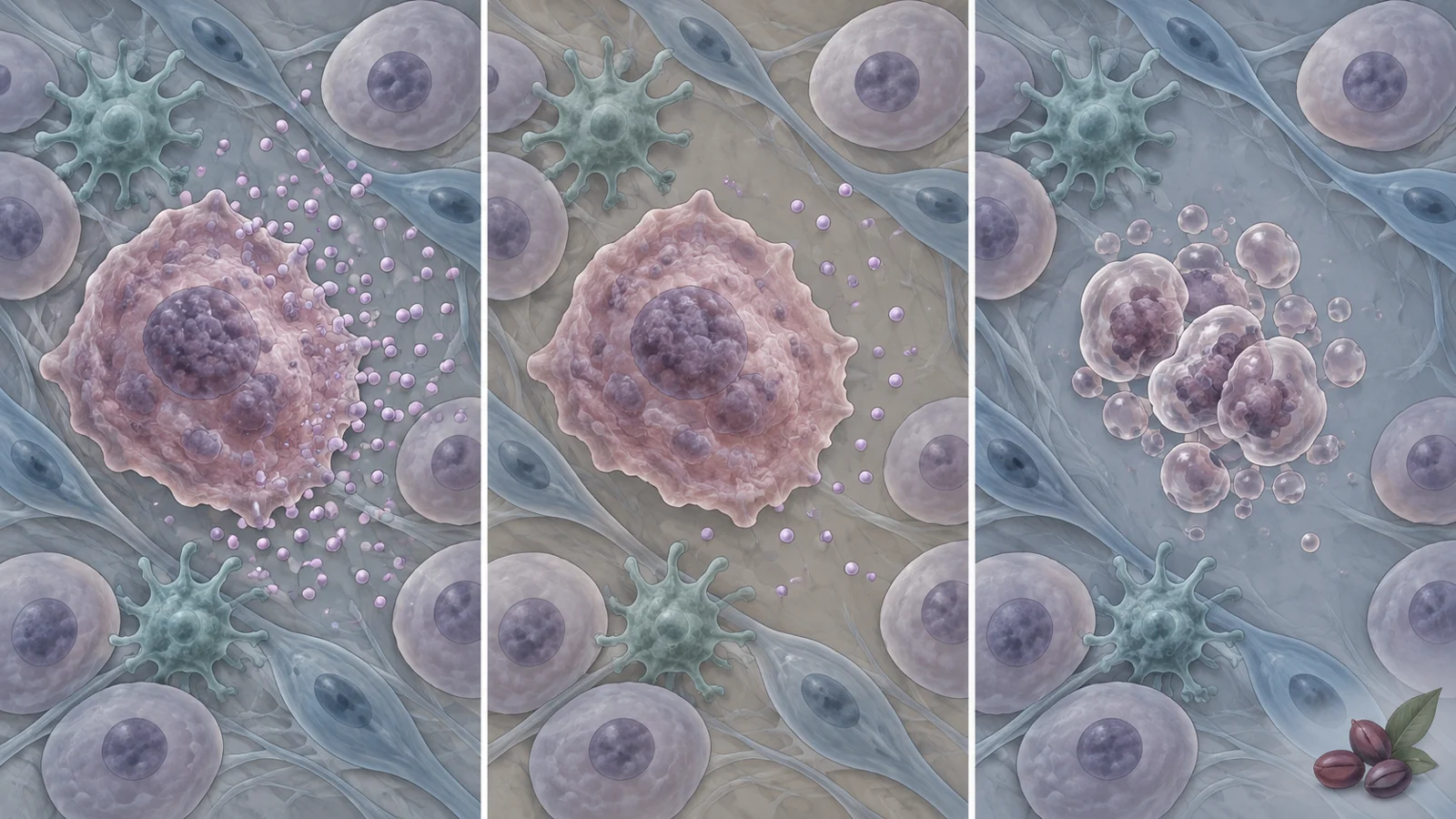
The review uses two terms for these approaches. Senomorphic action suppresses senescence-associated secretions without inducing cell death. Senolytic action selectively triggers death in senescent cells. Senolytics often act on mechanisms that help those cells survive; senomorphics interfere with signaling that sustains their harmful secretions.
Procyanidin C1, abbreviated PCC1, makes this distinction especially concrete. The compound was isolated from grape seed extract. According to the review, at lower experimental concentrations it attenuates the secretory behavior of senescent cells. At higher concentrations, it can selectively induce their death. The same molecule can therefore produce different kinds of action depending on exposure.
The reported cell-death mechanism involves changes in mitochondria—the cell structures involved in energy production—and activation of an internal pathway for programmed cell death. That is a different event from reducing inflammatory output while leaving a cell alive. Concentration helps determine which event occurs; increasing it is not simply turning up the strength of an otherwise identical effect.
The review also describes PCC1 treatment in aged mice, with reduced burdens of senescent cells and improvements in measures including motor coordination, balance, endurance, and muscle strength. These observations add a functional dimension to the cellular findings. They connect the research to how an animal moves and performs, rather than stopping at a change in a molecular marker.
PCC1 also illustrates why a compound’s name alone cannot define its action. The relevant description includes the concentration, the cells exposed, and the outcome measured. Calling a plant compound “senolytic” without that context can hide a distinction that the experiments themselves reveal.
Changing the conversation between cells
A green-tea compound offers a closer look at how secretions affect neighboring cells. The review describes experiments with epigallocatechin gallate, or EGCG, in endothelial cells, which line blood vessels. Researchers induced senescence in these cells with etoposide and examined how EGCG treatment changed their interactions with monocytes, a type of immune cell.
EGCG treatment reduced several senescence-associated features in the endothelial cells. When monocytes were cultured together with those treated cells, the monocytes showed weaker inflammatory responses than when they were paired with untreated senescent cells. The experiment thus followed a sequence from treatment of one cell population to a changed response in another.
Part of that connection involved extracellular vesicles—small particles released by cells that can carry signals. Senescent endothelial cells released more of these particles than nonsenescent cells. Vesicles from the senescent cells amplified the inflammatory response of monocytes exposed to an inflammatory stimulus. Vesicles from EGCG-treated senescent cells instead attenuated that response, keeping activation near baseline in the reported experiment.
This example shows why researchers examine what cells release as well as what happens inside them. Altering the output of vessel-lining cells can change how nearby immune cells respond. The biological effect travels through communication between cell populations, giving researchers a way to investigate how persistent senescence might sustain inflammation across tissue.
It also helps explain the appeal of senomorphic action. A treatment could potentially interrupt a harmful interaction while retaining the cell. Here, the informative observation is the altered inflammatory exchange between endothelial cells and monocytes.
What the human findings and experimental exposures can support
The review’s discussion of resveratrol brings the question into human research, where the findings are mixed. A 26-week trial involving 23 older participants who were overweight suggested benefits in glucose metabolism, connectivity within the hippocampus, and memory performance. The review also describes a meta-analysis and a larger follow-up study involving 225 patients that did not demonstrate significant cognitive or memory improvements with supplementation.
These findings limit the confidence that can be placed in the small trial’s encouraging results. They also address a different level of evidence from the cell experiments. A memory test measures a person’s performance; a measurement of brain connectivity assesses another aspect of function. Neither outcome, by itself, establishes that senescent cells were selectively cleared from the participants. A proposed mechanism and a clinical outcome need evidence connecting them.
Exposure poses another challenge. A compound’s presence in a familiar food does not establish that eating that food produces the concentrations used in an experiment, or that enough of the compound reaches the relevant tissue. The authors identify improved delivery systems as a priority for developing these compounds into treatments. Delivery matters because a substance must reach its target at an exposure that produces the intended action.
PCC1’s concentration-dependent behavior makes that problem particularly tangible. An exposure that changes secretion and one that induces cell death cannot be treated as interchangeable. The review also discusses dose-dependent adverse effects and potential toxicity in senescence-targeting therapies. Plant or dietary origin does not settle safety at a therapeutic exposure, and these findings do not provide a basis for a clinical dosing recommendation.
Taken together, the cell, mouse, and human examples support different conclusions. They provide evidence of altered cell behavior, reported physical-function benefits in aged mice, and an unsettled picture for human resveratrol outcomes. They do not establish that ordinary dietary intake reproduces the experimental treatments, that the effects transfer across polyphenols and cell populations, or that these interventions extend human lifespan. Robust clinical trials would need to connect a defined intervention with both acceptable safety and a meaningful benefit in people.
What this could change
If plant-derived compounds can be delivered safely to the relevant cells, they could become starting points for treatments intended to help older adults retain strength and mobility. The causal possibility is specific: reducing persistent inflammatory secretions or selectively clearing troublesome senescent cells could improve the tissue conditions that support physical function.
The PCC1 findings in aged mice give that prospect a concrete basis in measurements of balance, endurance, coordination, and strength. Demonstrating corresponding benefits in people could eventually mean helping older adults keep walking, climbing stairs, and carrying out daily activities independently. From the perspective of this May 2025 publication, that remains a conditional clinical possibility. Its value would come from preserving abilities people use, with selective cellular action serving as the means to that outcome.
Key Sources
- Primary source: The Antiaging Potential of Dietary Plant-Based Polyphenols: A Review on Their Role in Cellular Senescence Modulation.
DOI or Journal Page · Peer-Reviewed Paper · 2025-05-19
Keep exploring