
Research Signal – Source date 2024-09-29
Berries, walnuts and tea contain polyphenols, a large family of plant compounds studied for their biological effects. Calling these compounds “anti-aging,” however, brings together experiments that ask very different questions. Helping a cell remove damaged material, extending a worm’s lifespan and preserving an older person’s physical abilities are distinct outcomes. Evidence for one does not automatically establish the others.
A review published in Nutrients on September 29, 2024, brings this research together around twelve hallmarks of aging—biological processes associated with aging, including mitochondrial dysfunction, impaired cellular recycling and chronic inflammation. It organizes existing findings from cells, animals and selected human studies; it does not present a newly tested longevity treatment. The research it describes does not establish that ordinary consumption of polyphenol-rich foods or supplements extends human lifespan.
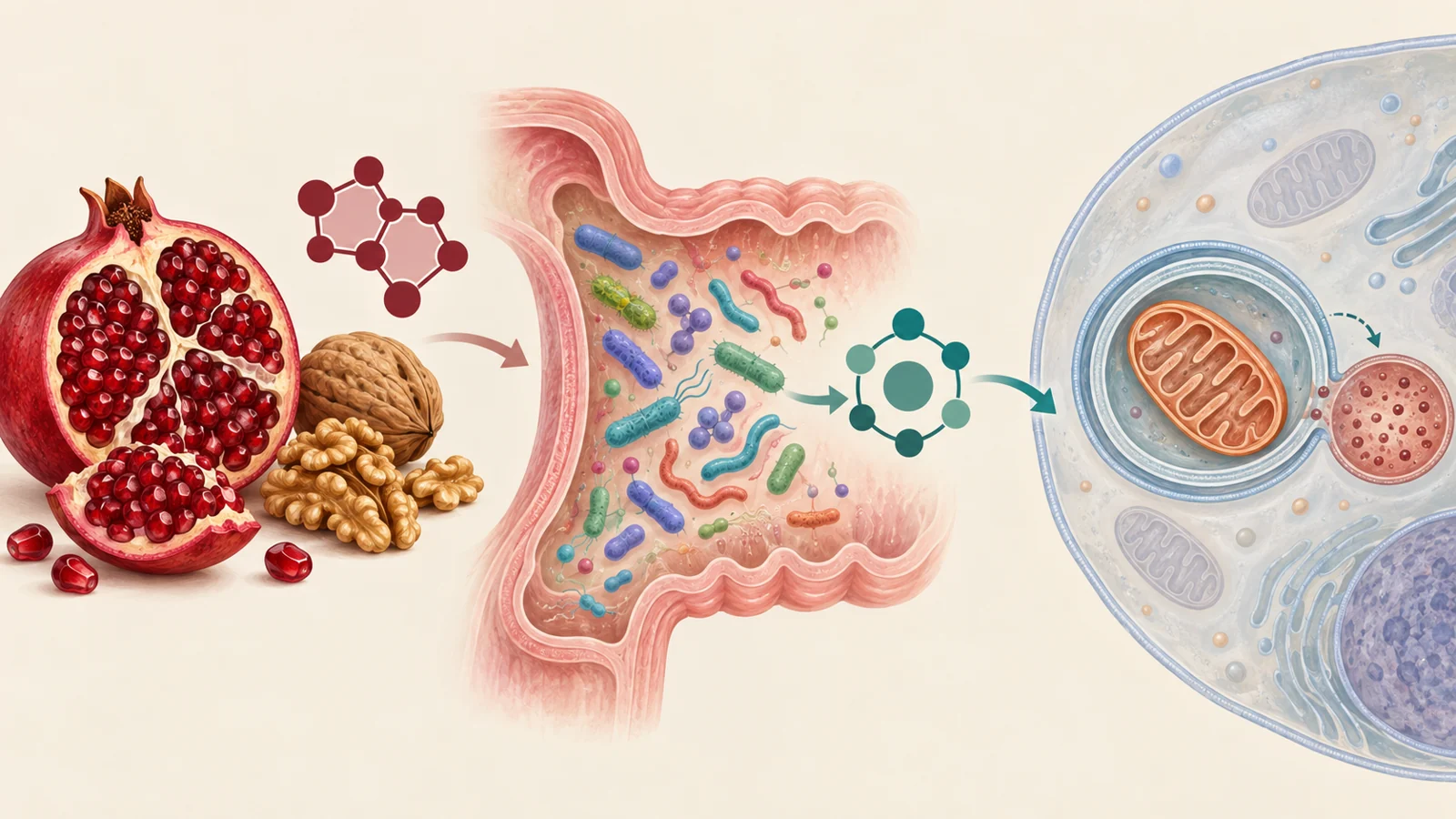
The most revealing thread follows what happens between food and the cell. A compound in a pomegranate can be transformed by intestinal microbes into another substance with different biological activity. Researchers can also administer that second substance directly. Following those steps helps explain both the interest in these compounds and what particular experiments actually test.
How cells recycle worn components
Polyphenols are often described as antioxidants because some can help limit damage associated with reactive oxygen species, chemically reactive molecules that can injure cellular components. The review also explores a different aspect of cellular maintenance: how cells dispose of material that has already become damaged or unnecessary.
Autophagy is a cellular recycling process. In its major form, macroautophagy, a cell encloses material in a double-membrane compartment. That compartment then merges with a lysosome, where its contents are broken down. The material can include misfolded proteins, protein aggregates or damaged internal structures. This process helps maintain the cell’s working contents as conditions and demands change.
The review describes declining autophagy with age as a problem for cellular upkeep. If damaged components accumulate and replacement slows, the cell’s ability to maintain normal function can suffer. This gives researchers a reason to investigate compounds that influence recycling alongside those that affect the production of cellular damage.
Mitophagy is the selective removal of mitochondria, the structures involved in producing energy for cells. One substance discussed in the review, urolithin A, stimulates this process in laboratory and animal experiments. In the worm Caenorhabditis elegans, the review connects urolithin A with mitochondrial recycling, maintenance of mitochondrial production and respiratory capacity, and extended lifespan. Here, the lifespan finding belongs to worms, while the proposed biological connection concerns the upkeep of their mitochondria.
The gut changes the substance being tested
Urolithin A provides a particularly useful example because it connects familiar foods with an intervention used in experiments. Ellagic acid occurs in foods including pomegranates, raspberries and walnuts. Gut microbes can convert ellagic acid into urolithin A. The parent compound and the resulting metabolite are different substances, even though one can give rise to the other.
That conversion makes the gut an active part of the story. Eating a food containing ellagic acid begins a sequence involving digestion and microbial metabolism. Administering urolithin A directly begins farther along that sequence, bypassing the need for microbes to produce it from the parent compound.
People also differ in their capacity to make urolithin A. The review discusses variation in microbial conversion as a possible contributor to different responses to ellagic acid. Two people consuming the same parent compound may therefore have different exposure to the metabolite. The amount in a food cannot, by itself, tell us how much of a particular downstream substance will become available.
This matters beyond one food or molecule. The review describes relatively low gastrointestinal bioavailability for polyphenols and substantial interaction with microbes in the large intestine. Some biological activity may arise from the transformed substances. To understand an experiment, it helps to identify exactly what was administered, what conversion was required and which substance was linked to the measured effect.
Recycling cell contents and removing whole cells
Another line of research concerns senescent cells. These cells can release inflammatory substances and other signals that affect surrounding tissue. The review describes how their secretions can contribute to a cycle in which inflammation and cellular senescence reinforce one another.
Senolytics are treatments designed to selectively eliminate senescent cells. Their biological target differs from that of autophagy. Cellular recycling breaks down material within a cell; a senolytic treatment aims to remove particular cells themselves. Keeping those processes separate makes the review’s many uses of “anti-aging” more informative.
Quercetin, a polyphenol found in plant foods, appears in the review as part of a senolytic combination with the drug dasatinib. The authors describe findings in aged mice in which treatment with the combination reduced intestinal cellular senescence and inflammatory burden while also altering the gut microbiome.
The intervention in those experiments was dasatinib plus quercetin. Its results belong to that combination, in those experimental conditions. They cannot be assigned to dietary quercetin alone. A familiar ingredient name can obscure a major change in the intervention when it moves from food into a drug combination intended to eliminate cells.
What the human findings actually measure
The review’s human examples address different parts of the aging question. One involves directly administered urolithin A. The authors report improved mitochondrial activity in older adults after 28 days of oral treatment at doses of 500 or 1,000 milligrams. Those are details of the research exposure, rather than an established intake recommendation.
This finding concerns a response over four weeks. It can help investigate whether the administered metabolite affects mitochondrial biology in people. By itself, it does not demonstrate sustained improvement in muscle function, preserved independence or a longer healthy life. Nor does direct administration establish an equivalent effect from eating ellagic-acid-containing foods, whose conversion depends on gut microbes.
The quercetin example asks a different question. The review reports an association between higher dietary quercetin intake and a lower likelihood of frailty, a syndrome involving vulnerability arising from multiple age-related physiological changes. Frailty is closer to everyday health than a cellular measurement, but an intake association does not establish that adding quercetin causes the difference. Other features of diet, health or behavior could contribute to the relationship.
These examples show why both the intervention and the outcome need attention. A short intervention examines what happens after a specified substance is administered. An intake association examines how a dietary exposure relates to an outcome across people. Neither can substitute for evidence that a defined approach produces durable functional benefits over a relevant period.
Safety belongs to that same comparison. Food, a concentrated preparation, a directly administered metabolite and a drug combination create different exposures. Favorable safety findings for a particular preparation under studied conditions do not establish blanket safety across products, doses or durations. The evidence discussed here does not justify a universal effective intake, a supplement regimen or replacing established treatment. The review’s proposal to develop polyphenol-based approaches remains a research direction from its September 2024 perspective.
What this could change
One possible payoff is helping older adults preserve muscle function and the everyday independence it supports. The causal path would run from an intervention that reliably affects mitochondrial maintenance to sustained improvements in how muscle works, and then to abilities such as walking, climbing stairs or getting up from a chair. Relevant compounds or metabolites would have to produce those durable functional benefits at tolerable exposures in people.
If that path can be established, the distinction between a food compound and its microbial product could become practically useful. Understanding who produces an active metabolite, and whether direct administration provides a reliable exposure, could help shape interventions aimed at maintaining physical capacity. The valuable outcome would be more time in which older adults can carry out daily activities for themselves—a concrete purpose for research into cellular maintenance.
Key Sources
- Primary source: Dietary Polyphenols as Anti-Aging Agents: Targeting the Hallmarks of Aging.
DOI or Journal Page · Peer-Reviewed Paper · 2024-09-29
Keep exploring