
Research Signal – Source date 2023-08-08
A porous material tested for pulling carbon dioxide from air also took up a substantial amount of water. In a controlled test at 50% relative humidity, it captured about 1.7 millimoles of carbon dioxide and 3 millimoles of water per gram—roughly 1.8 times as many water molecules as carbon dioxide molecules. The result makes a practical question hard to ignore: when damp air enters a carbon-catching material, how much carbon dioxide does it hold, and can it release that gas and work again?
A study published on August 8, 2023, examined one candidate through measurements of both gases, heating tests, humidity exposure and repeated cycles. The material showed that water uptake does not automatically rule out carbon capture. But measuring the gases separately matters, and the laboratory results do not yet tell us how a device or facility would perform.
The binding molecules matter as much as the pores
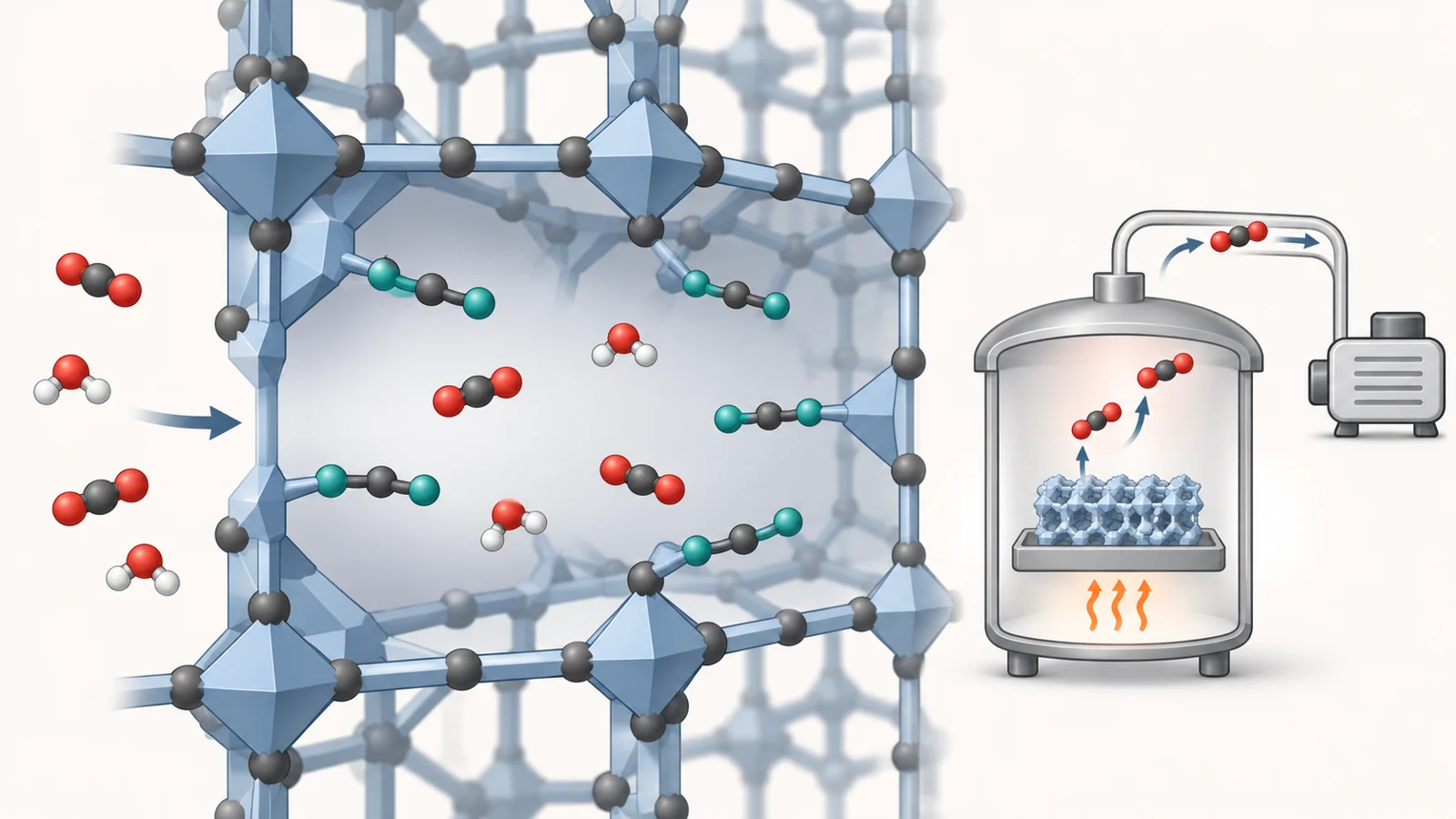
The material is a metal-organic framework, or MOF: a solid with a network of tiny pores. The researchers attached N,N′-dimethylethylenediamine molecules, shortened to mmen, to magnesium-based framework channels. These attached diamines give carbon dioxide places to bind even when it is diluted in air.
At 25 °C, the mmen-treated material captured about 1.5 millimoles of carbon dioxide per gram in a test at 400 parts per million, a concentration close to that in air. That low-concentration result is central to its promise for direct air capture, which aims to collect carbon dioxide directly from ambient air rather than from a concentrated exhaust stream.
The framework’s surface area alone does not explain the result. Attaching the diamine reduced its measured surface area from 2,920 to 1,550 square meters per gram and narrowed its pores. Yet the treated material held onto carbon dioxide better in the low-concentration test. A comparison with a framework bearing a single amine did not show comparable capture or the same low-pressure binding behavior. In this material, the attached diamine is part of the capture function, not just a way to decorate a porous surface.
The untreated framework also lost carbon dioxide uptake after several days in ambient conditions, while the diamine-treated sample showed comparable uptake after 10 days in the reported comparison. Those observations suggest the attachment can help the material retain its behavior during exposure. They do not settle how long it would last through extended operation.
Water changes the measurement
Air contains moisture, and the mmen-treated framework collects some of it along with carbon dioxide. To tell whether capture is still working, a combined weight change is not enough: the same increase could reflect either gas, or both. The researchers therefore analyzed gases released from the sample during heating and checked water uptake with a separate chemical measurement.
In the controlled humid-carbon-dioxide test at 50% relative humidity, the sample held about 1.7 millimoles of carbon dioxide and 3 millimoles of water per gram. The water measurement was also supported by a separate titration. These distinct readings make it possible to distinguish carbon dioxide capture from the material’s simultaneous uptake of moisture.
A separate water-uptake test showed a gradual increase up to about 30% relative humidity, followed by a sharper rise between 40% and 50%. At 90% humidity, the measured water uptake reached 40 millimoles per gram. This changing water load matters for interpreting reuse: a sample exposed to more humid air may carry a different amount of water into a cycle, even when carbon dioxide capture is the question of interest.
Heating releases carbon dioxide before the diamine breaks down
A reusable sorbent must give up the carbon dioxide it has collected. In the thermal measurements, the captured gas began to come off around 90–100 °C. Signals associated with breakdown of the attached diamine appeared only above 200 °C. The separation matters: heating enough to release carbon dioxide need not mean heating enough to destroy the binding molecules, under the tested conditions.
Regeneration also depended on the gas around the sample. The study identified two effective regeneration conditions: 120 °C while gas was continuously pumped away under vacuum, and 150 °C while nitrogen flowed over the sample. In cycling comparisons, nitrogen at 150 °C preserved more of the measured capacity than regeneration in a carbon-dioxide atmosphere. Temperature and regeneration gas therefore shaped the results; a single heating number cannot describe how the material will behave in every cycle.
These are laboratory conditions, not a measure of the energy a capture system would use. The experiments show that the material released captured carbon dioxide at temperatures below those associated with diamine fragmentation, but they do not establish the energy balance of an operating process.
Repeated cycles depend on humidity and protocol
The researchers tested the material under more than one sequence, and the measurements do not all answer the same question. In one ambient-air cycling protocol, ten cycles at 25–30% relative humidity showed no decrease in overall carbon dioxide-plus-water uptake. After exposure at 45–50% humidity, the overall combined uptake fell by about 15%. Because those readings combine the two gases, they do not reveal exactly how much carbon dioxide-specific capacity was retained in those cycles.
Other cycle tests varied the regeneration atmosphere. With nitrogen regeneration at 150 °C, about 90% of total capacity was maintained in the reported extended cycling test. A test using a gas mixture containing 15% carbon dioxide retained about 88% of total capacity. In a humid cycling protocol, overall combined uptake remained steady, but separating the carbon dioxide and water contributions would be needed to establish carbon dioxide-specific retention there as well.
The pattern is useful but conditional. The material could be regenerated repeatedly in the tested arrangements, while the measured outcome changed with humidity exposure and regeneration conditions. A retained combined signal is encouraging evidence about the sample’s total uptake; it cannot by itself show that carbon dioxide capture stayed constant while water uptake changed.
Severe aging exposed a different failure mode
Humidity can affect the amount of water in the pores, but harsh exposure can also affect the binding molecules themselves. In an accelerated aging test at 70 °C and 80% relative humidity for 12 hours, the measured diamine loading fell from about 60% to trace levels. The sample’s low-pressure carbon dioxide uptake then dropped from 1.5 to 0.07 millimoles per gram.
When researchers attached diamine to that aged sample again, its measured uptake returned to the earlier level. This supports the interpretation that the lost diamine was responsible for much of the lost low-pressure capture in that test. It is a demonstration on a laboratory sample, not evidence that an installed capture system could be practically maintained by repeating that treatment.
The study therefore separates two issues that can look alike in a simple weight measurement: reversible water uptake during exposure, and loss of the diamine that helps bind dilute carbon dioxide. Distinguishing them is essential to understanding what a material retains from one use to the next.
What this could make possible
A direct air capture facility that works reliably through damp days could collect carbon dioxide from ambient air, release it for handling, and repeat the cycle while tracking carbon dioxide separately from water. That could make atmospheric removal more dependable as weather changes, if the material proves durable and engineers also solve the challenges of process energy, system design and durable carbon storage. Capturing carbon dioxide in a sorbent sample alone does not establish net atmospheric removal or long-term storage.
The 2023 study offers a piece of the evidence bridge: it measured carbon dioxide and water separately under humid conditions and compared regeneration temperatures and gases. Its laboratory tests do not demonstrate facility-scale recovery or operation. A nearer milestone would be repeated device-scale cycles using ambient air across changing humidity, with separately measured carbon dioxide and water outputs and carbon dioxide-specific capacity reported after each cycle. That would show whether the distinction the study measured in a sample holds up in equipment designed for repeated use.
Key Sources
- Primary source: Suitability of a diamine functionalized metal-organic framework for direct air capture.
DOI or Journal Page · Peer-Reviewed Paper · 2023-08-08
Keep exploring