
Research Signal – Source date 2025-07-02
A tooth-colored filling can face two different ways of failing: decay may develop along its edge, or the filling itself may crack. A material that addresses one problem may not address the other. A review published on 2 July 2025 surveys experimental changes to dental composites that target both, from altering the resin to changing the particles and the bond between them.
The distinction matters because a filling’s strength is only one part of its performance. The review describes work on bacterial activity near restoration margins, the release of minerals, and stresses that form as the material hardens. These are promising material-level results, but they do not yet show that a particular new composite prevents recurrent cavities or keeps fillings in place longer in everyday care.
Three parts shape a composite
Resin-based composites are tooth-colored materials used to restore teeth. They have been in use since the late 1950s, and their appearance and versatility have helped make them common. Yet decay can recur at the boundary between tooth and restoration, and the material can fracture. Either problem can shorten a restoration’s service life.
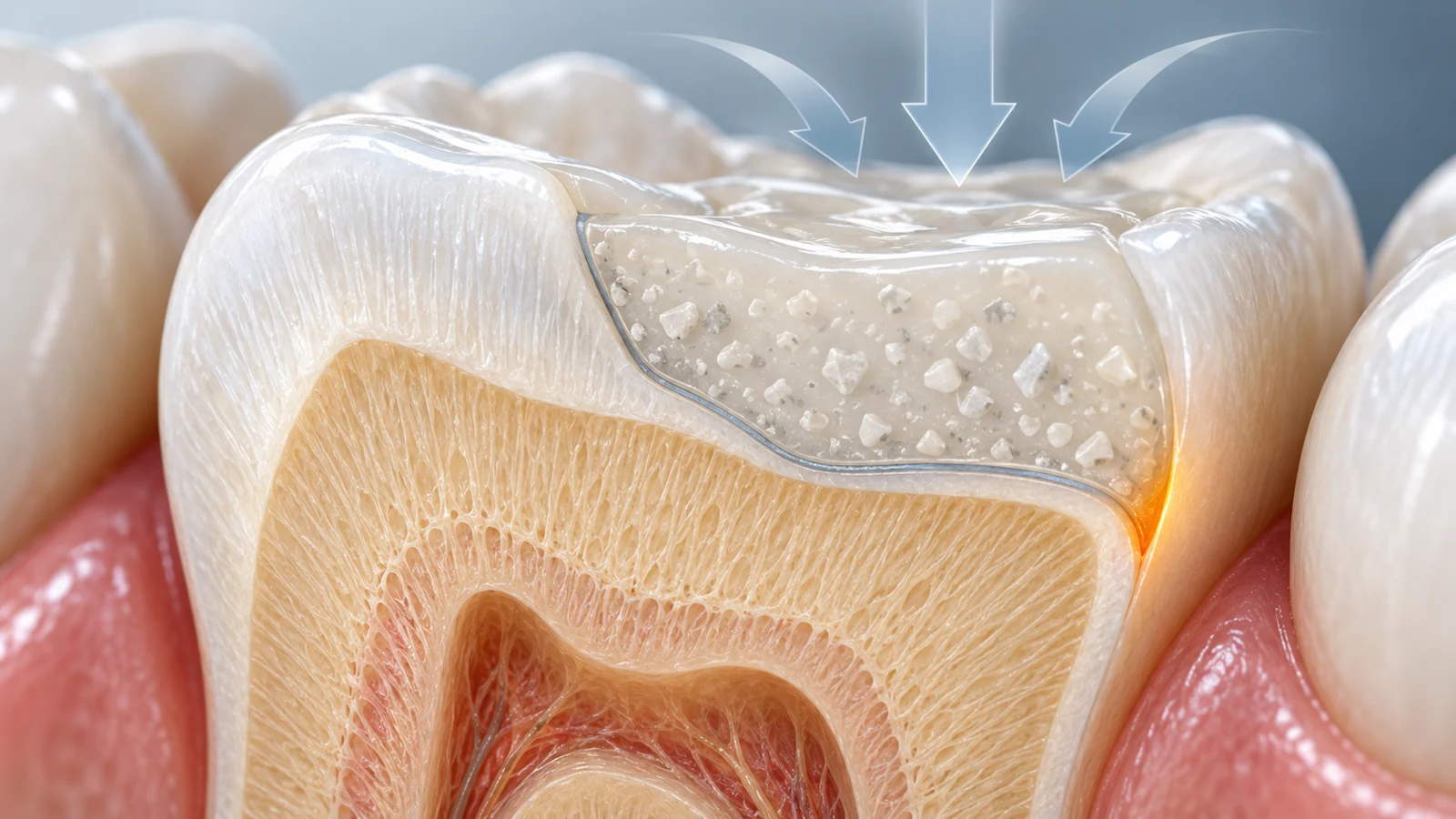
A composite has three interacting parts. The resin matrix is the material that hardens during curing. Filler particles sit within that matrix and help determine properties such as stiffness and strength. A coupling interface bonds the particles to the resin, helping the composite act as a connected material. The review groups recent experiments around changes to these three parts because each can affect a different aspect of performance.
The sections are connected in practice. A formulation may be designed to affect bacteria or mineral release, while another changes how the composite bears force or responds to moisture. Improving one measured property does not automatically improve all the others.
Edge decay calls for more than a harder filling
One approach changes the resin to address conditions associated with recurrent decay at the tooth–filling margin. In an experimental formulation, researchers combined a urethane-based resin with an antibacterial component and calcium-phosphate nanoparticles. The review reports that adding 2–5% of the antibacterial component and 20% of the nanoparticles did not compromise the tested mechanical properties. The formulation also reduced Streptococcus mutans biofilm and lactic acid production, while reducing stress from curing.
Those measurements relate to the edge-decay problem because bacterial biofilm and acid production are relevant to the environment around a restoration. But this experiment measured properties of a material and bacterial activity; it did not show that patients developed fewer new cavities.
A separate line of work aimed to supply mineral ions. The review describes three nanocomposite formulations containing calcium-fluoride nanoparticles. All released calcium and fluoride ions and could be recharged so that they released ions again. One formulation had the highest recharging capacity. The formulations also differed in mechanical tests: two were stiffer and stronger than comparison materials called resin-modified glass ionomers; the third had similar results on those measures.
Antibacterial activity and ion release are distinct design functions. One targets biofilm and acid production; the other supplies ions associated with mineral restoration. Both offer ways to study what a material might do near a vulnerable margin, but their measurements do not establish cavity prevention in patients. Nor do results from separate formulations show that one composite combines all these effects.
The bond matters when the filling hardens
The physical side of durability begins even before a restoration is in use. Light-curing turns the resin into a hardened material. As this happens, the resin can shrink and build stress against the surrounding tooth and within the composite. Researchers call this curing stress or polymerization stress.
The review summarizes an experiment in which nanogel treatments on filler surfaces reduced stress during curing by up to 20%, without reducing how much resin reacted during hardening or the composite’s measured stiffness. The treatment changed the filler surface, where resin and particles meet. The result illustrates why the interface matters: changing the connection between components can affect the stresses that develop during hardening while preserving other measured properties.
Other experiments focused on silane, a treatment that helps glass fibers bond to resin. In fiber-reinforced composites, the type and amount of silane changed how well the fiber–resin boundary resisted a crack and how much water the material absorbed. Composites with untreated fibers had the weakest boundary and poorer moisture resistance; treated fibers performed better in those tests. These laboratory results do not show that fillings made with treated fibers last longer in patients.
More filler is not always better
Filler content creates a straightforward design tradeoff. More particles can improve some mechanical properties, but a composite must remain stable and cure adequately. A network model identified 70% filler by weight as its best point for predicted stiffness and response under force; above 80%, it predicted instability and poorer mechanical properties.
A separate formulation study offers another example of competing targets. A composite with 6% by weight of a mineral filler called nano-hydroxyapatite had the highest measured resistance to compression and surface hardness among the versions tested. At 8% by weight, less of the resin reacted during hardening and curing reached the shallowest depth; this version also had the least measured shrinkage. No single filler amount led every measure in the same direction.
Together, these examples make the design goal clearer. Maximizing filler or a single strength measure is not the same as optimizing a usable composite. The resin, particles, interface, and curing behavior have to work together, and the preferred balance depends on the property being targeted.
What the measurements can tell us
The studies in the review use different formulations and endpoints: bacterial biofilm, acid production, ion release and recharge, mechanical properties, curing stress, and moisture behavior. Those measures can help researchers identify material designs worth pursuing, but they are not interchangeable with a restoration’s survival in routine dental care.
One summarized six-month volunteer experiment compared a composite containing an antibacterial filler called quaternary ammonium silica with a control composite. It reported fewer live bacteria for each of three volunteers: 54%, 30%, and 28% fewer, respectively. The result is a small volunteer measurement of live bacteria. It is different from counting recurrent cavities, measuring fractures, or following how long restorations remain in place, and it does not establish a population-level clinical benefit.
The review considered studies published from March 2019 through March 2024 and reports that its last search was on 30 March 2024. Its publication date, 2 July 2025, comes later; the search window describes the evidence it considered, not a claim that the reviewed research continued through the publication date. Across that window, the examples show several ways to alter composite behavior, while leaving patient-level durability as a separate question.
What this could change
A future tooth-colored filling that resists both decay at its edge and fracture could help patients avoid replacements caused by those failures. Existing composites already restore teeth; the possible advance is more dependable control of several failure mechanisms in the same material. The review’s antibacterial, ion-release, and mechanical results point to parts of that path, but they come from different formulations and do not yet demonstrate that combined capability in routine care.
A meaningful next milestone would be a comparative clinical study that follows recurrent decay, fracture, and replacement over time. If a carefully balanced material can produce durable improvements across those outcomes, the laboratory advances could translate into fillings that remain sound longer. Until then, the review offers a set of design directions, not a quantified estimate of fewer replacements.
Key Sources
- Primary source: Five years of restorative resin-based composite advancements: a narrative review.
DOI or Journal Page · Review or Meta-Analysis · 2025-07-02
Keep exploring