
Research Signal – Source date 2021-03-24
A dental restoration has to do more than resist force. It also needs to suit the tooth, look natural and work with the way the restoration is made and bonded. That is why the strongest block on a laboratory chart may not be the best choice for every crown, inlay or other restoration.
A review published March 24, 2021, compares ceramic, polymer, composite and hybrid materials used for computer-aided design and computer-aided manufacturing, or CAD/CAM. The authors searched English- and Polish-language literature published from 1987 through August 31, 2020, and brought together laboratory measurements and clinical observations. Their comparisons show why one number cannot settle a material choice.
From a digital scan to a bonded restoration
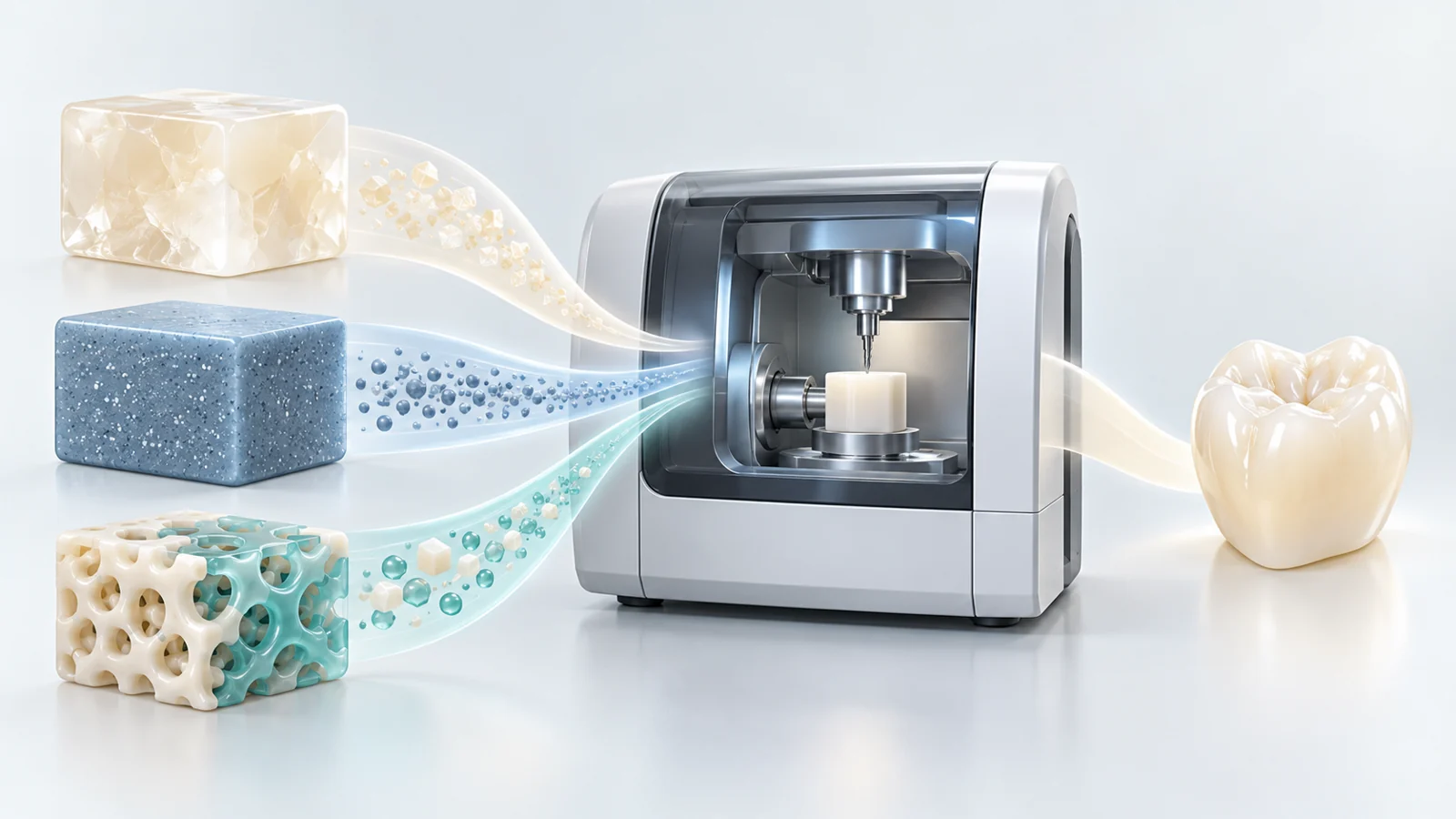
CAD/CAM describes a sequence: a dentist scans the mouth, designs a restoration on a computer, mills it from a material block, then bonds or cements it in place. Some chairside systems can complete those steps in one day. That possibility depends on the case and on each stage working well; it does not make every restoration a one-visit procedure.
The scan provides the digital impression used for design. The review notes that scan accuracy is more favorable over short distances, and that full-arch digital impressions have resolution limits compared with conventional impressions. Preparation of the tooth, scan quality, design, fabrication and cementation all contribute to the result. Materials also have different processing parameters, so the system must be adjusted to the material being milled.
This means a block’s properties are only one part of the decision. A material that can be milled quickly or has a high strength value still has to fit the restoration’s intended use and the rest of the treatment process.
Strength and hardness answer different questions
Flexural strength indicates how a material responds to bending, and the review presents it as one measure of general mechanical strength and rigidity. The values it lists vary substantially. For example, it gives 850 MPa for IPS e.max ZirCAD, a zirconium oxide ceramic, and 419 MPa for VITA In-Ceram ALUMINA, an aluminum oxide ceramic. It also lists 80 MPa for the composite VITA CAD-Temp and 150–160 MPa for the hybrid ceramic VITA ENAMIC.
Those figures can help characterize materials, but they do not rank every option for every restoration. The authors emphasize that the intended application—such as an inlay, onlay, crown, bridge or arch—matters alongside other mechanical properties. A value measured for bending is not a complete description of how a restoration will perform in a particular mouth.
Hardness raises a separate question: resistance to scratching and wear. The review reports a wide span, from 2,035 HV for aluminum oxide ceramics to 26 HV for PMMA, a polymer. It gives human tooth tissue hardness as approximately 274.8 ± 18.1 HV and VITA ENAMIC as 200 HV, describing the hybrid as a potential enamel-substitution candidate. Similarity on this measure is a point of comparison, not proof of long-term clinical performance.
The materials differ in structure as well as in their measured values. Glass-containing silicate ceramics, including feldspathic and lithium silicate types, can offer high translucency and a natural appearance. Their glass phase also contributes to brittleness and lower fracture strength. These ceramics are etched with hydrofluoric acid to create a surface for micromechanical retention, then adhesively bonded.
Resin composite blocks are attractive in part because they can be milled and repaired in the mouth. Some composites combine a polymer with ceramic filler. A polymer-infiltrated ceramic network has a ceramic scaffold permeated by a polymer network, while a resin composite block mixes filler into a resin. These are different structures, with different combinations of properties; the review does not establish long-term performance in patients for every newer hybrid material.
A laboratory load is not years of use
Laboratory tests and clinical follow-up answer different questions. In a cited laboratory study of crowns for an upper first molar, tested CAD/CAM composite blocks showed fracture strength about three to four times the average maximum bite-force benchmark reported for a molar, 700–900 N. Lithium disilicate glass ceramic was used as a control reference in that study. The result describes the tested blocks under laboratory conditions; it does not tell how long those materials will last in patients.
Clinical observations follow particular restorations over time. The review cites Vita Mark II ceramic inlays with survival rates of 90.6% after eight years and 85.7–89% after ten years. It also reports favorable long-term observations in patients for single zirconia crowns supported by teeth. These are separate material and restoration examples, not a direct head-to-head ranking of all ceramics, composites and hybrids. The clinical outcomes described for one material and restoration type cannot be transferred automatically to another.
The review also notes that survival evidence for CAD/CAM restorations is often presented in short- and medium-term studies, making comparison with conventional restorations more difficult. Clinical longevity therefore has to be considered alongside laboratory measures, rather than inferred from them.
The finish and bond are part of the result
Milling can leave a restoration surface rough. The review describes polishing and, for ceramics, glazing as finishing steps that smooth the surface and preserve optical properties. Roughness can contribute to biofilm accumulation and discoloration; it can also affect mechanical resistance and wear of opposing teeth. The appropriate polishing or glazing process depends on the material.
Bonding matters too. For silica-based ceramics, the review describes hydrofluoric acid etching followed by silanization as a way to support micromechanical and chemical adhesion. Procedures vary by material and by manufacturer recommendations. The point for the finished restoration is practical: its material alone does not determine the result. Surface treatment and a suitable bonding process also contribute to how it fits and functions.
Access depends on more than suitable materials
CAD/CAM equipment and materials remain costly, and the workflow requires trained personnel. The review describes a learning curve that can range from days to months. A practice also needs enough restoration work to justify the system investment. These constraints shape where the technology is available, even when a material could suit a particular case.
Case complexity matters as well. The review notes that the CAD/CAM system alone may not resolve some problems with how the jaws and teeth meet; the size of available blocks also limits the dimensions of restorations that can be milled. The clinician must consider the individual case when choosing both the material and the fabrication approach.
What more tailored dental restorations could offer
Matching a material and fabrication process to a particular tooth could support durable, natural-looking crowns or inlays, sometimes completed in one visit. That benefit depends on the whole workflow: a suitable scan and design, material-appropriate milling, skilled finishing and bonding, and continued evidence about wear and biocompatibility. Cost and access also affect who can receive the treatment. The review points toward options for tailoring restorations, while the long-term performance of newer materials still needs assessment.
Key Sources
- Primary source: Review on Polymer, Ceramic and Composite Materials for CAD/CAM Indirect Restorations in Dentistry-Application, Mechanical Characteristics and Comparison.
DOI or Journal Page · Review or Meta-Analysis · 2021-03-24
Keep exploring