
Research Signal – Source date 2022-01-14
A vaccine can prompt immune cells to recognize multiple myeloma without keeping the cancer under control for long. That gap is central to a 2022 review of dendritic-cell vaccines tested in people with myeloma, a cancer of antibody-producing cells that grows in the bone marrow. The studies described signs of immune activation and occasional clinical responses, but durable control was inconsistent.
The review is not a new treatment trial. It brings together preclinical research and clinical studies that used different vaccine preparations, patient groups, prior treatments and measurements. Their results show why an immune response is meaningful, while also showing why it cannot stand in for a lasting patient benefit.
The cells that teach T cells what to recognize
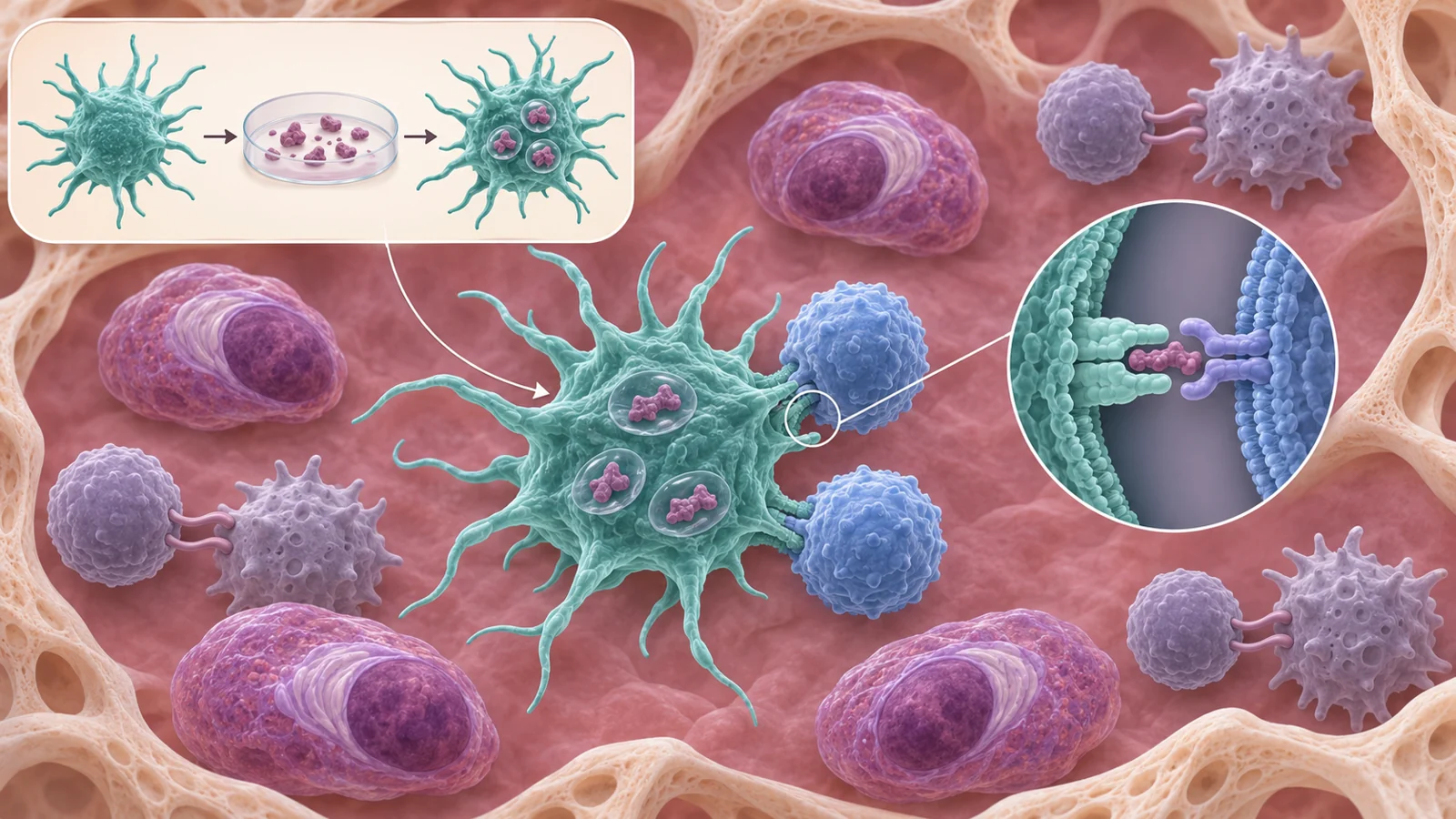
Dendritic cells are immune cells that gather material and present recognizable features, called antigens, to T cells. A T cell that recognizes a presented antigen may then take part in a targeted immune response. Because dendritic cells can present tumor material, researchers have tested whether they can help the immune system recognize myeloma.
Many of the clinical approaches in the review used monocyte-derived dendritic cells, or moDCs. Researchers collected blood cells from a patient, used laboratory signals to develop them into dendritic cells, and loaded them with myeloma-related material. Some vaccines used a single myeloma-associated protein; others used messenger RNA carrying instructions for selected tumor features, or combined dendritic cells with whole myeloma cells.
The preparation itself has practical demands. Producing large numbers of moDCs outside the body takes time and money, and requires controlled manufacturing and quality checks. More fundamentally, cells made from a patient with myeloma may not perform all the jobs needed to initiate an effective response.
A mature-looking cell may still be missing a key task
In laboratory comparisons discussed by the review, moDCs generated from myeloma patients could look mature, take up antigen and activate other people’s T cells about as well as cells generated from healthy donors. Yet patient-derived cells were less able to migrate toward lymph nodes and release an important immune signal, IL-12p70. Those functions matter because presenting a target is only part of coordinating an immune response.
The comparison helps explain why a favorable laboratory readout may not predict what happens in a patient. The review also describes changes in the dendritic-cell population around myeloma: circulating dendritic cells were reduced in patients, while some types accumulated in bone marrow as disease progressed. In that setting, accumulated cells could have immune-suppressing or tumor-supporting effects. The marrow environment, including suppressive immune cells and inhibitory signals, may also blunt a vaccine response.
These are distinct obstacles. A vaccine cell may have limited functional capacity, and the environment it enters may work against immune activity. Improving one does not by itself resolve the other.
One target is simpler; a wider target may be harder to escape
Some vaccines focused on the patient’s immunoglobulin idiotype, a distinctive protein associated with that person’s myeloma. Other studies loaded dendritic cells with selected myeloma-associated antigens. Choosing a defined target makes the intended immune recognition clear, but a tumor can evade a single target if it reduces or loses that feature.
A broader approach tried to show the immune system more of the tumor at once. Researchers fused patient-derived myeloma cells with dendritic cells, giving the vaccine a wider range of tumor material to present, potentially including features specific to that patient’s cancer. In one reported study, 11 patients had a twofold rise in both CD4 and CD8 T-cell quantities, alongside disease stabilization. In a separate phase II study of 36 patients, vaccination after a transplant using each patient’s own stem cells increased the division of T cells that recognized myeloma. The study compared two schedules: 24 patients received a series of four vaccines after transplant, while 12 received one before and four after it. The review reports no difference in T-cell response between those schedules.
These findings make the broader strategy plausible, but they do not show that presenting more tumor material reliably prevents relapse. The studies measured different outcomes, and immune-cell changes are not equivalent to sustained remission.
Patient observations varied with disease and treatment
The clinical record included small studies as well as larger combination trials, with different patient circumstances. In a six-person study of early-stage or early-relapse myeloma, one patient’s blood level of the distinctive myeloma protein fell by about 25% after vaccination. Two patients’ levels remained stable during follow-up extending to 81 months, while two had disease progression two and five months after vaccination. The review contrasts these observations with reports of clinical responses lasting less than five weeks in some advanced-stage patients. Such small, varied groups cannot settle which patients might benefit or how much a vaccine contributed.
Timing complicates the interpretation. Many studies involved people with advanced disease who had already received substantial treatment. Their immune systems and disease burden could differ from those of patients vaccinated earlier. The review discusses vaccination after high-dose chemotherapy and autologous stem-cell transplant as a possible way to target residual myeloma during immune recovery. It also describes studies combining vaccination with lenalidomide, a maintenance treatment, which can affect the tumor environment.
When a vaccine is given alongside transplant or maintenance therapy, an observed change belongs to the treatment context as a whole unless the study can separate the contributions. The varied schedules and combinations in the reviewed studies therefore make it difficult to attribute clinical outcomes to the vaccine alone. Across approaches, the review describes vaccines as generally feasible and safe, with mild fever reported in some patients, while longer-term clinical responses remained limited.
Where this research could lead
For someone whose myeloma is in remission after treatment, a tailored dendritic-cell vaccine could one day add dependable protection against relapse. The studies reviewed in 2022 offer part of the rationale: researchers could prepare patient-derived cells with myeloma material and observe immune recognition in patients. The remaining challenge is to turn that recognition into lasting control despite limitations in vaccine-cell function and the suppressive bone marrow setting.
The nearer milestone is a clear post-treatment comparison that tracks sustained remission as well as immune responses, and can identify whether vaccination adds a benefit beyond transplant or maintenance treatment. Better-functioning vaccine cells and ways to manage marrow suppression are also dependencies. The review describes promising approaches to test, not a demonstrated, durable benefit from any one of them.
Key Sources
- Primary source: Dendritic Cell-Based Immunotherapy in Multiple Myeloma: Challenges, Opportunities, and Future Directions.
DOI or Journal Page · Review or Meta-Analysis · 2022-01-14
Keep exploring