
Research Signal – Source date 2021-02-01
A dendritic-cell vaccine and nivolumab are intended to tackle different parts of the same problem. The vaccine aims to mobilize immune cells that can attack cancer; nivolumab is meant to make it harder for a tumor to evade that response. A 2021 review examined this pairing and described survival improvements across several tumor types, while the available abstract does not give the details needed to judge the size or scope of those improvements.
The vaccine’s job is to rally an immune response
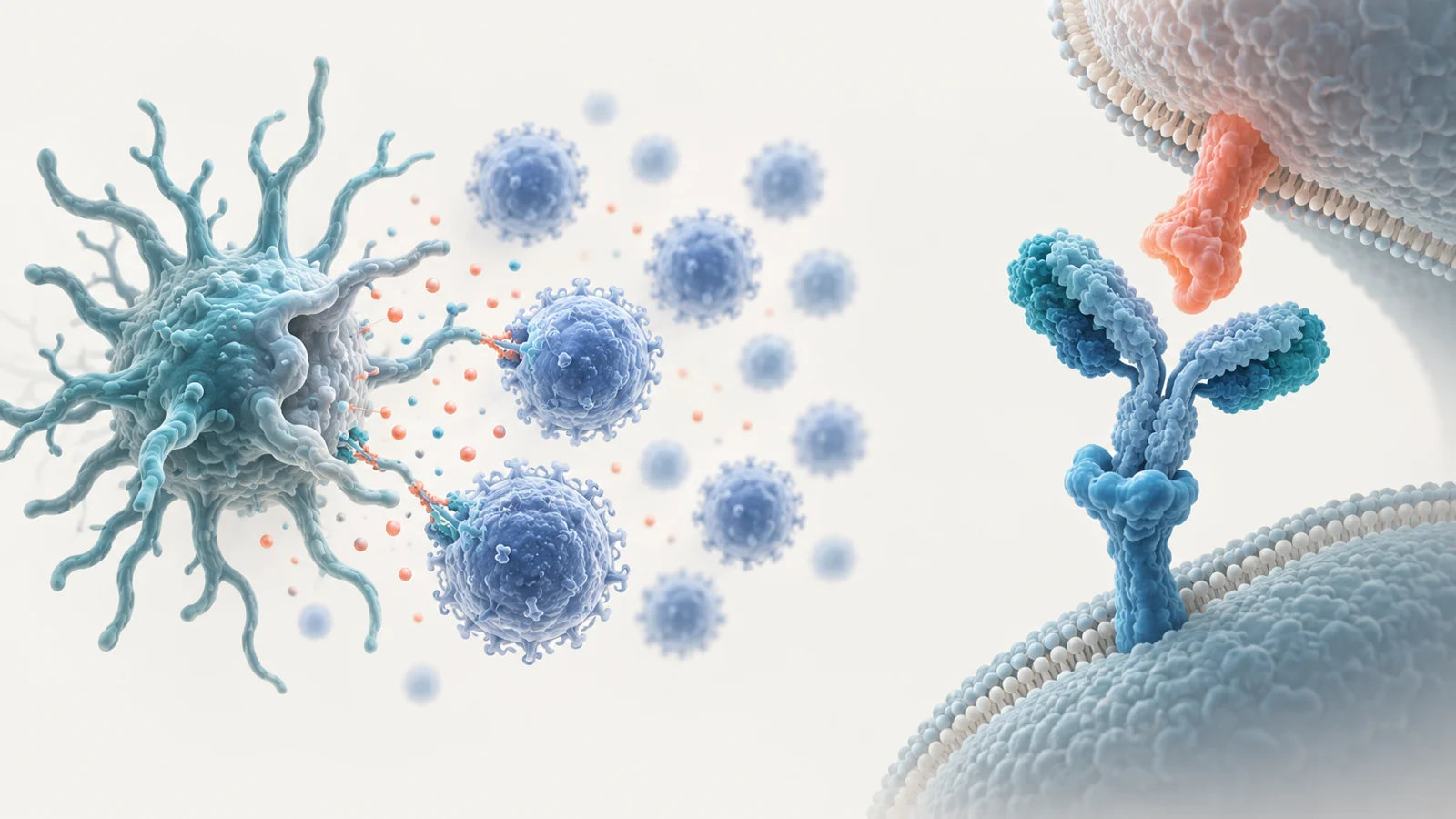
Dendritic cells help direct immune responses. In the approach described by the review, a vaccine based on these cells is intended to elicit and expand effector immune cells: cells that carry out the work of attacking a target. The aim is to increase the cancer-fighting response available to the body.
Mobilizing those cells may not be enough on its own. A tumor can still use immune escape mechanisms that interfere with an attack. The review presents the vaccine as a way to build or broaden the response, while recognizing that the tumor’s ability to evade it is a separate obstacle.
Nivolumab is meant to block an escape route
Nivolumab is a drug that blocks PD-1, an immune checkpoint involved in the tumor’s ability to escape immune attack. In the review’s account, blocking this route could help keep an immune response from being shut down in the same way. The proposed pairing therefore combines an effort to expand cancer-fighting cells with an effort to limit a tumor’s means of evasion.
This is the rationale for combining the treatments, not a guarantee that every mobilized cell will reach or eliminate a tumor. The review describes a strategy aimed at addressing two connected challenges; its abstract does not specify a treatment protocol or explain which patients might respond.
The survival statement needs its evidence context
The review’s authors state that the combination enhanced survival in several types of tumors and suggest it could help establish combination immunotherapy as a first-line treatment. That is an author-level conclusion from a review, rather than a newly reported human trial in this article.
The verified abstract does not identify the tumor types, comparison groups, study designs, or numerical size of the stated survival improvement. Those details matter: without them, readers cannot tell from the abstract how large the benefit was, which patients it concerned, or how confidently it can be attributed to this particular pairing. This limit applies to the evidence supplied here; it is not a claim about everything in the full paper.
What this pairing could change for patients
From the review’s 2021 perspective, the possible clinical consequence was that a combination regimen might become a first-line option for people with particular cancers. That would give those patients access to an approach designed both to rally immune cells and to impede tumor escape early in treatment. Reaching that point would depend on dependable clinical evidence establishing a benefit for those specific patients; the review’s proposal does not show that first-line use had already become standard.
Key Sources
- Primary source: Pharmacological combination of nivolumab with dendritic cell vaccines in cancer immunotherapy: An overview.
DOI or Journal Page · Review or Meta-Analysis · 2021-02-01
Keep exploring