
Research Signal – Source date 2025-08-01
Sleep disturbance in Alzheimer disease and other dementias is not one problem with one outcome. A person may take a long time to fall asleep, wake repeatedly, spend less time asleep or become more confused and agitated as evening arrives. At the same time, a caregiver may be awake too, listening for movement, responding to nighttime behavior or trying to restore a disrupted routine.
That makes treatment results easy to overread. When a study says sleep improved, whose sleep changed? Did the person with dementia sleep longer, did a caregiver have a better night, or did researchers measure a different feature of sleep or daytime function? An updated review of completed ClinicalTrials.gov studies, published on August 1, 2025, offers a useful way to ask those questions without turning a small and varied evidence base into a simple ranking of treatments.
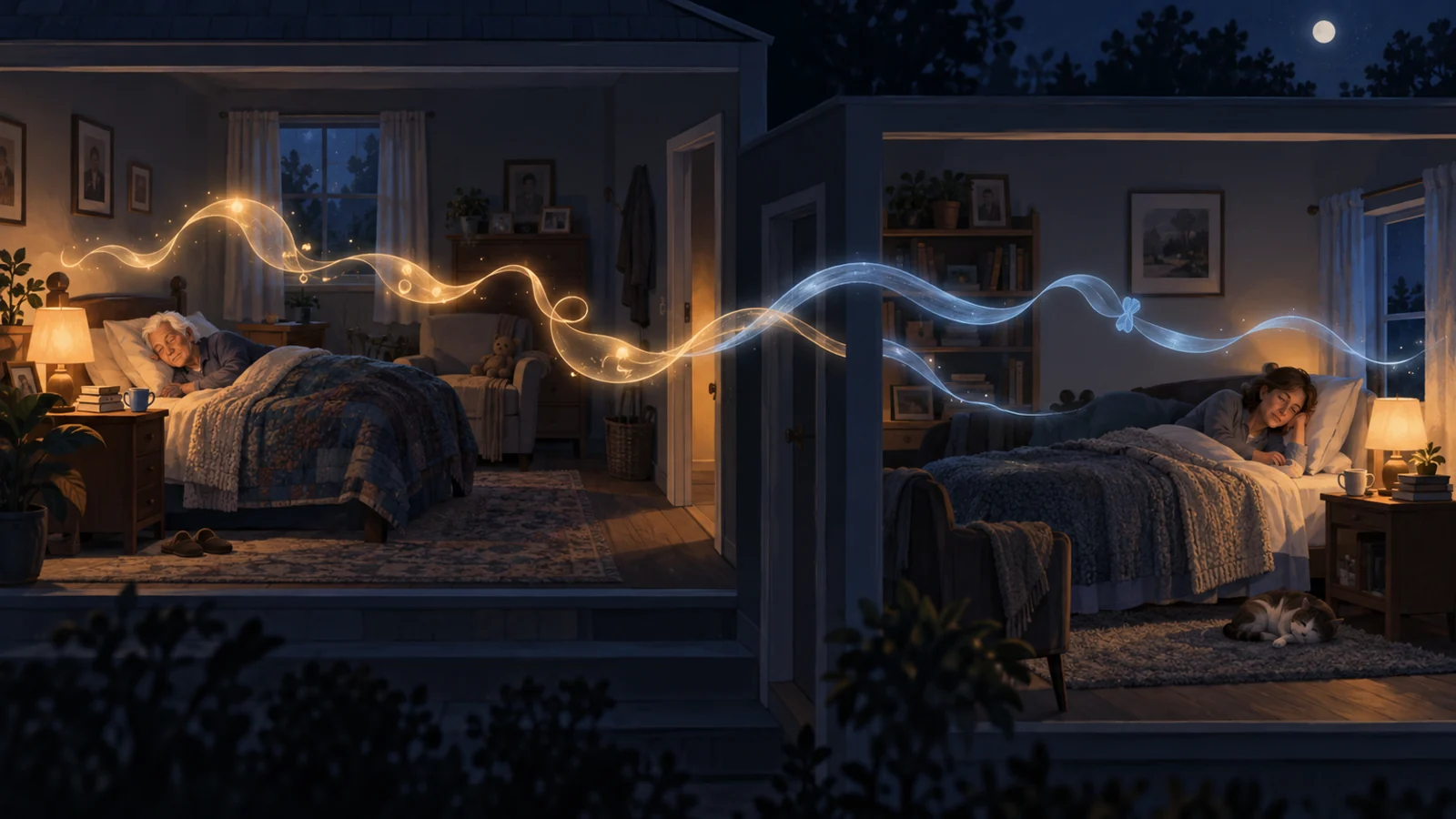
A night can be difficult for two people at once
Sleep-related symptoms are common in Alzheimer disease. The review describes prolonged sleep latency, frequent awakenings, reduced total sleep time and lower sleep efficiency, with problems often appearing early and worsening as the disease progresses. Circadian rhythms can also become irregular. Some people experience a reversal of the sleep-wake cycle or increased confusion and agitation in the late afternoon and evening, commonly called sundowning.
The effects reach beyond the bedroom. Fragmented sleep can contribute to daytime sleepiness and worsening cognitive difficulties, while nighttime disruption can leave caregivers stressed, sleep-deprived and at risk of burnout. The patient’s sleep and the caregiver’s rest are connected, but they are not interchangeable outcomes. A treatment that improves one may leave the other unchanged.
That is the central reading task for the trials discussed in this paper. A reported benefit needs to be attached to the people studied, the outcome measured and the length of follow-up.
What the registry search actually captured
The authors searched ClinicalTrials.gov on July 21, 2024, looking for completed interventional trials focused specifically on sleep-disturbance interventions in people diagnosed with Alzheimer disease or dementia, with results available. They identified nine trials involving 1,139 participants. Six were pharmacological and three were nonpharmacological.
Those nine studies are a selected registry set, not a count of every study on dementia and sleep across all research sources. They also differ substantially in design and population. The accounts include placebo-controlled drug trials, a single-group behavioral intervention and a quasi-experimental comparison based on adherence to a breathing treatment. Most participants came from randomized studies according to the review’s aggregate description, but the individual accounts do not form one uniform experiment.
The review itself notes variability in how interventions were delivered and possible recording or classification problems in registry data. Its results are therefore most useful as a set of specific findings to interpret, rather than as a direct comparison showing which treatment works best.
The clearest number came from a four-week drug trial
The strongest quantitative anchor in the review is a randomized, double-blind, placebo-controlled trial of suvorexant for insomnia in people with mild-to-moderate probable Alzheimer dementia. It included 285 participants and lasted four weeks.
Researchers measured total sleep time with polysomnography, an overnight recording that tracks sleep-related signals. Compared with placebo, the suvorexant group had a 28-minute advantage in the change in total sleep time. The study also reported a 16-minute reduction in wake after sleep onset, particularly during the last third of the night. Somnolence was the most common adverse event, and the account reported no significant worsening of cognitive function or neuropsychiatric symptoms during the trial.
The 28-minute figure is a between-group difference, not a promise that every person receiving suvorexant slept exactly 28 minutes longer. It describes how the treatment group’s change compared with the placebo group’s change over four weeks. It also does not tell us whether the improvement would persist over a longer period, remain tolerable for people at different stages of dementia or translate unchanged to ordinary home or residential care.
Even so, the result answers a concrete question: in this particular population, under this particular protocol, did a sleep medicine alter an objective measure of nighttime sleep relative to placebo? The answer reported by the review was yes. That is narrower, and more informative, than saying that the treatment generally improves dementia or solves nighttime care.
A genetic signal can point to variation without choosing a treatment
The piromelatine trial asks a different question. In the six-month ReCognition study, 371 people with mild Alzheimer disease received one of three doses of piromelatine or placebo. The overall account reported no statistically significant differences between piromelatine and placebo on the described cognitive and sleep measures, and it reported no safety concerns in the study.
The more intriguing finding appeared after researchers examined genetic differences. A cluster of polymorphisms at 2q12 was associated with different patterns of response. Carriers, who made up about 27% of the sample, showed improvement on one computerized cognitive measure but worsening on another cognitive measure and on a sleep-quality measure. Noncarriers showed improvement on the latter cognitive and sleep measures with piromelatine.
That pattern is not a straightforward success story hidden inside a negative overall result. Different measures moved in different directions, and the subgroup analysis was not a validated clinical rule for deciding who should receive piromelatine. It is better understood as a reason for further investigation into response variation than as a ready-made genetic test or treatment-selection method.
When a better night belonged to the caregiver
The bright-light study makes the patient-caregiver split especially visible. It enrolled 118 people with memory impairment and their caregivers. Care recipients received either bright white light of about 4,200 lux or dim red light of about 90 lux for 30 minutes each morning over two weeks. Both conditions were paired with sleep-hygiene therapy.
For the care recipients, the reported results were disappointing. They spent less time in bed and had less total sleep time, lower sleep efficiency and more wakefulness after sleep onset. The study did not find significant improvement in subjective insomnia symptoms. The caregiver results moved in the opposite direction: wakefulness after sleep onset, sleep efficiency, sleepiness, insomnia symptoms and depressive symptoms all improved.
The finding matters because it shows how a study can produce a meaningful caregiver outcome without demonstrating better sleep for the person with dementia. It also cannot isolate bright light as the cause of the caregiver improvements, since sleep-hygiene therapy accompanied the light regimen and the protocol itself may have introduced structure into the household routine.
A small nursing-home behavioral study reported a more favorable result for residents themselves. The LOCK intervention included 23 participants in a single group and lasted 15 weeks. Actigraphy, a wearable-based measure of movement and rest, showed significant improvements in total sleep time and sleep efficiency. Caregivers also reported less severe nighttime behavior and better daytime functioning for the residents.
Those findings are encouraging in a practical sense, but the study’s single-group design leaves no separate comparison group to show how much of the change came from the intervention rather than the passage of time, participation or other changes in care. Its result belongs beside the controlled drug trial as a different kind of evidence, not above or below it on a single treatment ladder.
Why CPAP answers a different question
The breathing-treatment study is easy to place in the wrong category. It was not another randomized Alzheimer insomnia trial. It involved 54 older adults with mild cognitive impairment and obstructive sleep apnea. Mild cognitive impairment refers to measurable problems with thinking or memory that do not necessarily amount to dementia. Obstructive sleep apnea is repeated blockage of breathing during sleep. Continuous positive airway pressure, or CPAP, uses a mask and steady air pressure to keep the airway open.
Participants were compared according to CPAP adherence over one year: 29 used it for at least four hours per night, while 25 used it for less than four hours. The adherent group had better psychomotor and cognitive processing speed, with additional small to moderate differences favoring adherence for memory, attention, daytime sleepiness and everyday function.
This was an adherence comparison, not random assignment. People who use a device consistently may differ from people who do not in ways that also affect cognition or daily function. The result therefore cannot establish that CPAP caused the cognitive differences. It also cannot be transferred directly to people with established Alzheimer dementia and insomnia.
The review’s aggregate description says eight of the nine studies were randomized, yet its individual accounts include the single-group behavioral study and this quasi-experimental CPAP comparison. That inconsistency is a reason to preserve the design details rather than manufacture a corrected tally. The studies do not answer the same question, use the same population or measure the same outcome.
Reading the nine trials without making a treatment ranking
Across the review, the interventions touch different parts of the sleep problem. Suvorexant provided a placebo-controlled estimate for total sleep time. Piromelatine raised a question about whether genetic differences might shape responses, while its overall results were not statistically significant on the reported measures. Bright light was accompanied by better caregiver outcomes but not better care-recipient sleep. The LOCK study reported improvements in a small, single-group nursing-home sample. The CPAP account connected adherence with cognitive and daily-function measures in people with mild cognitive impairment and sleep apnea.
These results cannot be arranged into a reliable contest between drugs, behavioral care, light therapy and breathing treatment. The populations, designs, endpoints and follow-up periods differ too much. A longer night is not the same endpoint as fewer nighttime behaviors, better sleep efficiency, less caregiver insomnia or faster cognitive processing. Even when two studies use similar words, they may be measuring different experiences.
The practical value of the review is its insistence on keeping those experiences visible. A family reading about a sleep treatment should ask whether the outcome was recorded in the patient, reported by a caregiver, measured through a device or inferred from adherence. It should also ask how long the study lasted and whether the result was compared with a control group. Those questions do not dismiss the findings; they show what each finding can reasonably tell us.
What this could change
For a person with dementia, a durable reduction in disruptive awakenings could mean a calmer night and less exhausting daytime care. For a caregiver, more uninterrupted rest could make it easier to sustain care at home or in a residential setting. The potential benefit is shared, but it will only become dependable if sleep improvements persist, remain tolerable and transfer beyond the conditions of short or highly structured trials.
Future treatment decisions would also need to keep patient and caregiver outcomes separate. A night that improves for one does not automatically improve for the other. If interventions can produce both kinds of benefit in ordinary care, with results that hold across dementia stages and settings, sleep management could become a more practical way to reduce the daily strain of dementia without pretending that every promising result answers the same question.
Key Sources
- Primary source: Management of sleep disturbance related to Alzheimer disease and dementia: An updated review of ClinicalTrials.gov.
DOI or Journal Page · Peer-Reviewed Paper · 2025-08-01
Keep exploring