
Research Signal – Source date 2021-05-20
For someone caring for a relative with dementia, getting support can mean finding time away from the very responsibilities that make help necessary. Language and financial barriers can make access harder still. A proposed study brings support into the home and asks whether combining it with wearable monitoring could ease caregivers’ daily strain.
The May 20, 2021 ClinicalTrials.gov description of the Dementia Family Caregiver Study sets out a three-month intervention delivered by community health workers. It combines culturally and linguistically appropriate home visits, emotional support, caregiving education, and wearable measurements of stress-related physiology, sleep, and activity. This is a plan for a randomized comparison, with assessments extending to six months.
What a home visitor would provide
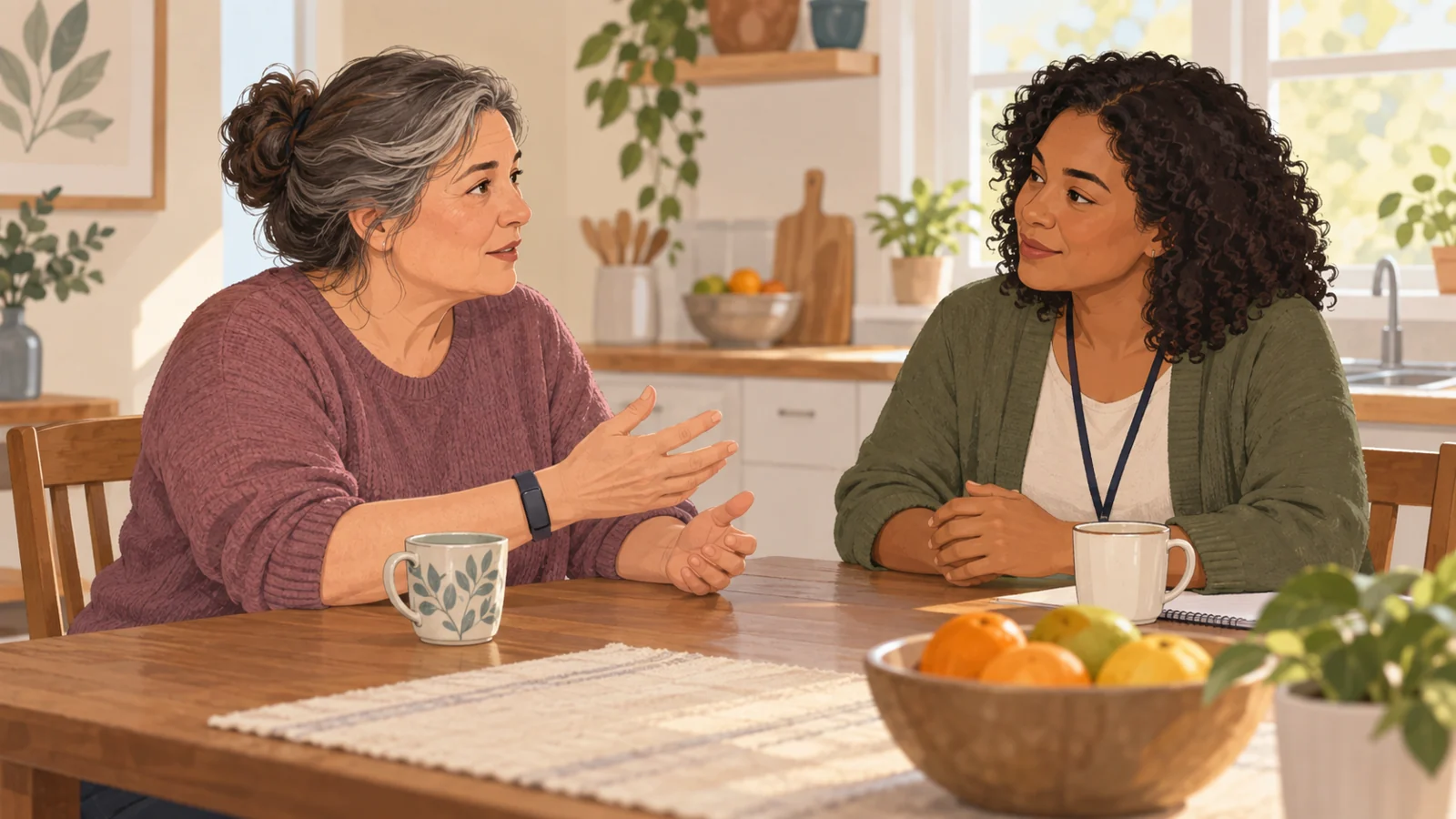
The proposed visits address two connected parts of caregiving. Mindful deep breathing and compassionate listening are intended to help caregivers manage their own distress. Education focuses on understanding the behavior of the person with dementia and improving how the caregiver responds. The intended benefit reaches into the relationship as well as the caregiver’s individual well-being.
These components have distinct roles. Breathing offers a stress-reduction practice; listening gives the caregiver space to express concerns; education aims to make difficult interactions more understandable and manageable. The community health worker brings those forms of help to the setting where care happens.
Cultural and language adaptation are central to that delivery choice. The investigators describe underserved caregivers facing barriers involving language, time, and finances, alongside limited use of available services. Home visits and communication suited to the caregiver are intended to make support more accessible. Whether that design translates into better outcomes is part of the question the study would test.
Why the study needs three groups
The planned randomized trial would compare caregivers receiving the full home-support package and wearable technology with two other groups. An attention-control group would use wearable technology only, while a third group would receive usual care.
The comparison between the full package and the wearable-only group could help identify the added value of home support when both groups use the technology. Comparing the wearable-only group with usual care could help assess whether participation centered on monitoring changes outcomes. Comparing the full package with usual care would address the broader question of what the combined approach offers beyond existing care.
These comparisons would evaluate the support package as a whole. They would not separately determine how much any benefit came from breathing, compassionate listening, education, or cultural and language adaptation. Those elements travel together in the proposed intervention.
Assessments are planned before the intervention, at three months, and at six months. The baseline assessment provides a starting point. The three-month assessment aligns with the end of the intervention, while the six-month assessment could show whether changes persist for the following three months. That timing gives the trial a way to examine both immediate change and some persistence afterward.
What the wearable measurements would mean
The description identifies heart rate variability—the variation in time between heartbeats—as a stress-related measure, alongside sleep and activity. These wearable records would allow the researchers to examine patterns over time.
The planned outcomes also include caregiver burden, depression, self-efficacy, health-related quality of life, stress, sleep, and the behavior of the person receiving care. Self-efficacy concerns caregivers’ confidence in their ability to manage caregiving. Burden and quality of life address how that responsibility affects daily experience.
A change in a recorded physiological signal and meaningful relief for a caregiver are different claims. A wearable reading alone cannot establish that someone feels less overwhelmed, more capable, or better able to cope. Reading the physiological and behavioral measurements alongside the other outcomes would help researchers judge whether recorded changes accompany improvements that matter in everyday life.
How much the early account supports
The investigators describe preliminary work with Latino, Vietnamese, and Korean caregivers as acceptable to participants and effective in reducing stress and burden over the short term. That is their account of earlier experience, separate from the proposed randomized comparison. The summary does not provide enough quantitative detail to independently judge the size or reliability of those preliminary benefits.
Cultural and language adaptation does not itself establish equivalent benefit across groups. The evidence available here supports explaining the design and its rationale; it does not establish comparative results or a numerical treatment effect for this trial.
The planned six-month assessment could address persistence over that interval, while longer-lasting benefit would require further evidence. The intervention’s clinical focus is caregiver well-being and interactions with the person receiving care. It is not a proposed treatment or prevention for dementia itself.
What this could change
If the combined approach proves effective and workable, community health workers could bring practical caregiving skills and emotional support to families who struggle to access services elsewhere. Delivering that help at home, in an appropriate language and cultural context, could make it easier to use where daily difficulties arise.
The downstream payoff would be a more manageable caregiving experience: better support for handling stress, greater confidence in responding to dementia-related behavior, and more constructive interactions with a relative. Establishing that benefit could give community services a concrete basis for offering home support to underserved families.
Key Sources
- Primary source: Dementia Family Caregiver Study
Government or Regulator · Peer-Reviewed Paper · 2021-05-20
Keep exploring