
Research Signal – Source date 2025-03-01
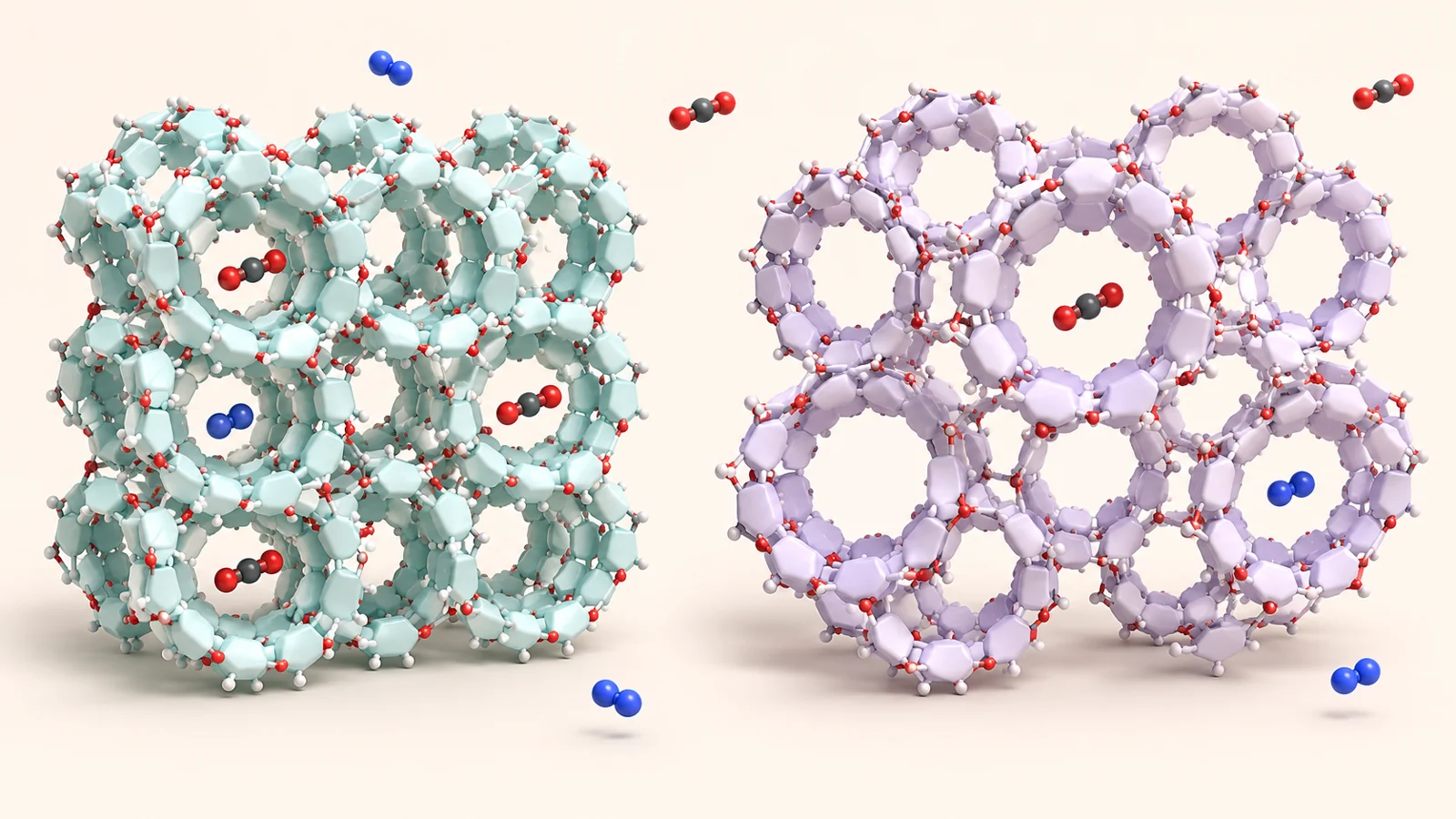
A porous material can hold a gas without strongly preferring it. In a study dated March 1, 2025, researchers reported both properties for two materials built from cyclodextrin, a sugar-based molecule: α- and β-cyclodextrin metal-organic frameworks. Their measured CO₂ uptake was 10.8 and 11.2 cubic centimeters per gram, respectively, and the authors described both materials as strongly selective for CO₂ over nitrogen.
The figures make these materials worth examining as early candidates for gas separation. They do not, by themselves, show how well the materials would capture CO₂ from an exhaust stream or how much energy and work repeated use would require.
Two kinds of evidence from the gas measurements
Uptake describes how much CO₂ a given mass of material takes up under a measurement. Here, the reported values are volumes of gas per gram of material. The abstract does not give the conditions attached to those measurements, so the figures cannot be directly translated into performance in a particular capture system.
Selectivity answers a different question: when CO₂ and nitrogen are both present, does the material favor one over the other? The study reports strong preference for CO₂ over nitrogen, but the supplied evidence gives no numerical selectivity ratio. Uptake and selectivity are complementary: one concerns the amount held, the other the preference between gases. Neither alone describes a complete capture process.
A simpler route is part of the result
The researchers prepared both materials with a hydrothermal method, adjusting incubation time and solvent ratios. They describe the approach as cost-effective and environmentally friendly, with straightforward procedures, safety characteristics and mild reaction conditions. Those descriptions convey the researchers’ assessment of the preparation. The evidence presented here does not provide comparative cost or life-cycle measurements that would establish economic or environmental advantages at scale.
A hydrothermal route uses a heated liquid environment to carry out a reaction. In this case, it gave the team a way to make α- and β-cyclodextrin frameworks while tuning preparation time and the proportions of solvents. The practical question is whether that route can produce the desired porous materials reliably and efficiently beyond the reported laboratory work; the abstract alone does not settle it.
What the characterization can tell us
The team used several methods to check what they had made and how it behaved. Powder X-ray diffraction examines the material’s structure by measuring how it scatters X-rays. Scanning electron microscopy provides images of its appearance. Thermogravimetric analysis tracks how a material’s mass changes as it is heated, while nitrogen adsorption and desorption measurements probe pore-related properties.
The researchers also used infrared spectroscopy to examine the proposed CO₂ adsorption mechanism. This method detects how a material interacts with infrared light, which can help investigate chemical interactions. Together, these techniques characterize the samples and explore how they may take up CO₂; the supplied findings do not establish the selectivity or capacity that would result in a working unit under real mixed-gas conditions.
Reuse matters as much as first capture
The abstract describes the materials as having excellent thermal and cycling stability. Thermal stability matters because a capture material may encounter heat; cycling stability matters because it is intended to be used repeatedly. Those are encouraging qualitative findings for a candidate intended for reuse.
The description does not specify a demonstrated service lifetime or the conditions and number of cycles behind the stability assessment. Nor does the evidence here establish the energy or other requirements for releasing captured CO₂ so the material can be reused. Those details matter to whether a material that performs in laboratory measurements can become useful in an operating process.
What this could change
If later work confirms the reported preference and uptake in relevant gas mixtures, an industrial capture unit could have another reusable material option for separating CO₂ from nitrogen-bearing exhaust, allowing more of that CO₂ to be collected instead of released. This study contributes an early candidate made by a hydrothermal route, alongside reported uptake, selectivity and cycling stability; other advances in realistic gas testing, regeneration and manufacture would still be needed.
A nearer milestone would be independent measurements of selectivity, uptake and repeated-cycle performance under stated, relevant gas-mixture conditions. Results there would show more clearly whether the laboratory promise can carry into the separation task that matters for capture.
Key Sources
- Primary source: Eco-friendly one-pot hydrothermal synthesis of cyclodextrin metal-organic frameworks for enhanced CO2 capture
DOI or Journal Page · Peer-Reviewed Paper · 2025-03-01
Keep exploring