
Research Signal – Source date 2025-09-25
A porous crystal can look spacious on paper and still lose much of its usable interior when prepared for an experiment. That matters for carbon capture: a gas needs to enter the material, and the pores must remain accessible after solvent is removed. But a rigid structure may not adjust to welcome gas molecules. A study published on September 25, 2025, tested a design meant to balance those demands: pillared metal-organic frameworks built with a bulky, three-dimensional cubane linker.
The researchers found that one of the materials retained substantial accessible surface area after activation and could reversibly change its pore structure as carbon dioxide entered and left. The experiments point to a way to combine structural resilience with motion. They are laboratory results, however, rather than a demonstration of carbon capture in an operating gas-treatment system.
A three-dimensional pillar helps preserve accessible space
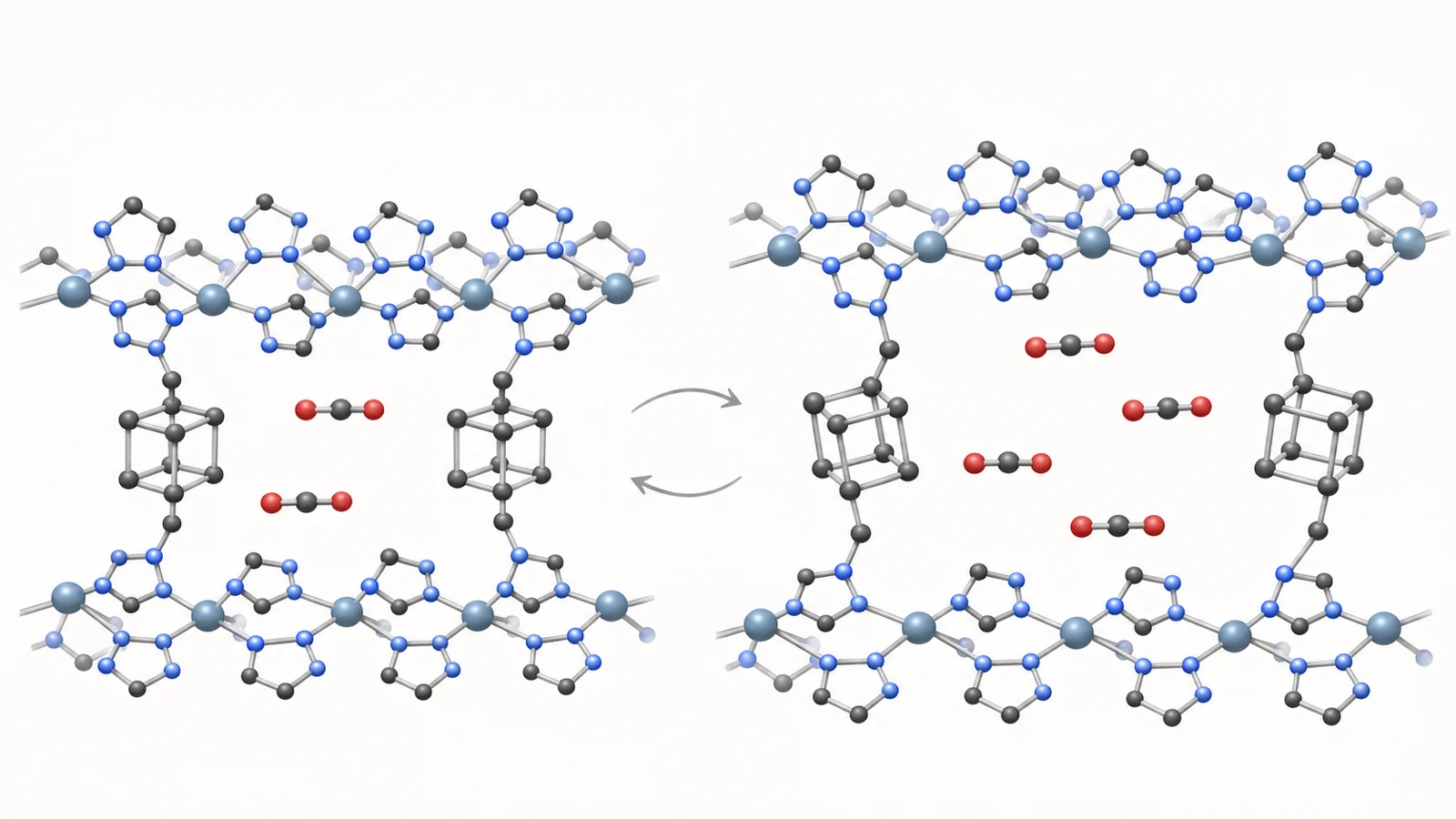
Metal-organic frameworks, or MOFs, are crystals assembled from metal centers and organic linkers. Their repeating structure can contain pores that admit gas molecules. In this study, zinc and triazolate linkers formed sheet-like layers, while a cubane-based linker connected the sheets, acting as a pillar. Cubane has a rigid, three-dimensional shape rather than the flat, ring-shaped core of the benzene-based linker used in a comparison material.
The team made two related frameworks, named UNSW-100 and UNSW-101. Both used zinc-triazolate sheets; UNSW-100 had the cubane pillar, while UNSW-101 used a brominated version. The design question was whether a bulky pillar could help preserve the spaces between layers after activation, the preparation step that removes guest solvent molecules so the pores can be tested.
After solvent exchange and activation under vacuum at 120 °C, UNSW-100 had a measured nitrogen BET surface area of 1,490 square meters per gram. BET is a standard way to estimate the surface area accessible to gas in a porous sample. The study’s structural calculation estimated 1,904 square meters per gram for this material, so the measured value also indicates that some collapse occurred.
The planar-linker comparator, FJU-40-H, measured 138 square meters per gram under the researchers’ activation comparison, despite a calculated area of 2,577 square meters per gram. The gap suggests that its apparent pore space was largely lost during preparation. UNSW-100 did not avoid every structural loss, but it retained far more accessible area in this measurement. The comparison shows why a crystal’s ideal structure alone cannot establish how much of its pore network survives preparation.
Diffraction caught the pores changing as gas entered
The researchers went beyond measuring gas uptake before or after exposure. They recorded X-ray powder diffraction while measuring carbon dioxide adsorption. Diffraction reveals how atoms are arranged in a crystal; collected alongside gas uptake, it can show when the structure changes as gas enters or leaves.
For UNSW-100, the activated material began in a narrow-pore state. During carbon dioxide adsorption at 273 K, the diffraction pattern showed an intermediate phase beginning around 10 kilopascals, when the sample had taken up 37 cubic centimeters of carbon dioxide per gram. At about 81 kilopascals, after uptake reached 76 cubic centimeters per gram, the structure changed to an open-pore phase.
The sequence reversed during release. As pressure fell, the open-pore structure moved back through the intermediate phase, with the transition starting around 55 kilopascals; under vacuum, the narrow-pore state returned. This reversible sequence connects the changing diffraction pattern to gas uptake and release under the reported laboratory conditions. It also helps explain the step and hysteresis in the adsorption measurements: the crystal’s response depends on the pressure it has reached and whether gas is entering or leaving.
Small changes in the zinc sheets widen a channel
The pore motion was not simply a pillar swinging aside. In the refined structures, the zinc-triazolate sheets changed shape, altering the channel that runs through the framework. In the narrow-pore phase, the main channel measured about 7.22 by 10.84 angstroms. With carbon dioxide present in the open-pore phase, it widened to about 8.14 by 11.12 angstroms.
The structures showed a corresponding change in the angle along zinc chains in the sheets: about 88.5 to 88.6 degrees in the narrow state, compared with 110.7 degrees in the open state. The sheet rearrangement compresses part of the structure while making the channel more accessible. This is a local adjustment of the crystal’s coordination geometry, the way zinc atoms are connected to neighboring linkers.
Computational calculations added a picture of how carbon dioxide might interact with the framework. The researchers searched for favorable positions for a carbon dioxide molecule and then allowed the framework to adjust around it. In those calculations, the open metal site in UNSW-100—an accessible zinc site—was associated with stronger interaction when the framework could flex. The calculations help interpret why the material moves; they are modeled interactions, separate from the measured diffraction changes.
Bromination trades some motion for stronger uptake
UNSW-101 tests whether more flexibility necessarily means more carbon dioxide uptake. It does not. The brominated pillar occupied more pore space and limited structural motion; calculations found little change in its cell dimensions as carbon dioxide interacted with it. Yet at 100 kilopascals, UNSW-101 adsorbed 128 cubic centimeters of carbon dioxide per gram at 273 K and 109.5 at 293 K. UNSW-100 adsorbed 112 and 75.5 cubic centimeters per gram at those temperatures, respectively.
The reported heat of carbon dioxide adsorption was also higher for UNSW-101: 37.5 kilojoules per mole, compared with 27.3 for UNSW-100. The authors’ calculations suggest that interactions involving bromine and zinc contribute to the stronger attraction. In other words, the framework that moves more is not automatically the one that takes up more gas at every condition. Pore access, structural motion, and the strength of gas-framework interactions can pull in different directions.
The comparison has another measurement limit. UNSW-101 did not adsorb nitrogen in the reported test, so its nitrogen-based BET area could not be calculated accurately. Its carbon dioxide uptake therefore provides a separate view of interaction with that gas; it should not be read as a direct nitrogen surface-area comparison with UNSW-100.
A promising selectivity number still needs a mixture test
Separating carbon dioxide from methane is relevant because the two gases can occur together in gas streams. The researchers measured each gas’s adsorption separately and used those data in an adsorption model to estimate how the material might favor one gas over the other. For an equal-part carbon dioxide and methane mixture, the model gave UNSW-100 a selectivity of 19, meaning it predicted a marked preference for carbon dioxide over methane under those modeled conditions.
That value is a model-based estimate, not a measurement of separation in a flowing mixed-gas stream. Single-gas measurements and a calculated selectivity can guide which material to test next, but they do not show how much carbon dioxide a working bed would capture, how well it would separate the gases as they flow through, or whether its capacity would persist over repeated operation. The reported reversible pore change is likewise evidence under specified laboratory conditions, not proof of long-term performance in a scaled pressure-swing process.
What this could change
A dependable porous solid that remains accessible after preparation, responds to carbon dioxide in a methane-rich stream, and can release captured gas when pressure changes could become part of a more practical gas-separation bed. The potential public value would be a material that helps separate carbon dioxide from a useful gas stream; separation technology already exists, and these experiments do not show an operating plant, energy savings, or lower emissions.
The design offers a concrete reason to test that possibility: UNSW-100 retained measured porosity, its crystal structure reversibly shifted with carbon dioxide pressure, and its calculated carbon dioxide-to-methane selectivity was encouraging enough to investigate. A nearer milestone is a repeated-cycle test with a flowing carbon dioxide and methane mixture, measuring actual separation and whether capacity remains after activation. Process design and validation under operating conditions would still be needed to establish whether the material can serve that role.
Key Sources
- Primary source: Restoring Porosity and Uncovering Flexibility in Pillared 3D-Linker Metal-Organic Frameworks.
DOI or Journal Page · Peer-Reviewed Paper · 2025-09-25
Keep exploring