
Research Signal – Source date 2024-06-01
Catching sunlight is only the beginning of making a chemical fuel. A material must turn the absorbed energy into electrical charges, keep those charges from canceling each other out, and deliver them to a surface where molecules can react. A material that absorbs light readily can still accomplish little useful chemistry.
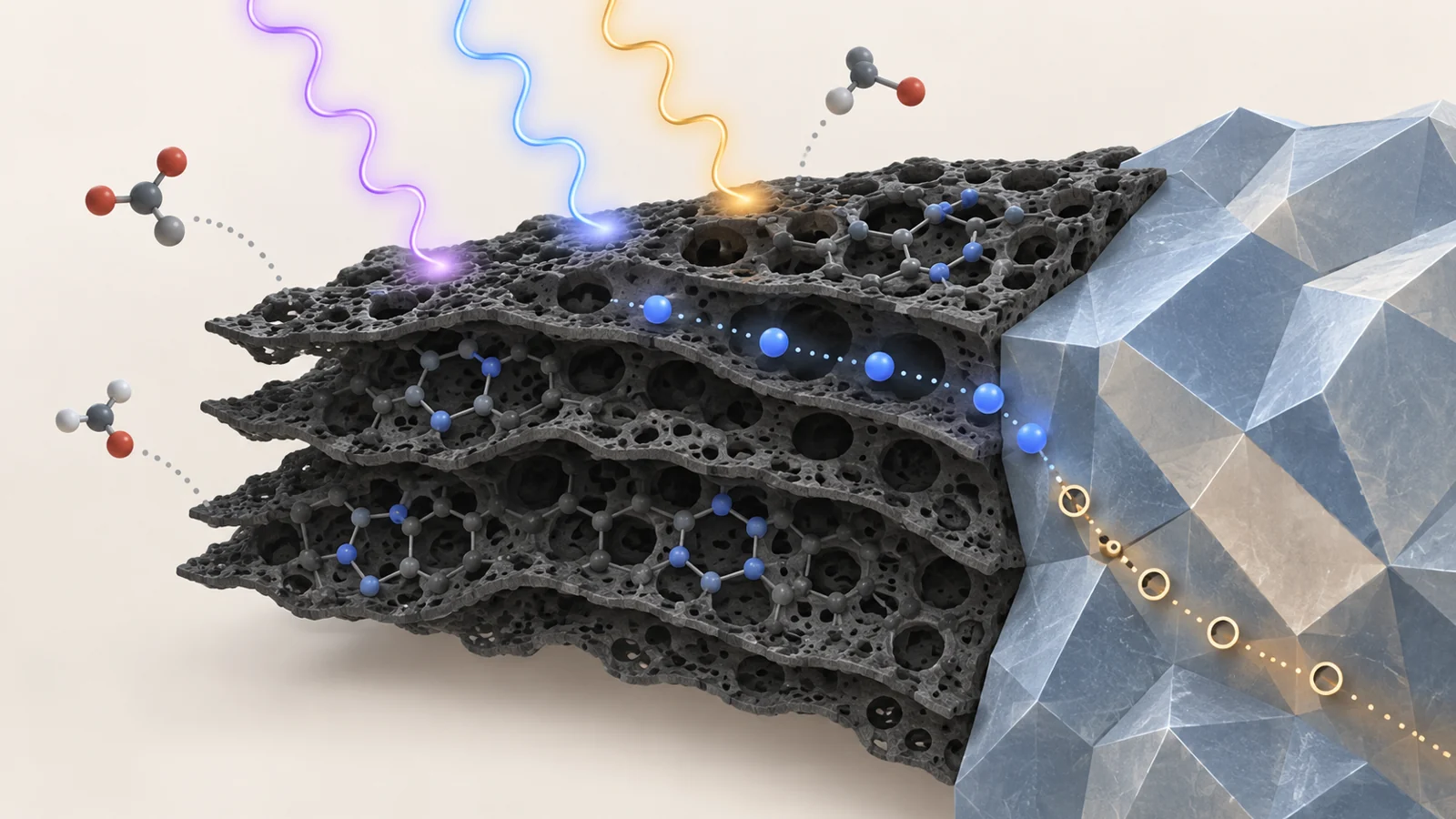
Covalent triazine frameworks, or CTFs, give researchers several ways to influence that journey. These porous, carbon-rich polymers contain nitrogen-bearing rings linked into extended structures. Their molecular ingredients, pores, and layers can be adjusted to change both their response to light and the movement of charge through them.
A June 2024 review in Heliyon brings together methods for making CTFs, strategies for modifying them, and reported applications ranging from hydrogen production to pollutant degradation. Its contribution is to connect material design with laboratory behavior across many systems. It does not experimentally validate a single new catalyst or establish a working commercial process.
The useful question is therefore quite specific. Which changes help light-generated charges reach a reaction, and what would have to hold true for that advantage to survive outside a laboratory experiment?
From absorbed light to a surface reaction
The review describes four linked stages of photocatalysis. Light must be absorbed; its energy must excite charge carriers; those carriers must separate and travel; and they must participate in reactions at the surface. Each stage can limit the eventual chemical output.
When a semiconductor absorbs light with enough energy, an electron can move into a higher-energy state. It leaves behind a positively charged vacancy called a hole. The electron and hole can support different chemical reactions, but only if they remain available long enough. If they recombine before reaching useful reaction sites, that opportunity is lost.
CTFs have electronic structures that researchers can tune through their molecular composition. The review gives a bandgap range of roughly 2.36–2.98 electron volts for representative unmodified CTFs. The bandgap is the energy threshold involved in exciting an electron. These values help explain interest in visible-light photocatalysis, although absorbing a wider range of light does not by itself guarantee that the resulting charges can drive a desired reaction.
Geometry matters after excitation, too. Charges generated deep inside tightly stacked material must reach an accessible surface. Reactant molecules must also reach the relevant sites. Pores, thin layers, and exposed interfaces can influence these journeys, while the arrangement of energy levels determines where charges can move and what chemistry they can support.
The review treats overall efficiency as the combined effectiveness of successive steps. This explains why improving one measurement, such as light absorption, may yield a disappointing change in product output when separation, transport, or surface chemistry remains a bottleneck.
The preparation method leaves a lasting imprint
Making a CTF involves choosing more than its chemical ingredients. The synthesis route helps determine crystalline order, pore structure, surface area, and optical behavior. A preparation method can strengthen one property while damaging another.
One established approach uses zinc chloride and high temperatures to assemble aromatic nitrile building blocks into triazine networks. The review describes conditions exceeding 400 °C that can produce ordered structures and high surface areas. But such heating can also partially carbonize the material, compromising the optical properties needed for photocatalysis. It consumes substantial energy and limits the choice of molecular components to those able to withstand the treatment.
Milder condensation routes offer a different balance. The review describes CTF preparation at temperatures of 120 °C or below, without strong acids, yielding colored materials that retain an optical bandgap. It also reports multigram preparation without specialized equipment. That is a useful synthesis capability, though multigram production alone does not establish economical manufacturing.
The tradeoff is consequential. A catalyst intended to use renewable light still has to be made through a workable process. High surface area, controlled structure, and favorable light response need to be considered alongside the heat, reagents, and processing required to obtain them. There is no single synthesis advantage that settles all of those questions.
Different structural changes address different obstacles
Donor–acceptor design works at the molecular level. Researchers combine units with different tendencies to donate or accept electrons, encouraging charge to move between neighboring parts of the polymer. The resulting internal electronic arrangement can help separate bound electron–hole pairs and extend the time available for charges to participate in reactions.
Doping changes the material’s composition by introducing selected atoms. The review discusses additions including phosphorus, sulfur, and boron, as well as metal-containing modifications. These can alter energy levels, surface charge, and light absorption. The identity and concentration of the added atoms matter; “doped” describes a design choice, not a uniform improvement shared by every modified CTF.
Defect engineering deliberately introduces departures from a perfectly regular structure. Carefully chosen irregularities can help charges separate, but uncontrolled defect formation makes the outcome harder to predict. The review contrasts less controllable treatments with molecular approaches that use selected building blocks and adjusted proportions to regulate the resulting structure. Here, precision matters more than simply maximizing the number of defects.
Heterostructures act at the boundary between materials. Joining a CTF to another semiconductor or catalytic component creates an interface through which charge may be directed. In one example summarized in the review, combining a CTF with carbon nitride was associated with stronger visible-light absorption and measurements indicating improved charge separation and transfer. The interface has to function electronically; placing two materials together is only the starting point.
Morphology addresses physical access and distance. Thinner sheets, designed pores, and templated structures can expose more active interfaces and shorten the paths charges must travel. The review discusses compact stacking as an obstacle in bulk CTF systems and dispersed nanosheets as a way to overcome it. This is a different intervention from changing molecular energy levels, even when both changes eventually increase reaction output.
What the laboratory examples actually demonstrate
Hydrogen evolution provides a concrete example of interface design. The review summarizes work attaching cobalt phosphide nanocrystals to CTFs through a phosphating strategy. It describes a phosphorus–carbon connection that changes electron transfer within the framework and helps deliver electrons to the attached cocatalyst, where hydrogen formation takes place.
The reported hydrogen evolution rate was 7.6 millimoles per hour per gram of catalyst. The scientific interest lies in the connection between a deliberately formed interface, changed charge movement, and measured chemical output. The example also uses a non-platinum cocatalyst. Its rate alone cannot establish the performance of a complete sunlight-to-hydrogen installation or show that the same output would persist under practical operating conditions.
Carbon-dioxide conversion illustrates a different design objective: controlling which product forms. In another study summarized by the authors, researchers incorporated defined ruthenium–nitrogen sites into a CTF. The review reports formate production at 2,090 micromoles per gram per hour, with selectivity reaching 98.5%, without an additional photosensitizer.
Selectivity concerns how strongly the reaction favors the intended product. It is distinct from production rate and from the fraction of incoming light energy converted into chemical energy. This example therefore adds something beyond another fast reaction: it connects the local catalytic site to the direction of the chemistry. It also shows why a carbon-rich framework should not automatically be described as a metal-free working catalyst once additional components are incorporated.
These numbers are study-specific observations summarized by the review. Expressing output per gram does not make different experiments interchangeable. Light conditions, reaction mixtures, catalyst composition, and measurement duration all matter when interpreting performance. Hydrogen and formate production also answer different chemical questions, so their numerical rates cannot serve as a common ranking.
The broader application range includes hydrogen peroxide production, organic pollutant degradation, and nitrogen fixation. Together, these examples show the variety of reactions being investigated. They do not establish that one CTF recipe can perform all of them effectively.
The difficult step is making the behavior reproducible
A central unresolved issue is the relationship between structure and activity. If a preparation changes crystallinity, porosity, defects, and interfaces at once, it becomes difficult to identify which feature caused a measured improvement. The review identifies stable, well-ordered, precisely defined CTFs as an ongoing challenge. Better control would make it easier to reproduce a result and carry the useful feature into another material.
Light response also remains incomplete. The authors highlight limited exploitation of visible and near-infrared light. Extending absorption must be coordinated with suitable electronic energy levels, effective separation, and usable reaction sites. Otherwise, an optical improvement may fail to translate into additional chemistry.
The move toward application also requires durability and manufacture to be considered together. A structure must retain its useful behavior, be prepared consistently, and function under conditions relevant to its intended use. The review calls for environmentally friendlier, simpler synthesis and better control of morphology and porosity. Those requirements help define the distance between an encouraging catalyst experiment and a dependable process.
What this could change
If researchers can reproducibly control CTF structures and interfaces while improving durability and preparation methods, these materials could offer more selective ways to use sunlight for chemical production. Directing charges toward chosen catalytic sites could help favor a desired carbon-dioxide conversion product; maintaining accessible surfaces could support sustained hydrogen production or pollutant treatment.
The same combination of controllable electronic behavior and adaptable physical form could eventually support integrated photoelectrochemical or energy-storage systems, possibilities raised by the review. The potential payoff is the ability to design where absorbed solar energy goes and which reaction it supports. Reaching that capability depends on molecular control surviving the demands of stable materials, repeatable manufacture, and realistic operation.
Key Sources
- Primary source: Efficient integration of covalent triazine frameworks (CTFs) for augmented photocatalytic efficacy: A review of synthesis, strategies, and applications.
DOI or Journal Page · Review or Meta-Analysis · 2024-06-01
Keep exploring