
Research Signal – Source date 2026-06-01
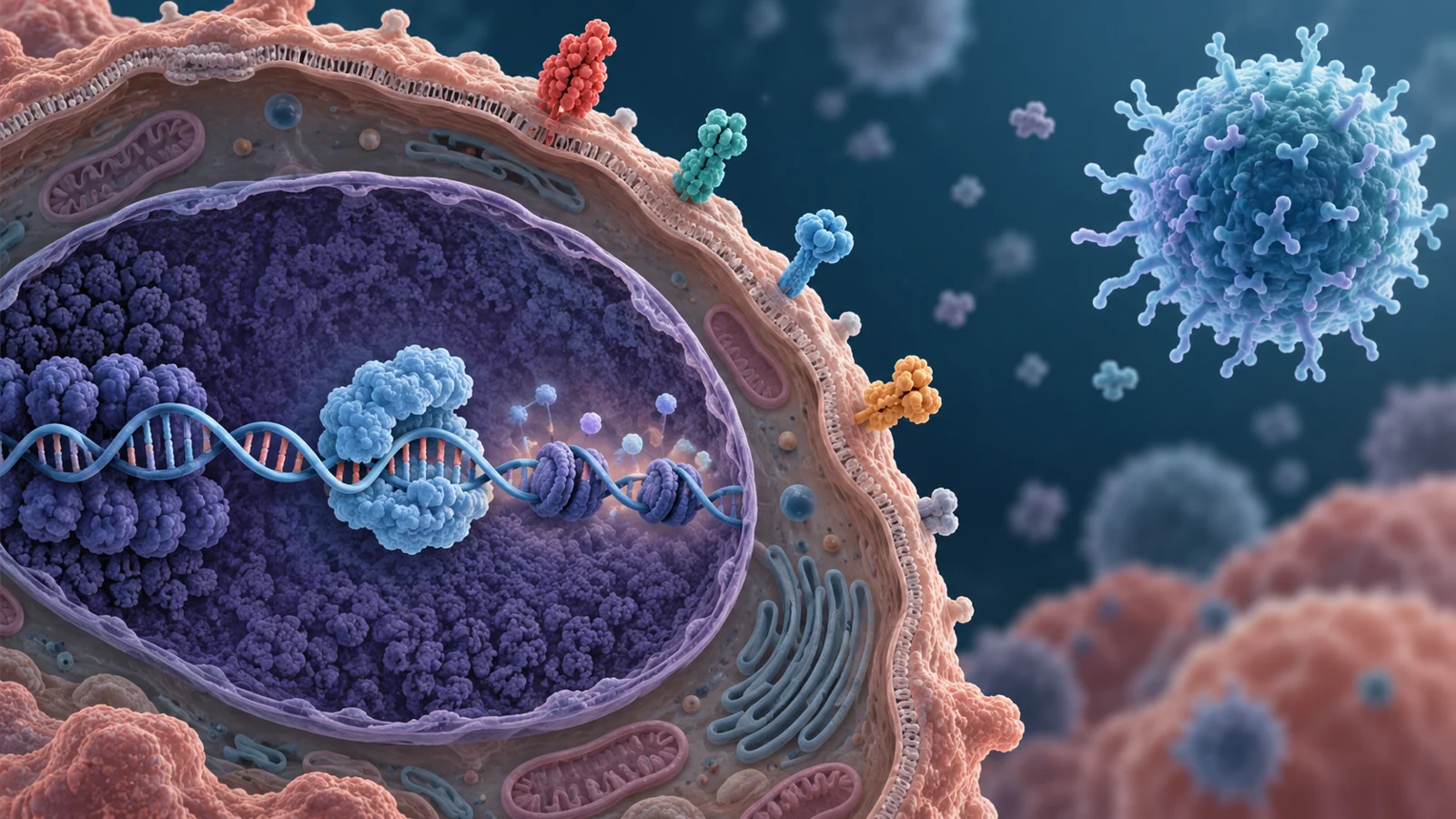
Could activating immune-related genes in a cancer cell make it easier for immune cells to recognize it? A review published June 1, 2026, surveys research from 2015 through 2025 on CRISPR-dCas9 tools designed to change gene activity without changing the DNA sequence. Among the approaches it describes, some aim to raise tumor-cell signals involved in immune recognition.
The idea is to adjust how a cell uses existing genes, rather than edit the sequence itself. That makes these tools a way to investigate whether changing a tumor’s molecular signals could influence how it is seen by the immune system. The review describes preclinical strategies; it does not establish that they improve outcomes for patients.
A gene-control tool that does not cut DNA
CRISPR-dCas9 uses a catalytically dead form of Cas9. “Dead” here means that the Cas9 component does not cut DNA. Instead, the system can be directed to a chosen genetic location and used to modulate gene expression there.
Epigenetic editing refers to changing how active a gene is through modifications that affect gene regulation, without changing the underlying DNA sequence. In this review, the focus is on using dCas9 as a targeting platform for that kind of control. The intended result may be to increase or decrease gene activity at a selected location.
For cancer research, this offers a way to test whether adjusting gene regulation can alter traits relevant to tumor growth or immune recognition. It is a different kind of intervention from rewriting the sequence: the target is gene activity. The practical effect depends on which location is targeted and what regulatory changes are recruited there.
Two ways to steer gene activity
The review describes combinatorial reprogramming and enhancer targeting as distinct approaches. Combinatorial reprogramming brings multiple chromatin modifiers to one locus. The goal is to combine regulatory effects at that location. Platforms named in the review include SunTag-like arrays, SSSavi modular docking, and CRISPRoff memory writers. These examples show different ways researchers are designing systems to recruit or organize multiple effectors; the supplied evidence does not rank them by effectiveness or safety.
Enhancer targeting focuses on a different kind of control point. An enhancer is a regulatory element that can affect gene activity from a distance. Systems such as enCRISPRa and enCRISPRi are described as ways to activate or silence these distal elements in cancer cells. Here the chosen control point is a distal regulatory element that can influence gene activity elsewhere.
The choice of target matters because cancer-related gene regulation is context-dependent. A method that changes activity at a selected locus or enhancer still needs to produce the intended effect in the cells and biological setting that matter. The review identifies context-dependence and off-target effects among the gaps that need attention before clinical translation.
Raising signals involved in immune recognition
Some of the reviewed approaches aim to make tumor cells display more immune-related signals. The review describes dCas9 activators used to raise MICA and MICB, ligands associated with natural killer (NK) and T cells, as well as genes involved in antigen presentation, including MHC I and MHC II.
The proposed purpose is to make tumor cells more recognizable to immune cells. In this research, the target is the tumor cell’s gene activity: an activator is used to increase expression of selected immune-related genes. The review presents these strategies as preclinical approaches. It does not show that changing these signals leads to better cancer treatment outcomes in people.
This distinction matters when interpreting the promise. Raising a signal associated with immune recognition is a research aim, not proof that immune cells will respond in a useful way across cancers. The review brings together approaches that investigate this possibility, while the supplied evidence does not identify a comparative winner or establish patient benefit.
Reaching the intended cells remains a hurdle
A precise control system can only be useful in an organism if it reaches the right cells. The review surveys next-generation delivery systems for dCas9-based tools as part of the path toward in vivo use. Delivery is therefore connected to the central design problem: the system must reach relevant tumor or immune cells so its gene-control effects can be studied in the intended setting.
The available summary does not establish that a particular delivery approach is ready for clinical use. Nor does it support a claim that delivery has been solved across different cancers. Reaching the intended cells, limiting unwanted effects, and confirming that the resulting changes are useful and safe remain part of the work needed before these strategies could be translated into treatment.
What this review can tell us
The paper synthesizes peer-reviewed literature published from 2015 through 2025. Its June 2026 publication date is not a later research cutoff: the review’s stated literature scope ends in 2025. It offers a view of the approaches under investigation, including combined chromatin-modifier recruitment, enhancer control, immune-related gene activation, and delivery research.
That scope supports a description of the field’s research directions and the gaps the review identifies. The supplied summary provides no comparative effect sizes or patient outcomes, so it cannot establish which platform works best, how much benefit a patient might receive, or whether any approach is ready to use as a cancer treatment. Those limits leave the ideas promising as research questions, rather than established clinical options.
How changing tumor signals might help cancer immunotherapy
If researchers can deliver these gene-control tools effectively and show that the resulting immune changes are useful and safe in relevant cancers, targeted control of existing tumor-cell genes might one day help immune-based treatments make tumors more recognizable. That could give cancer immunotherapy another way to influence the signals a tumor presents. The path to that capability depends on delivery and evidence in the cancers where it might be used.
Key Sources
- Primary source: CRISPR-dCas9 epigenetic reprogramming in cancer: platforms, immuno-modulation and delivery challenges.
DOI or Journal Page · Review or Meta-Analysis · 2026-06-01
Keep exploring