
Research Signal – Source date 2021-07-30
An experiment published July 30, 2021, produced an unexpected split. In rats housed at 4,500 feet, dietary creatine improved some depression-related behaviors in females. Adding the antidepressant fluoxetine removed the reduction in forced-swim immobility. In males, the combination improved a key behavioral measure even though neither treatment alone did.
The researchers were investigating whether replenishing a resource involved in brain energy could help under reduced oxygen availability. Their results make that possibility more interesting—and its explanation more complicated. The chemistry measurements offer clues, but they do not explain why adding the drug changed the behavioral outcome.
Why investigate brain energy at altitude?
Creatine participates in a system that helps cells keep energy available when demand changes. Cells convert creatine into phosphocreatine, which can donate a phosphate group to rapidly replenish ATP, the molecule that powers much cellular work. This reserve helps buffer energy demand while slower energy-producing processes continue.
That function gave researchers a reason to study creatine at altitude. Lower air pressure reduces oxygen availability, potentially putting pressure on brain metabolism. The paper describes earlier observations of lower brain creatine in people living at moderate altitude and in some research on major depression. These findings motivated the experiment; they do not establish that altitude causes depression or that a creatine shortage explains it.
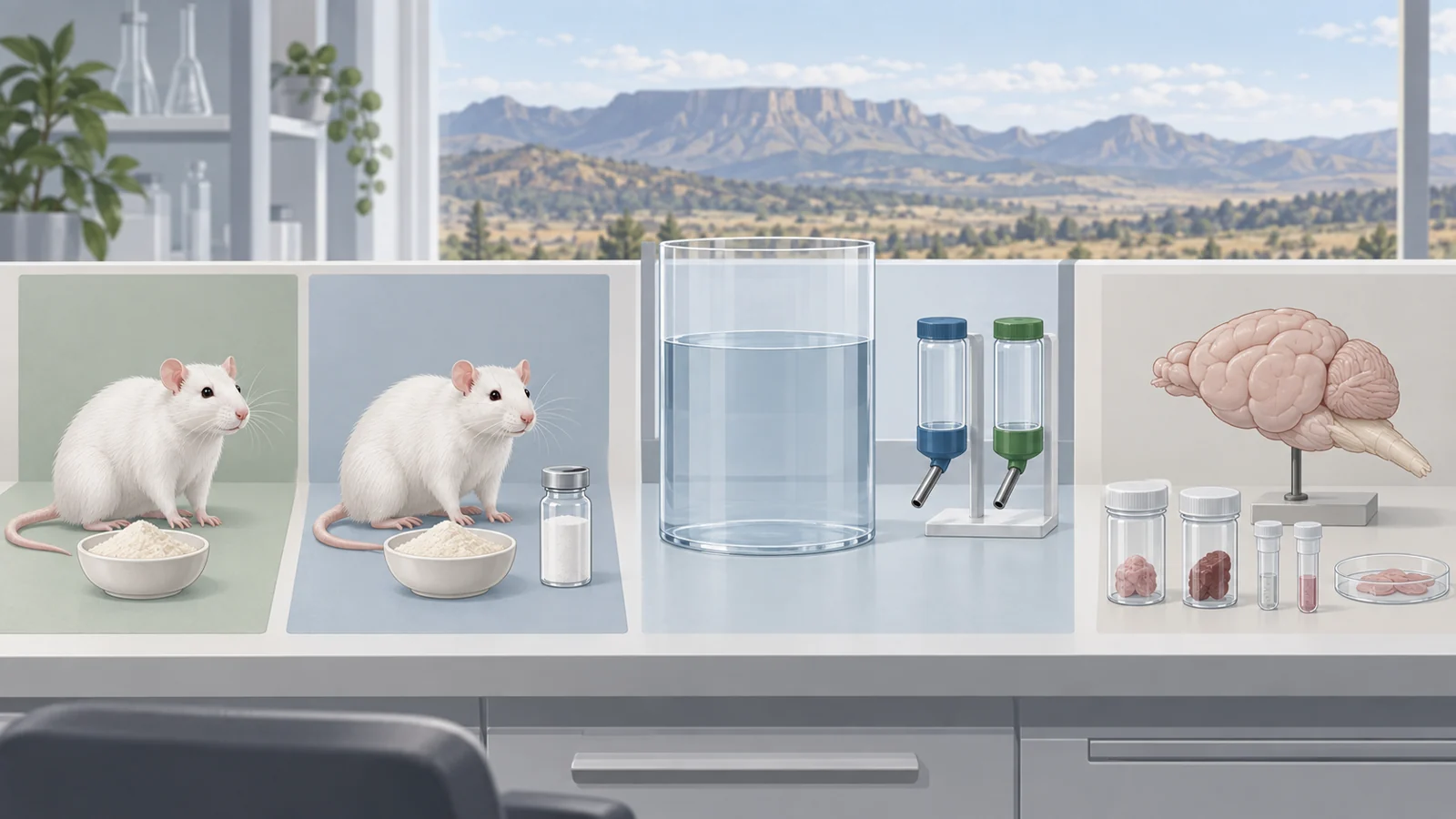
The study used male and female Sprague Dawley rats housed at 4,500 feet, roughly 1,370 meters. Three linked experiments examined different parts of the question. One followed brain creatine over time at altitude. Another tested five weeks of creatine monohydrate mixed into food at 4% by weight, compared with ordinary food, measuring behavior and brain chemistry. A further experiment tested supplementation with fluoxetine. Separate animals were used for the locomotor assessment and the drug-combination work.
The time-course experiment found declining creatine in sampled brain regions as altitude exposure continued. Its baseline was already one week at altitude, after acclimatization. It therefore describes changes during continued exposure, rather than a direct comparison with an unexposed starting point. The dietary percentage and five-week duration define the animal experiment; they supply no human dosing guidance.
What the behavioral tests actually measured
The forced swim test records how rats behave in water, including swimming, climbing and time spent largely immobile. Researchers use these measures to examine depression-like behavior and responses to antidepressant drugs. Immobility is an observed behavior, however, and cannot reveal whether an animal experiences the symptoms that define depression in a person.
In females given creatine alone, swimming increased, immobility fell by more than 20%, and the time before becoming immobile increased relative to food controls. A separate sucrose preference test also found a greater preference for sweetened water. That test provides a reward-related readout, used to investigate behavior associated with anhedonia—the loss of interest or pleasure. Agreement between two different tests made the female result more informative than a change in swimming alone.
Males receiving creatine showed no significant improvement in immobility or sucrose preference. This does not mean every measured behavior stayed the same: male swimming decreased. An open-field test detected no change in motor behavior with supplementation in either sex. That reduces concern that the female findings simply reflected a general increase in movement, although it does not turn either test into a diagnosis of depression.
Adding fluoxetine changed the comparison
Fluoxetine belongs to the selective serotonin reuptake inhibitor, or SSRI, class of antidepressants. In this altitude model, the tested dose of 20 milligrams per kilogram did not significantly reduce forced-swim immobility by itself in either sex. The combination experiment compared four groups, allowing the researchers to ask whether prior creatine supplementation altered the drug’s effect.
The table summarizes forced-swim immobility, with each treatment compared with the ordinary-food control unless otherwise stated.
Treatment Female rats Male rats Ordinary food Reference group Reference group Creatine alone Reduced immobility No significant reduction Fluoxetine alone No significant reduction No significant reduction Creatine plus fluoxetine No significant reduction; more immobility than with creatine alone Reduced immobility compared with all three other groups
The combination thus did something in males that neither component achieved separately. It also increased swimming compared with controls and creatine alone. But the improvement was not uniform across every endpoint. A finding for delayed immobility did not survive the adjustment used when making multiple comparisons, so it should not be counted as an equally secure result.
In females, adding fluoxetine erased the immobility benefit associated with creatine alone. Combined treatment also shortened the time before immobility relative to creatine alone, leaving those measures statistically indistinguishable from controls. The experiment therefore gives no basis for assuming that an intervention helpful on its own will retain that benefit when paired with an antidepressant. It also does not establish that this combination harms women or is clinically contraindicated.
Brain chemistry offered clues and an important exception
Supplementation reached the brain unevenly. Female creatine concentrations increased in all four sampled areas—the prefrontal cortex, striatum, hippocampus and brainstem—compared with food controls. Those concentrations were no longer significantly different from the one-week altitude baseline. In males, increases with creatine alone were detected in the striatum and hippocampus, while deficits persisted in the other two sampled regions.
Serotonin, a chemical involved in communication between nerve cells, followed a different pattern. Creatine alone increased it in the female prefrontal cortex and striatum, but reduced it in the male striatum and hippocampus. Adding fluoxetine in males raised striatal creatine and serotonin relative to creatine alone, alongside the reduction in immobility. This made the striatum a plausible place to investigate how the treatments interact.
The female combination result prevents a simple explanation based on higher chemical concentrations. Serotonin remained elevated relative to controls in some regions, with no significant differences from creatine alone in any sampled region. Yet the behavioral benefit disappeared. Improved biochemical measurements could therefore coexist with an absence of improvement in the forced swim test.
These were measurements of concentrations in brain tissue. Higher creatine does not itself demonstrate restored ATP production, and tissue serotonin does not directly reveal how effectively nerve cells are signaling. The study also did not experimentally isolate a pathway showing that either chemical change caused the behavior. Its findings connect treatment, regional chemistry and behavior while leaving the steps between them unresolved. The authors suggest examining other chemical systems, including dopamine and norepinephrine, but those possibilities remain explanations to test.
How far the model can take the result
Reported animal group sizes ranged from 8 to 20, and the researchers tested one dietary creatine concentration and one fluoxetine dose. Other amounts or treatment schedules could produce different interactions. Female reproductive cycles were not staged, so the study cannot determine whether cycle phase contributed to the responses. Nor can it establish a hormonal explanation for the differences between sexes. Sampling four brain regions also leaves open whether creatine’s effects were localized or more widespread.
The altitude model has an additional complication. In earlier experiments described by the authors, male increases in depression-like behavior after shorter altitude exposure were transient; with longer exposure, those behaviors no longer differed from sea-level animals. Brain creatine deficits persisted. The male combination result therefore should not be described as straightforwardly reversing a stable altitude-induced depressive state.
Similarly, “treatment-resistant depression” in this paper refers to an animal model in which antidepressants fail to produce expected responses in behavioral tests. It does not reproduce the full clinical history or range of causes behind depression that responds poorly to treatment in people. This experiment provides no human outcomes, no clinical safety assessment of the combination and no evidence that benefits persist after treatment stops.
The discussion places the work alongside earlier clinical studies of creatine added to SSRIs in adult and adolescent female patients. The authors report encouraging results from that literature, which helps explain their interest in clinical translation. Those are background accounts of separate studies, not patient evidence generated by this rat experiment or independently assessed here. They also underscore why the female rat combination result cannot serve as a treatment rule for women.
What this could change
If the metabolic rationale translates to people, and controlled human studies establish effective, tolerable regimens, supporting brain energy buffering could offer an additional route to symptom relief for some people whose depression responds poorly to SSRIs. Altitude-related research settings provide a specific place to investigate that possibility because reduced oxygen availability is part of the experimental rationale.
Two clinical possibilities would require separate validation. Creatine might improve the response to an existing antidepressant, or it might eventually have a role as a treatment on its own. Success in either case would mean improved symptoms and daily functioning in patients, beyond changes in brain chemistry. This 2021 experiment gives researchers a concrete reason to explore both possibilities while showing why evidence for one cannot substitute for evidence for the other.
Key Sources
- Primary source: Sex-Based Impact of Creatine Supplementation on Depressive Symptoms, Brain Serotonin and SSRI Efficacy in an Animal Model of Treatment-Resistant Depression.
DOI or Journal Page · Peer-Reviewed Paper · 2021-07-30
Keep exploring