
Research Signal – Source date 2024-10-16
Antidepressants can take time to help, and some people continue to have symptoms despite treatment. That creates a practical research question: could adding creatine, a compound involved in replenishing cellular energy, help an antidepressant work sooner or produce greater relief?
A narrative review published on October 16, 2024, brings together the biological rationale and early clinical findings. Its clearest example compares creatine plus an antidepressant with placebo plus the same antidepressant. That directly tests an added contribution within a particular treatment setting. How far the result extends to other patients is a separate question, especially because the review also describes an unsuccessful treatment setting and safety concerns in bipolar depression.
The paper’s contribution is its synthesis of earlier research. It brings animal experiments, observations of brain chemistry, and small human studies into one discussion; it does not report a new randomized treatment experiment. Read from its October 2024 perspective, it helps explain why brain energy has attracted interest—and which clinical distinctions matter when interpreting that interest.
How creatine helps cells meet energy demand
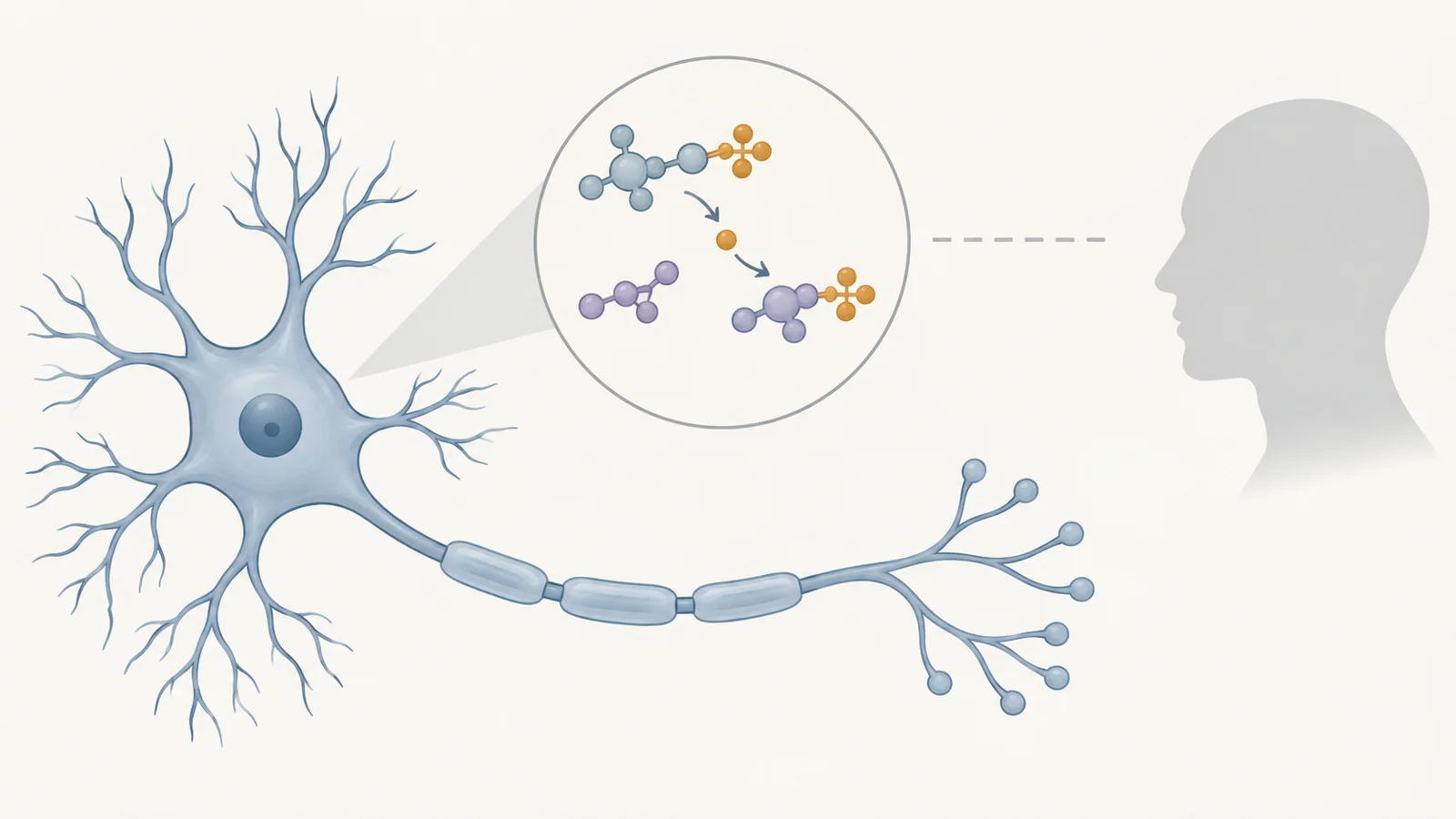
Brain cells need a continuing supply of usable energy to maintain their electrical activity and communicate. ATP, short for adenosine triphosphate, is a molecule cells use to transfer that energy. As ATP is used, it needs to be replenished.
Creatine participates in a system that helps with this rapid recycling. Its phosphate-bearing form, phosphocreatine, can transfer a phosphate group to help regenerate ATP. This provides a buffer between energy supply and immediate demand. The relevant idea is therefore more specific than simply giving the brain “more energy”: creatine helps cells maintain access to energy as their needs change.
The review connects this function with research linking depression to disturbances in energy metabolism, including mitochondrial function. Mitochondria help cells produce ATP. If energy handling contributes to symptoms in some people, supporting that system could offer a route to improving treatment response. This is a proposed biological explanation, not an account of why every person develops depression.
One observation gives that idea a measurable connection to human symptoms. The review describes brain spectroscopy research in adolescent females with depression resistant to selective serotonin reuptake inhibitors, or SSRIs. Higher frontal-lobe phosphocreatine levels were associated with lower depression scores. The measurement links an energy-related compound with symptom severity, but it cannot establish that increasing the compound caused the improvement.
Animal findings provide another kind of evidence. Creatine reduced immobility in a forced-swim test in female rodents, according to the review. Such behavior can help researchers investigate possible antidepressant effects. It does not reproduce the full experience of human depression or determine how well an add-on treatment will work in patients. The clinical comparison carries that question further.
What adding creatine actually tested
The most concrete trial described in the review involved 52 women with unipolar depression over eight weeks. Participants received escitalopram, an SSRI antidepressant, with either creatine monohydrate or placebo. The creatine regimen was 5 grams daily—a feature of the experiment, rather than an established depression-treatment protocol.
Because both groups received escitalopram, improvement in the creatine group alone would not answer the research question. Symptoms might also improve with the antidepressant and the broader circumstances of treatment. The placebo group provides the comparison needed to examine whether adding creatine produced a further effect.
The review reports that Hamilton Depression Rating Scale scores decreased by 79.7% in the creatine group and 62.5% in the placebo group. These figures describe reductions in symptom-scale scores. They are not the percentages of participants who recovered, and they do not mean that roughly eight in ten people would benefit from taking creatine.
Timing also mattered. In its account of the same study, the review describes an earlier antidepressant response in the creatine group, detectable as early as week two. Earlier improvement and greater improvement by the end of treatment are related but distinct possibilities. A treatment could affect one without necessarily affecting the other.
This comparison gives the research a defined clinical meaning: the reported advantage occurred when creatine was added to escitalopram in the women studied. It does not isolate creatine’s effectiveness when taken alone. Nor does a result in 52 women determine whether men, adolescents, or people receiving different antidepressants would experience the same added benefit.
When previous treatment has not helped
The review’s clinical account also includes women whose depression had not responded to several antidepressant classes, including SSRIs. It reports that creatine supplementation did not help in that setting.
This exception matters because adding something during antidepressant treatment and rescuing treatment after repeated nonresponse are different clinical problems. A favorable result in one combination cannot establish a reliable option for people whose symptoms have persisted through other treatments.
The reason for the differing outcomes remains unresolved here. The review brings together studies with different populations and protocols, so the contrast cannot identify a single explanation. Previous treatment response, the accompanying medication, and the characteristics of the participants are distinctions researchers need to disentangle. They should not be turned into a formula for predicting who will benefit.
Why diagnosis changes the safety question
Bipolar depression needs separate consideration from unipolar depression. Bipolar illness can include episodes of mania, so assessing a treatment involves more than checking whether depressive symptoms decrease. A shift toward mania is a clinically consequential outcome in its own right.
The review describes manic episodes in some bipolar participants receiving creatine, including people taking mood stabilizers. It explicitly acknowledges that these events do not establish creatine as the cause. Their occurrence nevertheless makes mood switching a safety question that cannot be answered by a favorable trial in women with unipolar depression. The authors’ suggestion that altered energy metabolism could be involved remains a hypothesis.
Kidney-related concerns are different. The paper calls for particular attention to impaired renal function and medications that may affect it. This identifies circumstances in which monitoring matters; it does not demonstrate that creatine generally causes kidney injury. Likewise, tolerability in a small, short study cannot resolve safety for someone with an existing kidney disorder.
The review also lists more common complaints, including gastrointestinal discomfort, water retention, headache, nausea, and sleep difficulties. These belong in an assessment of how manageable a treatment is, while possible mania and renal vulnerability raise different questions about who can be studied or treated safely. Combining them under a single claim that a supplement is “well tolerated” would obscure those differences.
What short trials leave unresolved
An eight-week symptom result cannot establish whether relief persists over many months, whether relapse becomes less likely, or how long supplementation would need to continue. Those are consequential questions for depression, where the value of treatment extends beyond an early change in a rating scale.
The review identifies a limited number of randomized trials, small samples, and heterogeneous study designs. It also highlights unresolved dose-response questions. The amount taken, the duration of treatment, and the degree to which brain creatine changes cannot yet be assembled into a well-established clinical protocol. A regimen used in one experiment is evidence about that experiment, not a general instruction for readers.
The same distinction applies to creatine used alone. A randomized add-on comparison can assess whether creatine contributes something alongside an antidepressant. Establishing it as a standalone treatment requires evidence that addresses that use directly. The findings discussed here do not establish that creatine can replace antidepressant treatment or psychotherapy.
Larger and more diverse studies would also help distinguish a repeatable treatment effect from findings tied to a narrow patient group. Measuring brain chemistry alongside symptoms could test whether energy-related changes help explain the response, rather than assuming that a plausible mechanism has already been demonstrated in people.
What this could change
If further trials confirm an added benefit that lasts, and identify the patients and treatment combinations for which it is safe, creatine could give clinicians another way to help some people obtain earlier or greater relief while continuing antidepressant treatment. Earlier relief could mean less time struggling with symptoms that disrupt work, relationships, and everyday routines. Greater sustained relief could help people whose existing treatment leaves a substantial burden behind.
That possibility gives the energy-metabolism research a concrete purpose. Connecting a reproducible clinical benefit with suitable patients could turn a biochemical rationale into a more useful treatment choice. From the October 2024 perspective, the downstream opportunity is an additional way to improve patients’ response to care, conditional on durable results and safety that hold up beyond the initial studies.
Key Sources
- Primary source: Creatine Supplementation in Depression: A Review of Mechanisms, Efficacy, Clinical Outcomes, and Future Directions.
DOI or Journal Page · Review or Meta-Analysis · 2024-10-16
Keep exploring