
Research Signal – Source date 2024-12-29
Creatine is familiar as a supplement for strength and short bursts of intense exercise. Its role in helping cells replenish usable energy also makes it an appealing candidate for broader uses. But should someone eating a vegan diet, a woman experiencing fatigue, and a person with a neurological condition expect the same kind of benefit?
A narrative review published in Nutrients on December 29, 2024, brings these questions together. It interprets existing research across populations and creatine formulations rather than reporting a newly tested treatment. Its detailed findings draw a sharper distinction than its broad promise might suggest. Increasing creatine inside muscle, improving a memory test, and slowing a disease are different achievements. The evidence for one cannot stand in for the others.
How muscle stores shape the response
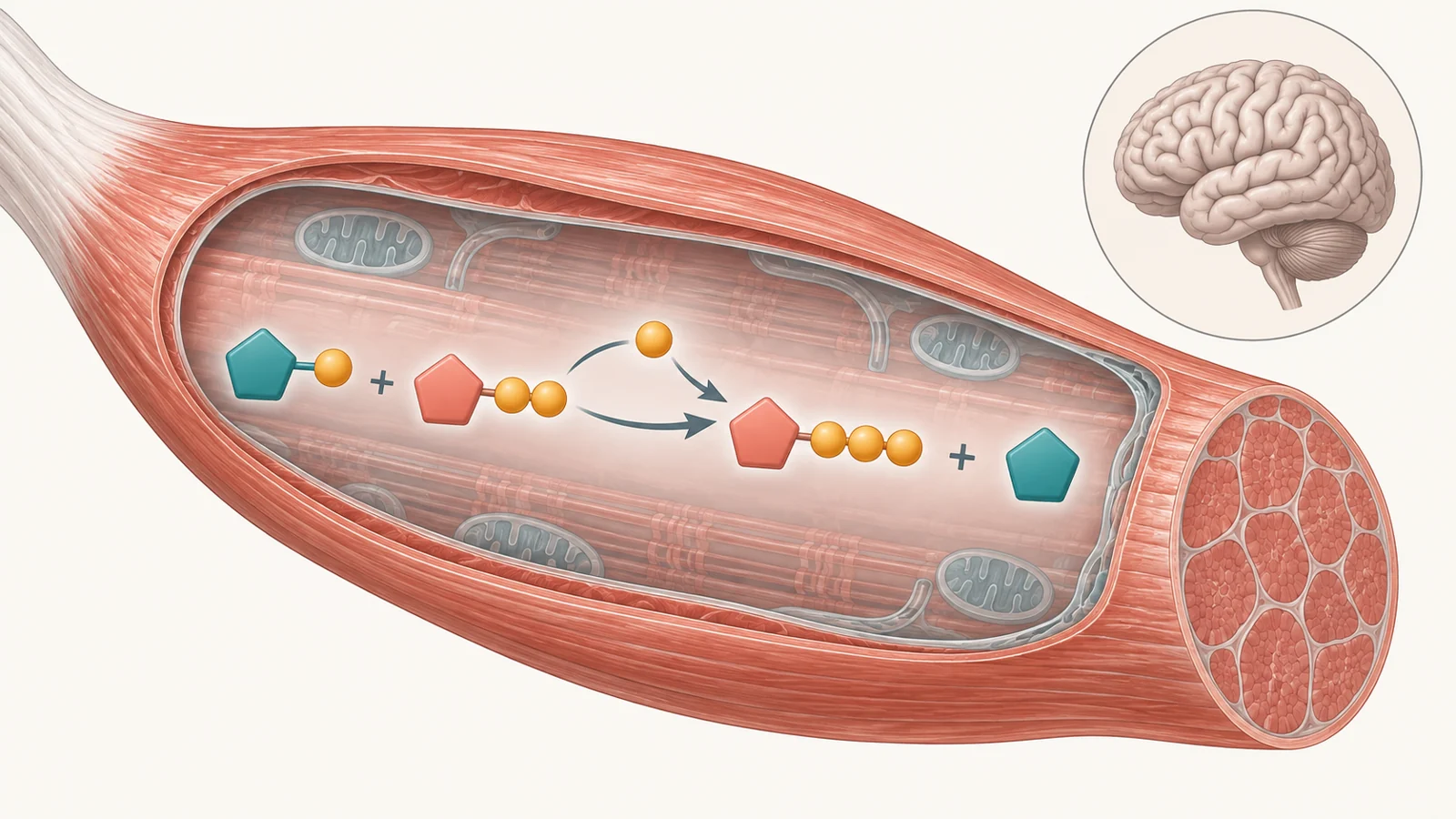
Creatine participates in a rapid energy-recycling system. Cells use ATP as an immediately available energy source; after ATP gives up a phosphate group, it becomes ADP. Phosphocreatine, a form of creatine carrying a phosphate reserve, can donate that phosphate to turn ADP back into ATP. This helps muscle meet a sudden surge in demand during an intense contraction.
About 95% of the body’s creatine is stored in skeletal muscle, according to the review. Roughly 60% of that muscle pool is phosphocreatine. Supplementation can enlarge these stores, giving the system more material to draw on. This explains why the muscle response is central to creatine research. Although the brain also uses the creatine system, a measurement taken in muscle does not reveal how much creatine is in the brain or whether memory will improve.
Diet provides a useful example of how starting conditions matter. Meat and fish supply creatine, while plant foods contain negligible amounts. The body also makes creatine from amino acids. People following vegetarian or vegan diets can therefore have lower muscle stores without that observation, by itself, establishing a clinical deficiency. Lower dietary intake and an inability to meet the body’s needs are different claims.
The review describes research in which vegetarian participants had a larger increase in muscle phosphocreatine after supplementation than omnivorous participants. A lower starting level can leave more room for stores to rise. But other studies summarized by the authors did not find a superior response in vegetarians. Even a larger biochemical increase does not automatically mean a larger gain in strength or exercise performance.
The dietary section also reports no observed difference in brain creatine in cited comparisons between vegetarians and omnivores. That detail matters when claims shift from physical performance to cognition. Lower muscle stores cannot be used to diagnose a shortage in the brain, and dietary identity alone cannot predict a memory benefit.
What the findings in women actually measured
The women’s section illustrates how much can change when a broad benefit is traced back to its measured outcome. The authors discuss menstrual changes in energy metabolism and report reduced fatigue after a sprint test during the luteal phase. They also report no significant change during the follicular phase in that finding.
Fatigue after a sprint is a specific response to intense exercise. It does not establish relief from the tiredness someone experiences during daily life around menstruation. The distinction is especially relevant because the abstract describes menstrual fatigue benefits more broadly than this detailed example supports. The authors themselves say the menstrual cycle’s effects on creatine efficacy remain incompletely understood and do not find a basis for adjusting supplementation timing or dose across cycle phases.
The menopause discussion asks a different question, concerning bone health. Here, the authors describe potential benefits as dependent on accompanying physical exercise; they report no improvement in bone health from creatine alone in the research they discuss. Exercise is therefore part of the context in which the result occurred. Removing it changes the claim. The useful interpretation concerns a possible contribution within an exercise program, rather than an expectation that taking the supplement alone will reproduce that outcome.
Do different forms offer a better result?
The review’s clearest formulation conclusion favors creatine monohydrate, the form used in most of the research. The authors point to its ability to raise tissue creatine, its safety record under studied conditions, and its generally lower cost than alternatives such as creatine hydrochloride or creatine ethyl ester. Evidence about monohydrate should remain attached to that formulation when discussing what a product can deliver.
Alternative forms have plausible design goals. Creatine magnesium chelate, for example, pairs creatine with magnesium, which participates in the relevant energy chemistry. That combination is intended to improve properties such as stability, absorption, or effectiveness. Yet a biochemical rationale or a change in absorption does not establish better strength, memory, or health outcomes than monohydrate. The authors do not establish an alternative as preferable.
The same distinction applies to blends containing creatine alongside vitamins, caffeine, carbohydrates, or herbal ingredients. The review does not establish a consistent advantage for these mixtures. Adding ingredients also changes the preparation being evaluated, so the findings for creatine alone cannot simply be assigned to the whole blend. For a reader comparing claims, the meaningful question is whether the particular formulation improved the relevant outcome in a direct comparison.
A better test result can coexist with an unchanged disease
The clinical discussion contains encouraging muscle findings alongside important neurological counterexamples. In some muscular dystrophies, the review describes increases in low creatine stores and improvements in muscle strength after supplementation. These findings connect the proposed energy mechanism to a physical function. Their application still depends on the particular muscle disorder and on establishing longer-term efficacy and safety in that population.
Cognitive findings are more mixed. The authors summarize improvements in measures such as memory, attention, and mental fatigue, including under demanding conditions. They also describe a six-week study that found no cognitive improvement over placebo at either of two tested doses. These results concern particular tests, participants, and study conditions. Taken together, they do not provide a reliable prediction that an individual’s everyday memory will improve.
Huntington’s disease offers an especially revealing comparison between kinds of outcome. The review describes a 16-week study in which creatine reduced a marker of oxidative DNA damage. A marker can reveal that a biological process has changed, but it cannot alone establish that people retain their abilities longer. Other studies discussed by the authors found no change in disease progression.
For Parkinson’s disease, the authors likewise describe an encouraging treatment-related observation alongside long-term studies that found no clinical benefit on validated measures of progression. Those findings prevent the energy mechanism from becoming a claim that creatine slows neurodegeneration. A plausible route through cell metabolism can remain scientifically interesting even when the clinical result people most need has not improved.
This is where the difference between athletic and therapeutic claims becomes consequential. Producing more force in a muscle test, changing a laboratory marker, and preserving function over the course of an illness answer different questions. The review brings them into the same discussion, but it does not make them interchangeable evidence of treatment benefit.
Why weight and kidney tests need context
Two familiar measurements can be misleading if they are treated as direct readouts of success or harm. The review describes rapid body-mass increases of about 1–3 kilograms, roughly 2–7 pounds, during short periods of creatine use lasting five to seven days. Water retention helps explain that early change, particularly during loading. A higher number on the scale over several days cannot be counted as an equivalent gain in newly built muscle or strength.
The authors also distinguish sustained daily intake from protocols that begin with larger loading amounts. Their discussion indicates that an initial high-dose phase is unnecessary for increasing stores over time and can bring gastrointestinal discomfort. These are observations about supplementation protocols, not a basis for selecting a personal regimen or extending a sports protocol to someone with a clinical condition.
Kidney interpretation involves a similar need to understand what a measurement represents. Creatinine is a breakdown product of creatine and is used in assessing kidney function. Supplementation can raise creatinine through increased creatine turnover, so a rise does not automatically mean kidney injury. Conversely, knowing that supplementation can affect the result does not establish that any particular abnormal reading is harmless.
The review’s renal reassurance primarily concerns people with normal kidney function, including healthy athletes. It cannot be transferred unchanged to people with pre-existing kidney disease or every other clinical population. The relevant distinction is between a supplement-related change in a marker and evidence about actual kidney function in the person or population being studied.
What this could change
If the reported strength benefits in particular muscle disorders prove durable and translate into everyday movement, creatine could become a useful addition to care aimed at preserving physical capability. The causal path would run from improved muscle energy availability to stronger contractions, then to tasks such as rising from a chair or managing stairs. Those daily-life benefits are a conditional downstream possibility, not outcomes established by the examples discussed here.
For people with lower muscle stores who are physically active, a dependable performance benefit could also help support continued participation in exercise while maintaining a plant-based diet. Because monohydrate is generally less costly than alternative formulations, establishing who gains a meaningful functional benefit could make such support comparatively accessible. The public value would lie in helping people do something that matters to them, with a preparation whose effect has been demonstrated for that purpose.
Key Sources
- Primary source: Creatine Supplementation Beyond Athletics: Benefits of Different Types of Creatine for Women, Vegans, and Clinical Populations-A Narrative Review.
DOI or Journal Page · Review or Meta-Analysis · 2024-12-29
Keep exploring