
Research Signal – Source date 2026-03-12
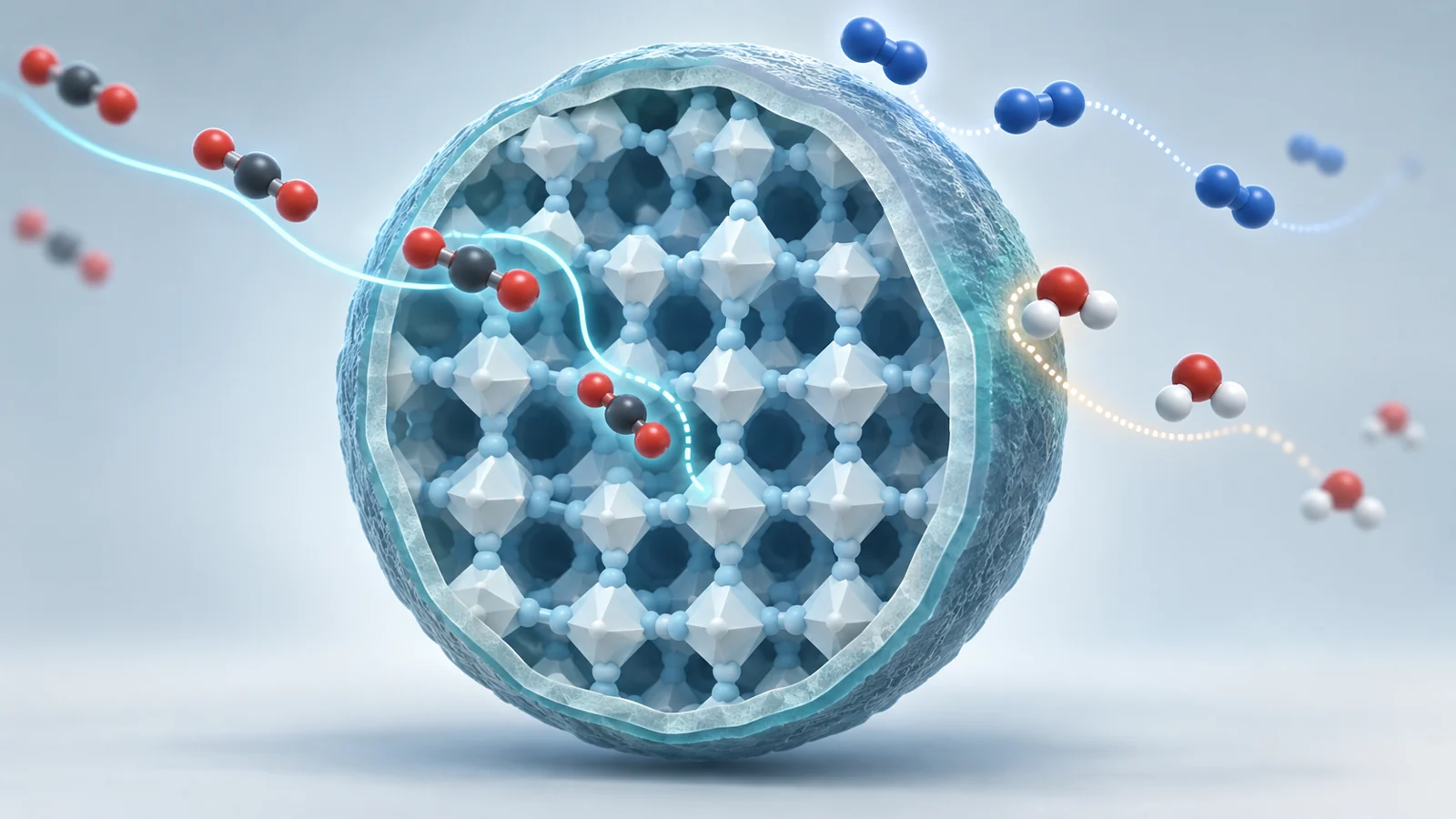
A porous material can offer many places for gas molecules to enter or for chemical reactions to occur. Yet more pores do not automatically mean better performance: moisture can destabilize some structures, gases can compete for similar pore space, and many metal–organic frameworks conduct electricity poorly. One proposed response is to build a composite in which a porous core and an outer shell perform different jobs.
A review published on March 12, 2026, surveys how researchers have made these core–shell composites and tested them in catalysis and gas separation. It brings together examples from earlier studies; it does not report a single new material test. The central design idea is to combine the core’s useful properties with a shell that changes what reaches it, how stable it is, or how it exchanges charge.
A coating changes the job of the pores
Metal–organic frameworks, or MOFs, are crystalline materials built from metal ions or clusters joined by organic molecules. Their structures can be designed with different pore sizes, surface properties and chemical functions. This flexibility has drawn interest in gas separation, catalysis and other uses, but it comes with practical constraints. Some MOFs can lose structure or performance in humid, acidic or basic conditions. Gas separation can also suffer when pores do not distinguish well between competing molecules. And many conventional MOFs are electrical insulators, limiting some electrochemical applications.
In a core–shell composite, the core is the inner material and the shell coats its surface. Either can be a MOF, or the outer or inner component can include a covalent organic framework, oxide, carbon, ionic liquid or polymer. The interface joining them may be held by chemical bonds or weaker interactions. The design assigns complementary roles: a porous core might supply adsorption capacity or catalytic sites, while a shell changes stability, electrical behavior or molecular access.
A shell also takes up space and changes the pore structure. The review notes that surface area and pore size can shift substantially after coating, with the changes depending on the materials and preparation method. So adding a layer is not automatically an improvement. Its value depends on whether the new access, protection or selectivity is worth any loss of available pore space or capacity.
The route determines how the shell forms
Making a uniform coating means guiding the outer material to grow on the core rather than forming separate particles in the same mixture. Different synthesis routes solve that problem in different ways.
Epitaxial growth starts with prepared MOF core particles and grows a second MOF over their surfaces in an oriented arrangement. It can create a continuous, well-matched interface, but depends on compatibility between the crystal lattices and on conditions such as solvent, pH and temperature. This makes it a natural choice when the two frameworks can align suitably, rather than a universal route for every pair of materials.
Seed-mediated growth also starts with prepared crystals, but uses surface sites, functional groups or leftover ligands to encourage the shell to nucleate. It is less dependent on lattice matching, so it can accommodate a wider range of core–shell combinations. The tradeoff is that the shell still needs careful control: precursor concentration, solvent and surface chemistry can affect its thickness and uniformity.
One-pot synthesis puts the ingredients for both frameworks in a single reaction system. The intended core forms first because one material nucleates faster; the other then grows around it. Adjusting the addition sequence, temperature and metal-to-ligand balance can influence the resulting interface. The approach offers a more continuous process, but relies on the difference in growth rates producing the desired order rather than competing structures.
These methods are not interchangeable recipes. They are ways to manage a materials-specific problem: getting the shell to form where intended, with dimensions and an interface suited to the job.
Catalysis depends on access as well as protection
For a catalyst, an outer layer can influence how reactants reach active sites and how the material fares during a reaction. In the examples gathered by the review, shells and cores play different roles rather than providing a single shared mechanism.
One cited study coated the MOF MIL-101(Cr) with a porous silica shell and tested the composite in indane oxidation. The review reports that it retained 82% of its initial conversion, compared with 46% for MIL-101(Cr). That comparison illustrates a result for this material and reaction; it does not show that silica coatings will produce the same change for other catalysts.
Other reviewed designs combine gold nanoparticles with a hollow, amino-functionalized bimetallic MOF shell. For oxidation of D-xylose without a base, the reported turnover frequency reached 76.53 per hour, 306 times the value for the unmodified gold nanoparticle catalyst. The example brings together the nanoparticles’ catalytic role and the shell’s structure. Its performance belongs to that particular system and test, not to core–shell materials as a whole.
Wet exhaust makes selectivity a balancing act
Capturing carbon dioxide from flue gas means separating it from a mixture in which nitrogen is more abundant and water is also present. The review describes typical flue gas as roughly 70–75% nitrogen, 15–16% carbon dioxide and 5–7% water. An adsorbent therefore needs to attract carbon dioxide while coping with competition from nitrogen and moisture.
A shell can help shape that competition. One design principle is for the shell to impede water’s diffusion toward a carbon-dioxide-selective core. Another is to tune the outer layer so that gas access and adsorption favor the intended separation. But a thicker or more selective barrier can also reduce how much gas reaches adsorption sites, so capacity and selectivity may need to be balanced.
The review describes an ionic-liquid molecular layer assembled on MOF-808. By varying the layer thickness, the study sought a balance between carbon-dioxide uptake and selectivity. At ambient temperature, the composite adsorbed 3.00 mmol of carbon dioxide per gram, reported as 2.6 times the uptake of uncoated MOF-808. Under simulated industrial flue-gas conditions with a carbon dioxide-to-nitrogen ratio of 15:85, its reported selectivity reached 372. These figures describe a particular material and simulated mixture. They do not establish performance in an operating capture plant, where the material would need to function reliably under engineering conditions.
Sometimes the gas to remove is the one captured
A separation material is not always designed to adsorb the product that users want to collect. In acetylene purification, the review describes a MOF coated with an ionic liquid that preferentially adsorbed carbon dioxide over acetylene. The review reports an IAST (model-based) selectivity of 104 for a 1:1 carbon dioxide–acetylene mixture; separate breakthrough experiments produced acetylene at 99.9% purity or higher.
Here, removing the impurity is the route to a purer product: carbon dioxide is captured while acetylene passes through. The result shows how a shell’s chemistry can redirect which gas is retained. It is evidence from one separation system and experiment, not a general property of coated MOFs.
What would make the materials usable at scale
The review identifies two connected barriers between promising examples and practical use: controlling the interface reliably and producing the materials without excessive resource demands. Researchers still need a clearer account of how shells nucleate and grow at core surfaces. The authors point to in situ characterization and multiscale computation as ways to move from adjusting conditions by trial toward more predictable construction.
Preparation can also involve high solvent use, energy-intensive reactions and long processing times. Aqueous or recyclable-solvent methods, lower-temperature synthesis and continuous-flow production are among the approaches the review identifies for reducing those burdens. Equally, materials intended for gas separation need testing in relevant engineering settings, such as adsorption columns or pilot-scale systems, rather than relying only on material-level or simulated-mixture results.
What more durable carbon-capture materials could enable
If researchers can make these interfaces reproducibly, reduce the cost and resource burden of synthesis, and validate performance under operating conditions, core–shell MOFs could offer a way to capture carbon dioxide from wet exhaust while preserving useful capacity. That could add a new class of separation materials to the options considered for industrial emissions. The reviewed examples are early evidence for design possibilities; they leave those manufacturing and engineering conditions as the work that must still be met.
Key Sources
- Primary source: Core-Shell Metal-Organic Framework Composites: A Review of Synthetic Strategies and Applications in Catalysis and Adsorption.
DOI or Journal Page · Review or Meta-Analysis · 2026-03-12
Keep exploring