
Evidence date · 2023-07-23 · Research note 2 of 3
1 2 3
See current Track status →
Since the previous research note · Earlier expectation not tested
Track continuity
Since the previous research note: How stalled cell renewal may sustain chronic lung injury
Previous expectation: Safely targeting persistent damaging cell states might preserve lung function by reducing injury and protecting repair.
What this study adds: The July 2023 review gives that therapeutic direction greater airway-epithelial specificity, connecting damage responses and impaired mitochondrial clearance with inflammatory secretion and describing pathway intervention in COPD epithelial cells. It does not test the earlier forecast of durable patient benefit.
What changed in this study
A cell that has stopped dividing sounds like a cell that has stopped doing much. Cellular senescence complicates that picture. It is a lasting halt in cell division, but the cell can remain metabolically active and continue releasing substances that affect its surroundings.
A July 23, 2023 review examines this problem in the airway epithelium, the lining that helps separate the lung from the outside environment. Its disease focus is chronic obstructive pulmonary disease (COPD), in which airway and lung damage can include excess mucus, emphysema and scarring of the small airways. The review brings together findings from people with COPD, laboratory-grown cells, animal models and selected therapeutic studies in other diseases. Its central question is not simply why airway cells stop renewing, but how a nondividing cell might continue shaping an unhealthy lung.
The airway lining can stay active after growth stops
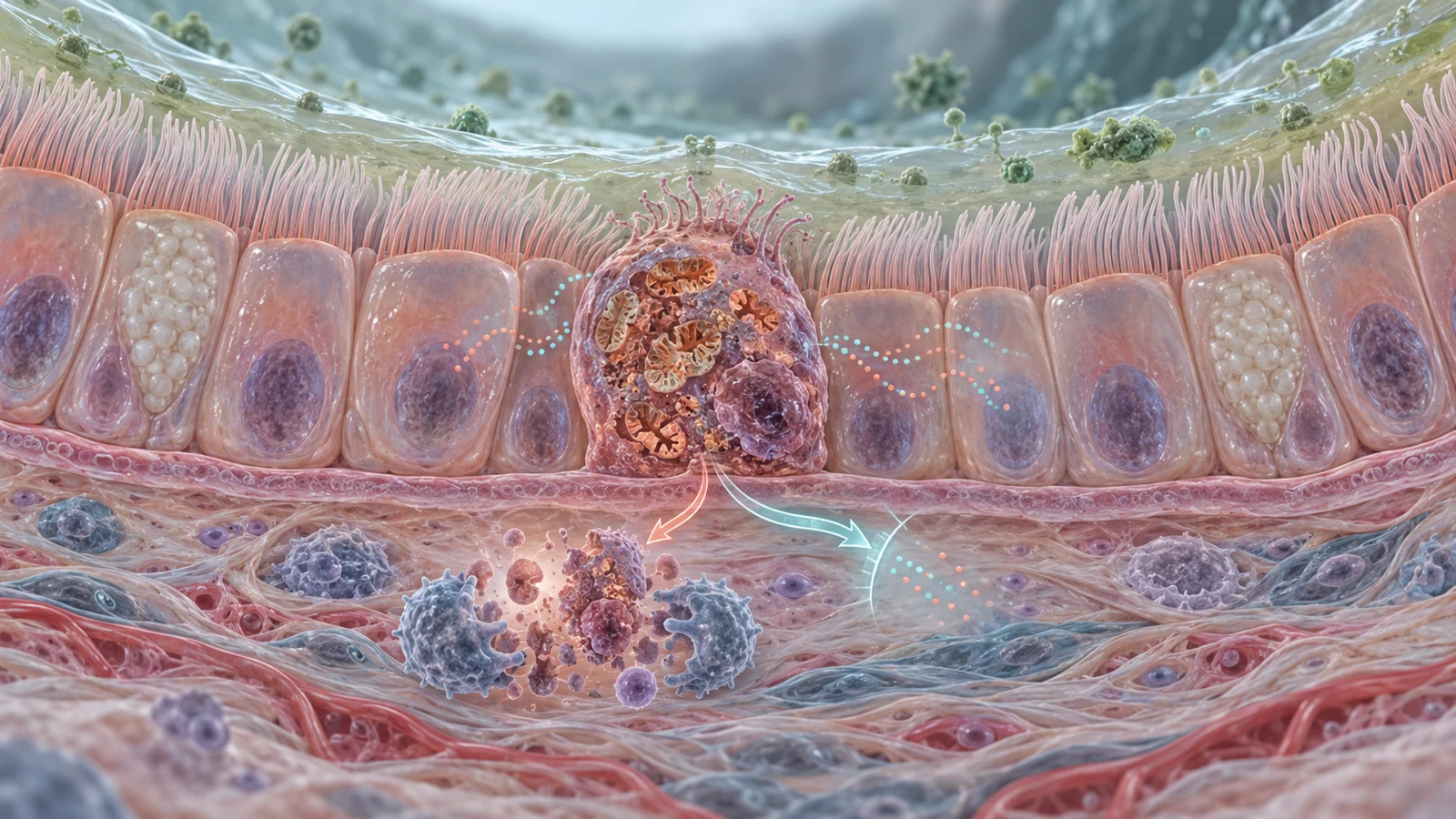
Airway epithelial cells normally help maintain lung homeostasis and defend against inhaled stressors and pathogens. When injury repeatedly challenges that lining, some cells enter senescence rather than continuing through the cell cycle. The change can reduce the supply of cells available for repair while leaving the senescent cells biologically active.
The review describes two major growth-arrest routes. The p53/p21 pathway responds to persistent cellular stress and helps initiate the arrest. The p16/RB pathway can help maintain it later. These pathways are not two neat steps that operate in every cell in the same way; they interact with several upstream and downstream signals. Their shared consequence is a cell that no longer divides normally but has not become inert.
That combination matters because the airway lining is a renewing barrier. A senescent cell may contribute less to replacement of damaged tissue while still changing the local chemical environment. The review presents epithelial senescence as one contributor to COPD inflammation and impaired repair, not as the sole explanation for the disease.
A stress response that does not switch off
The proposed sequence begins with damage. In COPD-related airway tissue, the review connects oxidative stress, telomere dysfunction and DNA damage with persistent activation of the cellular damage response. It cites increased global and telomeric DNA damage in lung cells from people with COPD, as well as evidence that smoke exposure can accelerate age-related changes in small-airway epithelium.
At the molecular level, persistent damage can activate kinases such as ATM and ATR and produce DNA-damage markers including phosphorylated H2AX. These signals feed into p53 and p21, helping keep the cell out of the division cycle. The review also discusses p16 and RB as part of the longer-term maintenance of senescence. The patient and animal observations support the presence of damage and senescence-associated changes; the complete direction of every link in the chain remains a mechanistic interpretation assembled from several kinds of evidence.
The cell may also struggle to clear damaged mitochondria. In COPD bronchial epithelium, the review describes lower PARK2 and increased PINK1 as findings that may reflect insufficient mitophagy, the selective removal of damaged mitochondria. Persisting mitochondrial damage can contribute to more reactive oxygen species, mitochondrial DNA damage and loss of mitochondrial function. In this account, inadequate cellular cleanup helps sustain the stress that keeps the senescent state in place.
The result is a reinforcing relationship between injury, arrested growth and impaired cleanup. It is not a single switch, and the review does not establish that epithelial senescence initiates every case of COPD. It offers a way to understand how several familiar features of the disease could coexist inside the same airway lining.
The message can spread beyond the original cell
Senescent cells release a collection of cytokines, chemokines, growth factors, matrix metalloproteinases and extracellular vesicles known as the senescence-associated secretory phenotype, or SASP. These secretions can act on the senescent cell itself and on nearby cells. In airway tissue, the review links this activity with inflammatory mediators including IL-6, IL-8, IL-1, TNF and CXCL1, alongside increased NF-κB activity.
This changes the scale of the problem. The initial damage may be inside one epithelial cell, but the cell’s secretions can influence the surrounding tissue. Nearby cells may receive signals that promote further stress or senescence, while inflammatory mediators alter the environment in which repair has to occur. The review describes the overlap between this profile and the “COPD-associated secretory phenotype” as support for a possible role of SASP in persistent COPD inflammation.
The same idea may help explain why inflammatory activity can remain relevant after smoking cessation. Ending smoke exposure removes an important source of injury, but it may not immediately remove cells that have already entered a persistent state or the signals they release. This proposed mechanism is not an argument against cessation; it identifies a possible reason that some inflammatory processes could outlast the initiating exposure.
Two ways to intervene in the senescent state
A treatment aimed at senescence could take more than one basic form. Senolytics are intended to eliminate senescent cells by making them undergo programmed cell death while sparing surrounding proliferating cells as much as possible. Senostatics and related approaches would instead alter the pathways that create or maintain senescence, or reduce the harmful secretions without removing the cell.
The review describes a concrete example of the second approach in COPD epithelial cells. Inhibiting microRNA-34a, a gene-regulating molecule associated with p53 and cellular ageing, restored levels of the anti-ageing proteins SIRT1 and SIRT6 in the reported experiment. The intervention also reduced measured senescence markers and inflammatory SASP factors. Those changes show that a pathway can be manipulated in COPD epithelial cells. They do not show that airway repair was restored, that established lung destruction was reversed or that people with COPD would breathe better.
Removing cells and changing their activity therefore involve different risks and promises. Elimination could reduce a source of damaging signals, but it could also remove cells that retain a useful role in tissue protection. Pathway modification might preserve the cell while making its behavior less disruptive, yet the extensive crosstalk among senescence pathways means that blocking one route could activate another. The choice cannot be made from a marker change alone.
The therapeutic evidence does not transfer cleanly
The review cites a first human senolytic study in 14 people with stable idiopathic pulmonary fibrosis who received dasatinib plus quercetin. The participants showed statistically significant and clinically meaningful improvements in physical function, and the combination was described as generally well tolerated. The analysis of circulating SASP factors was inconclusive, however, and the study involved a different lung disease rather than COPD. It therefore provides context for the idea of senolytic treatment, not evidence of COPD efficacy.
Other examples show why selectivity matters. Navitoclax, a drug that inhibits several BCL-2 family proteins, has been used experimentally to remove senescent cells by blocking survival pathways. The review also notes serious blood-related toxicities in a phase I study for lymphoid malignancies, including thrombocytopenia. A survival pathway that helps senescent cells resist death may also support essential cells elsewhere in the body.
Senescence itself is not simply a defect to erase. The review notes roles in wound healing and tumor suppression. Its effects also vary by cell type, and a strategy that appears useful in one tissue may behave differently in another. COPD airway epithelium, idiopathic pulmonary fibrosis and cancer-treatment settings cannot be treated as interchangeable experiments. Before a senescence-targeting therapy could be used for COPD, researchers would need to identify the relevant airway cells, reach them safely and show that changes in cellular behavior translate into durable clinical benefit.
What this could change
The practical promise is selective control of harmful airway-cell states. A treatment that safely reduces damaging epithelial signals, or removes the right senescent cells without disrupting protective functions, might preserve the airway’s capacity to repair itself and help protect remaining lung function in people with COPD.
That possibility depends on several conditions: the therapy must reach the relevant cells, separate harmful senescence from useful protective responses, avoid unacceptable effects on other tissues and produce durable benefit in patients. The July 2023 review gives this strategy greater airway-specific mechanistic detail, but it does not yet demonstrate that targeting epithelial senescence improves COPD outcomes.
Key Sources
- Primary source: Airway Epithelium Senescence as a Driving Mechanism in COPD Pathogenesis.
DOI or Journal Page · Review or Meta-Analysis · 2023-07-23