
Research Signal – Source date 2025-01-31
Finding an antibody that recognizes a disease target leaves researchers with substantial engineering work. To develop therapeutic antibodies—antibodies used as medicines—they must consider how strongly an antibody binds, how selectively it recognizes its target and whether it might provoke an unwanted immune response.
A review published on January 31, 2025, brings together computational approaches that could help with that work. Its abstract describes extensive engineering as a frequent requirement after antibodies are discovered through experiments in living organisms or laboratory systems. The authors argue that computer-based design and analysis can make this optimization more efficient. The contribution is an overview of available approaches, with experimental and computational work used together.
Several properties must work together
The review highlights three concerns. Affinity means binding strength. Specificity means selectivity for the intended target. Immunogenicity is the capacity to provoke an immune response; reducing it is one goal when engineering an antibody for therapeutic use.
These properties answer different questions. Strong binding does not, by itself, establish target selectivity or a low likelihood of provoking an immune response. The abstract explicitly recognizes tradeoffs between critical properties. Researchers therefore face several design goals, and an improvement in one cannot stand in for a complete assessment of the others. The engineering challenge is to find a useful balance.
What information can computers use?
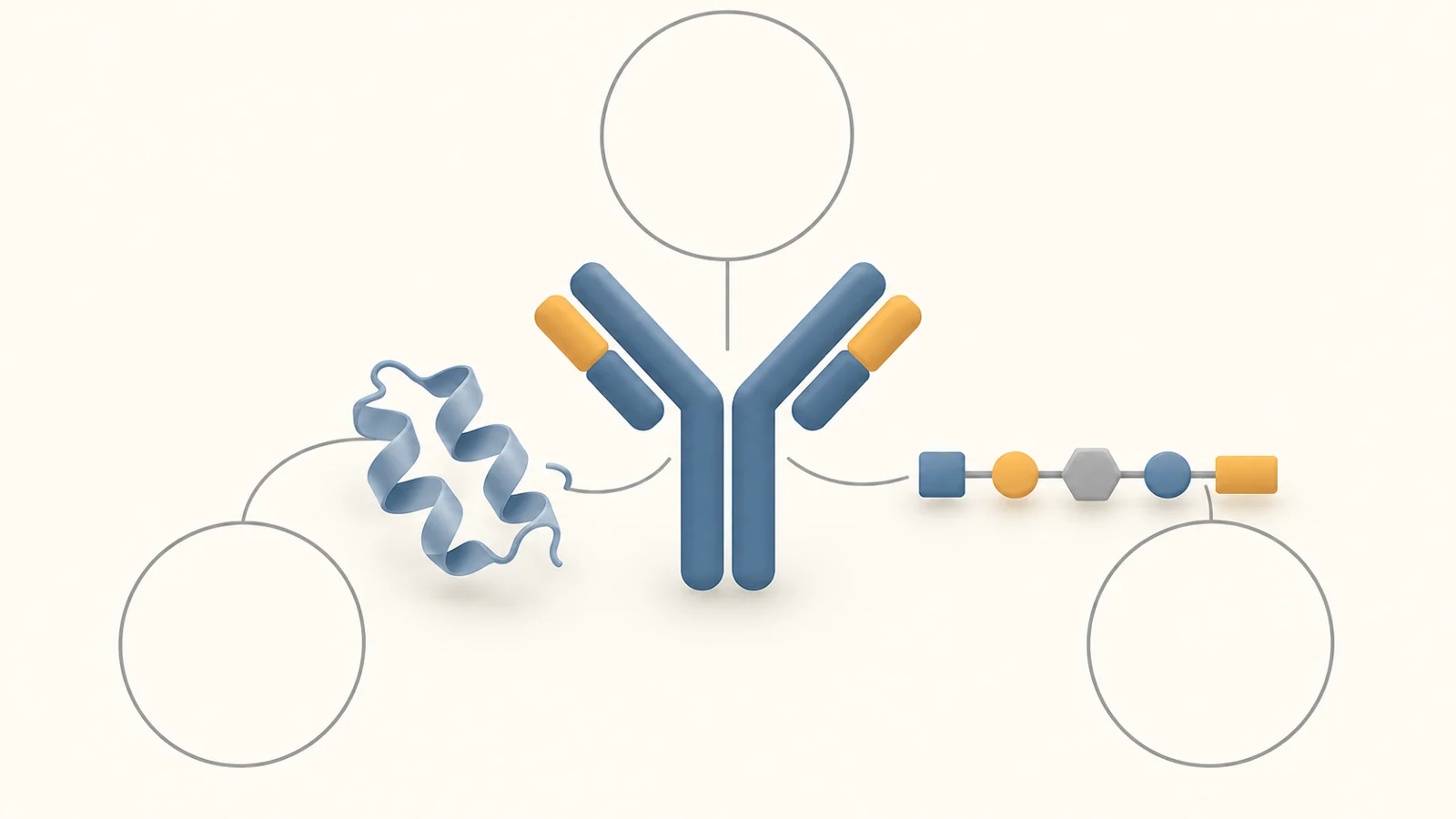
The approaches collected in the review draw on different kinds of information. Sequence bioinformatics examines the order of an antibody’s molecular building blocks, while structural bioinformatics considers their three-dimensional arrangement. These offer complementary ways to describe an antibody and investigate possible changes.
Sequencing-based data mining works with information generated by next-generation sequencing. Its emphasis is on extracting useful patterns from sequence data. Machine learning is another approach named in the abstract, alongside systems biology, immuno-informatics and integrative methods. These extend the range of questions toward biological interactions, immune responses and combinations of information.
Computational antibody design thus encompasses more than machine learning. Sequence analysis, structural analysis and biological modeling contribute different perspectives. The abstract presents them as parts of a broad toolbox; it does not provide enough detail to assign each one a demonstrated advantage for a particular engineering problem.
How much improvement does this establish?
The authors describe conventional antibody development methods, including hybridoma technology and display techniques, as resource-intensive and time-consuming. They argue that computational approaches can improve the precision and speed of discovery, optimization and validation. Those are broad conclusions from the review.
This account is based on its abstract. That level of access supports explaining the proposed direction, but cannot establish how many months or dollars a particular method saves, which algorithm performs best, or how consistently an advantage carries across different antibodies. Assessing those claims would require the underlying comparisons and validation details. The abstract also does not establish clinical benefit, safety or approval prospects for a computationally designed antibody. These limits concern what can be verified here, rather than what the complete paper may contain.
What this could change
If computational predictions survive experimental testing and the proposed efficiency gains hold through development, teams could use their resources to bring more discovered antibodies into experimentally usable therapeutic candidates. That could widen the set of candidates available for diseases such as cancer and autoimmune disorders, where the review places antibody-based treatment in context.
The potential payoff is greater development capacity. More candidates that meet several engineering goals could give researchers more options to investigate for treatment. From the review’s January 2025 perspective, that possibility depends on connecting computational design with experimental work closely enough for predicted improvements to become useful properties in real antibodies.
Key Sources
- Primary source: Navigating the landscape: A comprehensive overview of computational approaches in therapeutic antibody design and analysis.
DOI or Journal Page · Review or Meta-Analysis · 2025-01-31
Keep exploring