
Research Signal – Source date 2021-01-25
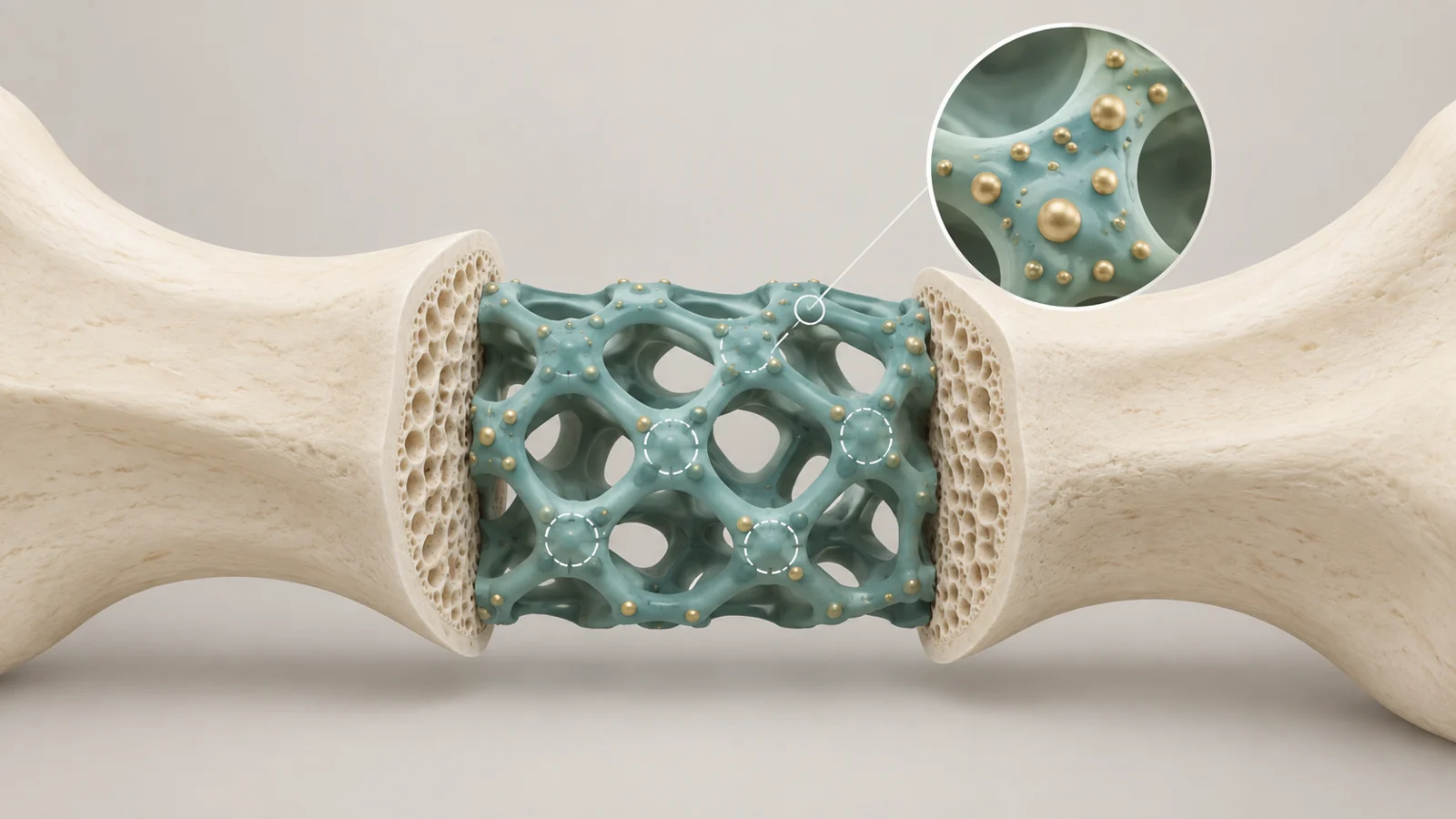
A support placed where bone needs repair has several jobs. It must provide a physical structure while allowing cells to attach, blood vessels to grow and new tissue to become integrated with surrounding bone. Researchers call such a structure a scaffold—a support intended to help tissue grow. Making it stronger addresses only part of that assignment.
A review published in Molecules on January 25, 2021, examines how combining polymers with other materials can help tailor these supports. It brings together prior work on tissue engineering, wound materials and drug delivery. Its central materials question is how to combine ingredients so that their mechanical behavior, internal organization and breakdown suit a particular biological task.
Bone repair makes the challenge tangible. A structure has to fit a physical space, yet the tissue developing within it is active and changing. The same design priorities will not apply to a soft dressing that holds moisture against a wound. Understanding that difference helps explain both the appeal of composite materials and the difficulty of judging their medical value.
The connection between ingredients matters
A composite combines materials with different properties. In the systems discussed here, a polymer forms the matrix—the surrounding material—and an added component acts as a filler. A biopolymer is a polymer derived from biological sources. The review discusses these materials alongside modified and other polymers used in biomedical systems.
The filler can change how the matrix behaves, but its presence alone does not determine the result. The boundary where the two materials meet matters because reinforcement depends on their interaction. The review describes graphene and its derivatives as fillers used to improve mechanical properties, and identifies metallic nanoparticles as another class of additives investigated for biomedical composites.
Those additions can also clump together. Instead of being distributed through the surrounding polymer, particles form agglomerates, leaving the structure uneven. The authors identify this poor dispersion and weak bonding between filler and matrix as major obstacles to obtaining the intended mechanical behavior. An ingredient list therefore tells only part of the story; how the ingredients are arranged and connected helps determine what the material can do.
Composition also provides ways to adjust chemical structure and degradation—the process by which a material breaks down. For a support intended to accompany tissue growth, the timing of that breakdown is part of its function. The design question includes how the material behaves over time, as well as how it performs when first made.
Bone needs space for living activity
Bone itself combines an organic matrix with a mineral component. The review connects that composite organization to the demands of bearing loads and resisting fracture. An engineered support must also accommodate the biological work involved in forming and remodeling tissue.
That brings attention to the spaces within a scaffold. The authors describe porous architecture as important for vascular growth, meaning the growth of blood vessels. They also discuss surface features at micro- and nanometer scales in relation to cell attachment, multiplication and differentiation—the process through which cells develop specialized roles. The outer shape, internal openings and surfaces encountered by cells each contribute a different part of the design.
A support fitted to a bone defect therefore needs more than a matching outline. Its interior must offer room for the vascular and cellular activity that regeneration requires. The review also discusses incorporating growth factors and molecules associated with the extracellular matrix, the material surrounding cells, to help guide biological responses. These are approaches to making the scaffold an environment in which tissue can develop.
Three-dimensional printing offers a way to manufacture complex shapes across different sizes and produce personalized parts in small quantities. That makes it relevant to fitting a support to a particular defect. Printing establishes a fabrication capability, however; the biological goal remains the union of newly formed bone with neighboring host bone and the restoration of local function. Producing the shape and achieving that integration are separate accomplishments.
A wound dressing has a different job
At a wound surface, retaining moisture and conforming to the application site become central requirements. The review discusses hydrogels, which are polymer networks that hold water. Their moist, three-dimensional structure can provide a local environment for cell attachment, movement and growth, while also carrying medicines, cells or peptides.
Connections within the polymer network are called crosslinks. Adjusting crosslinking can influence how loaded substances are released. This gives researchers a way to work on the timing of local delivery alongside the material’s physical behavior. A dressing can thus be designed both to occupy the wound surface and to carry an agent released there over time.
The review’s drug-delivery discussion broadens that point. Release behavior depends on choices made during preparation, including how the material is manufactured and how the therapeutic payload is incorporated. Size, shape, surface characteristics and degradation also need to suit the intended delivery site. Carrying a substance and releasing it in a useful way are distinct design tasks.
This application changes what counts as useful performance. A water-holding network that conforms to a wound is being asked to do something different from a porous structure shaped for a bone defect. Even when both use polymer composites, their functions have to be judged in relation to the tissue and setting they are meant to serve.
Success in one task does not settle another
The January 2021 paper is a review of prior work across different formulations and applications. Those examples help explain the range of design options, but they cannot automatically be combined into a ranking of one best material. A mechanical measurement, a cell response and a drug-release pattern answer different questions. A favorable result for one formulation in one setting does not establish the performance of another scaffold or dressing.
The distinctions also matter when interpreting medical potential. Printability demonstrates that a shape can be made. Cell-supporting behavior concerns a biological interaction under the conditions examined. Controlled release concerns the delivery of a payload. Patient benefit, long-term safety and restoration of tissue function require evidence that addresses those outcomes directly. The properties described here do not by themselves establish them, or justify a numerical healing advantage.
Likewise, biological origin is a description of where a material comes from, rather than a guarantee of implantation safety or environmental superiority. The specific formulation, its additives and its intended use remain relevant. The review is useful for understanding the choices available to researchers without treating the entire material category as interchangeable.
What this could change
For people needing bone repair, the potential payoff is a support fitted to the geometry of their defect that also provides internal space for living tissue to develop. If shaped, porous composites can combine suitable physical support and degradation with vascular growth and integration into host bone, they could help new tissue restore local function.
The causal path links fabrication to biology. Complex shaping could place the support where it is needed; internal architecture could accommodate vessels and cells; and a suitable material could maintain support while tissue develops and the structure breaks down. From the January 2021 perspective, bringing those functions together is the concrete opportunity: structures tailored to a bone defect that can participate in rebuilding tissue.
Key Sources
- Primary source: Recent Advances in Biopolymeric Composite Materials for Tissue Engineering and Regenerative Medicines: A Review.
DOI or Journal Page · Peer-Reviewed Paper · 2021-01-25
Keep exploring