
Research Signal – Source date 2022-08-03
A vaccine can teach immune cells to recognize colorectal tumor cells and still fail to show that patients live longer or avoid recurrence. That gap runs through a 2022 review of colorectal cancer vaccine research: immune responses appeared in some studies, but clinical benefits remained limited. The key question is not only whether a vaccine can make the immune system notice a tumor. It is whether that response can last and reach the outcome patients care about.
Why the immune starting point varies
Colorectal cancer is common, but its tumors do not all present the immune system with the same challenge. About 15% of patients have tumors with high microsatellite instability, or MSI-H, a feature associated with a higher number of mutations. These tumors are more likely to attract tumor-infiltrating lymphocytes, immune cells already present in or around the cancer. The more common group, with mismatch-repair-proficient or microsatellite-stable tumors, tends to have fewer mutations and a weaker existing immune response. The 2022 review described this group as less sensitive to the immune checkpoint treatments available at the time.
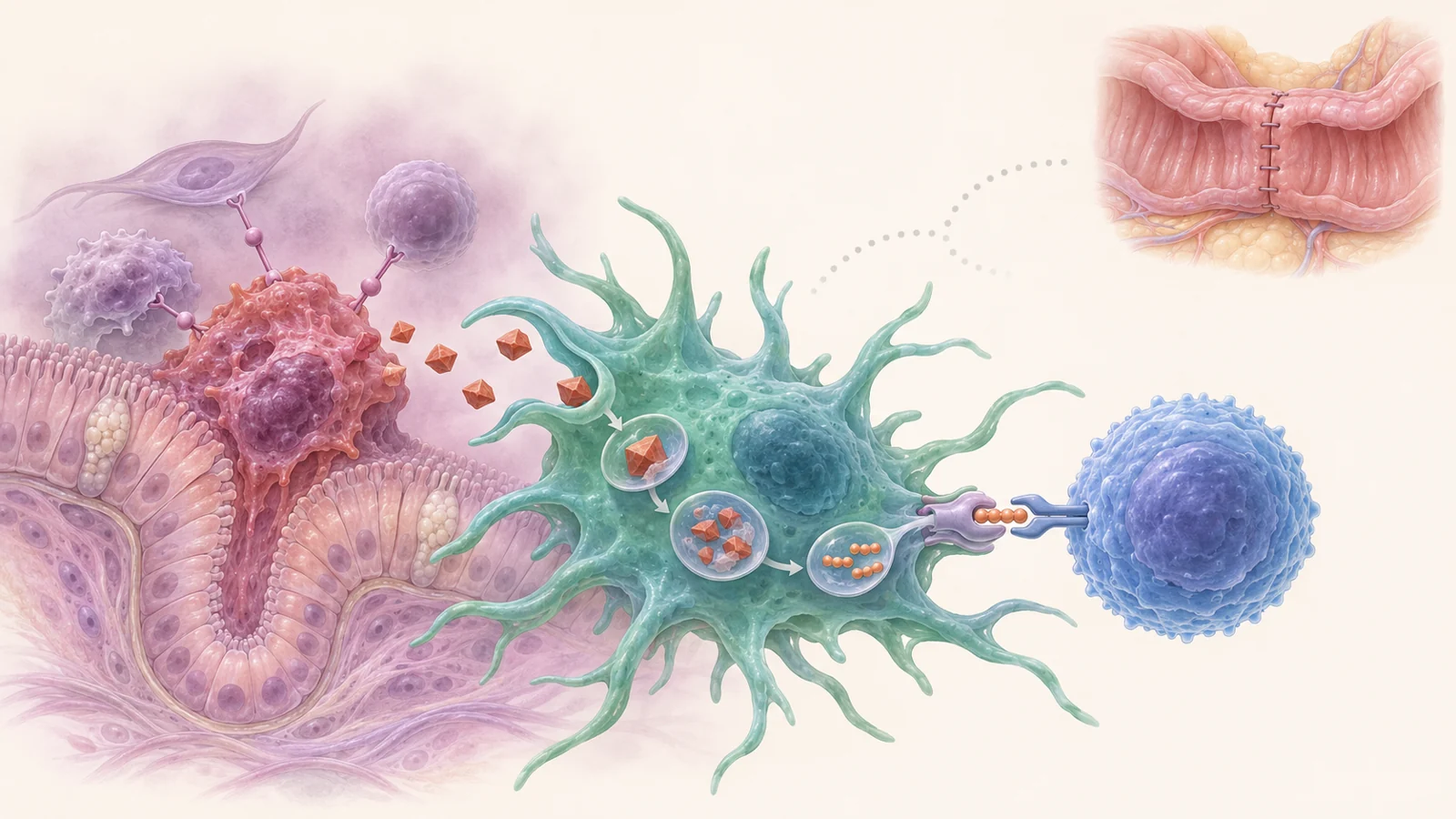
A cancer vaccine aims to make tumor recognition more deliberate. It supplies clues from the cancer so antigen-presenting cells—especially dendritic cells—can take them up and display pieces of them to T cells. Activated T cells may then multiply, travel to the tumor, and attack cells carrying the recognized target. Some can also become memory cells. This sequence explains how immune activity might begin; it does not by itself show that enough active cells reach the tumor, persist there, or prevent the cancer from returning.
Choosing the clue the immune system sees
Vaccine design starts with its target. Tumor-associated antigens are proteins found at higher levels in cancer cells than in normal cells. Because they can also occur in healthy tissue, a target may be less exclusive to the tumor. A tumor-specific antigen, also called a neoantigen, comes from a mutation in cancer cells and is not expressed by normal cells. That specificity makes neoantigens attractive, but finding a target that a patient’s immune system can recognize takes analysis of tumor material and how the resulting peptide is presented to immune cells.
Whole-cell vaccines take a broader approach. They use a patient’s own cancer cells or cells from another source, often with the aim of exposing the immune system to many tumor clues at once. Using a patient’s own cells can make the vaccine more individualized; using cells from another source can be faster to produce for groups of patients. The breadth also has a trade-off: whole-cell material includes antigens that may be present in normal tissues, raising the possibility of autoimmune reactions.
Mutation-targeted vaccines narrow the focus. The review describes Nous-209, an off-the-shelf vaccine encoding several frameshift peptides—new sequences that can result when mutations disrupt the usual reading of genetic instructions. The approach was being investigated with the checkpoint drug pembrolizumab in a phase I/II trial involving metastatic gastrointestinal tumors. Other neoantigen vaccine trials were also underway. These studies represented active investigation, not established patient benefit.
Nanoparticles address a different part of the problem: how to deliver tumor antigens and other vaccine components. The review describes silicon particles designed to release antigen and immune-stimulating ingredients in a controlled way, as well as particle systems combining cancer-cell material with light-based treatment approaches. These examples showed activity in colorectal cancer mouse models. They offer delivery ideas for researchers, but animal results do not tell us whether a nanovaccine will safely prevent recurrence in people.
The patient outcomes behind the immune measurements
OncoVax, a vaccine made from a patient’s cancer cells combined with BCG, was tested as an addition to surgery. In a randomized phase III trial, 412 people received surgery alone or surgery plus vaccination. After 7.6 years of follow-up, the groups did not differ significantly in disease-free survival or overall survival. Disease-free survival tracks how long people live without the cancer returning; overall survival tracks how long they live.
A subgroup analysis found improved disease-free and overall survival among patients with stage II disease. That result is a reason to ask whether a defined group might benefit, but it does not turn the trial’s overall comparison into a success. A result in a subgroup can be less conclusive than a positive result across the randomized trial population, so it needs a focused test in patients selected in advance for that question.
A separate comparison involving PANVAC, a vaccine approach delivered with a viral vector, shows why the comparator and endpoint matter. In patients with metastatic colorectal cancer, one group received dendritic cells with PANVAC and another received dendritic cells with GM-CSF, an immune-stimulating factor. At two years, recurrence-free survival was 47% in the PANVAC group and 55% in the comparison group. Measured T-cell responses against CEA, a tumor-associated antigen, were statistically similar. The immune measurements and the recurrence outcome answer different questions; the former cannot stand in for the latter.
Across the studies covered, researchers sometimes detected vaccine-triggered immune activity, while large phase III trials had not shown significant benefit. A response in blood or an immune assay is an important sign that a vaccine can engage its intended biology. Whether it changes recurrence or survival requires those outcomes to be measured directly.
A tumor can resist an activated immune response
Even when T cells are activated, the tumor environment can make their work difficult. The review describes immune suppression and tolerance as major obstacles. As a tumor and the immune system interact, some cancer cells may be eliminated, while others persist and eventually escape immune control. At that stage, an immunosuppressive environment can blunt the response a vaccine is meant to strengthen. The review also raises the possibility that immune-stimulating and immune-suppressing T-cell populations may expand in ways that cancel each other’s effects.
This helps explain why producing an immune response is only one step toward durable protection. A vaccine needs both a recognizable target and an immune response that remains effective in and around the tumor. For patients with metastatic disease, personalized neoantigen vaccines also face a practical constraint: the review describes a three-to-five-month interval from obtaining tissue to delivering a personalized vaccine, alongside the need to reduce cost and preparation time.
Combining vaccines with checkpoint-blocking drugs is one research response to immune suppression. The review describes combinations with anti-PD-1 treatment as a frequent focus of clinical trials, including the hope that the two approaches could help patients who would not benefit from either alone. That remains a question for trials, rather than a proven broad benefit. The 2022 review also noted trials exploring preventive vaccines in people with Lynch syndrome.
What this could make possible
After colorectal cancer surgery, a patient could one day receive a vaccine aimed at the tumor’s own recognizable features alongside established care. If the immune response were strong and durable enough, the added treatment could lower the chance of recurrence compared with established care alone. Surgery already offers a treatment; dependable added protection after surgery would be the new capability.
The biological bridge is antigen recognition: a vaccine could help immune cells identify cancer cells that remain after surgery. The OncoVax stage II subgroup result offers a clinical reason to investigate that possibility, while its lack of an overall survival or disease-free survival difference shows why the signal still needs confirmation. A meaningful nearer milestone would be a randomized stage II comparison defined in advance that improves disease-free survival. Researchers could measure immune responses alongside that outcome, but the immune result would not replace evidence that fewer patients experienced recurrence.
Key Sources
- Primary source: Colorectal cancer vaccines: The current scenario and future prospects.
DOI or Journal Page · Review or Meta-Analysis · 2022-08-03
Keep exploring