
Research Signal – Source date 2024-09-15
For repeated capture, a material must give up some of the carbon dioxide it has collected. In a study published on September 15, 2024, researchers measured how carbon dioxide and nitrogen adsorb in a porous cobalt metal-organic framework, then used those measurements to estimate how much carbon dioxide a pressure-and-temperature cycle could release again.
For one modeled set of conditions, doubling the carbon dioxide pressure in the feed raised the calculated working capacity from 0.76 to 1.58 moles per kilogram of material. Those values describe an equilibrium-based estimate, not recovery demonstrated in an operating capture unit. The pressure effect is the central result: the material’s usefulness depends on the difference between what it holds during capture and what remains after regeneration.
A cycle depends on what remains behind
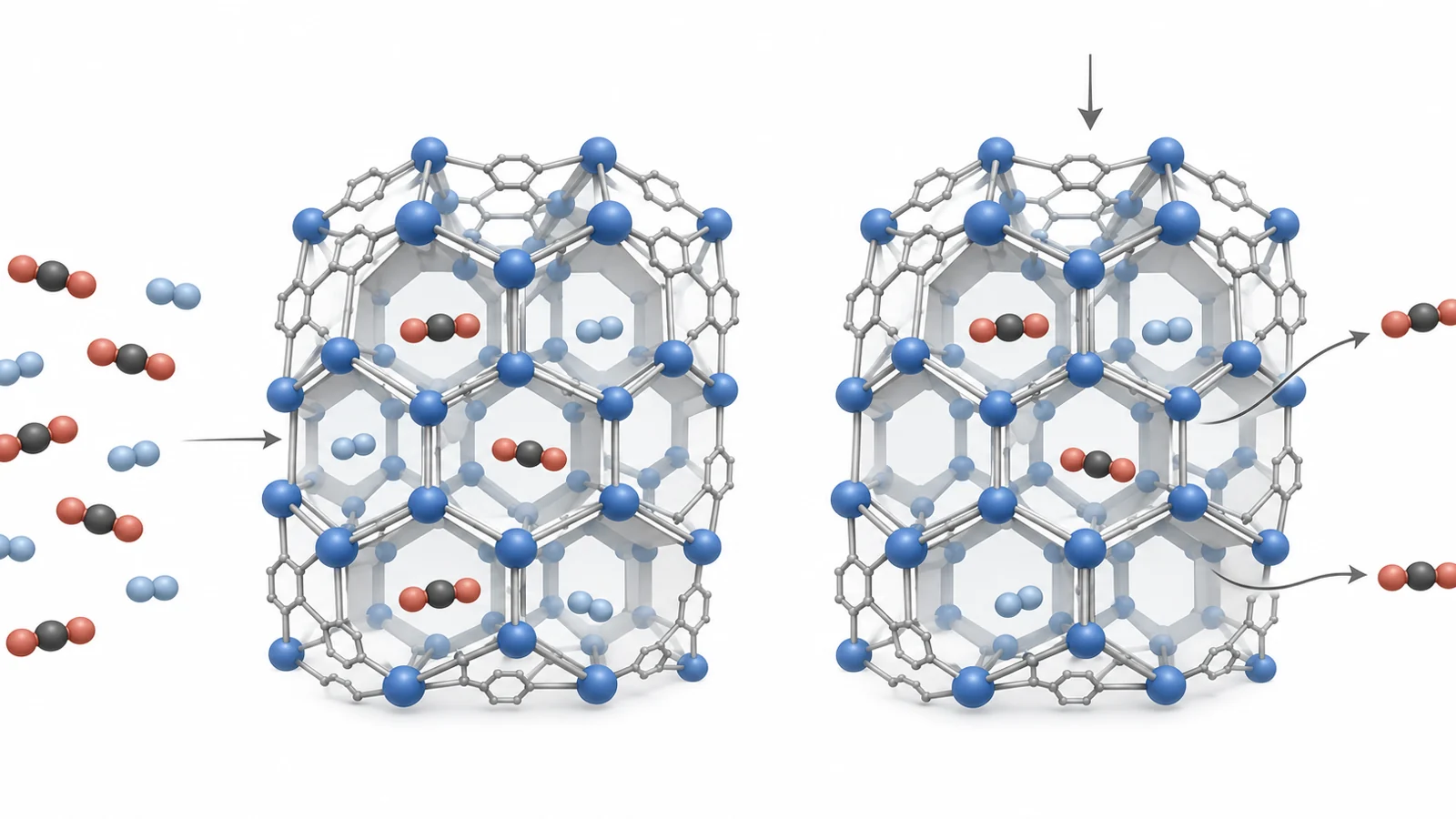
Adsorption is the sticking of gas molecules to the internal surfaces of a porous solid. In a capture cycle, a gas mixture contacts the material at feed conditions; later, changed conditions encourage some of the captured gas to leave. Working capacity is the amount adsorbed during the feed phase minus the amount still adsorbed after regeneration. It is this releasable difference, rather than the total amount the material can hold at one condition, that matters for a repeated capture process.
The researchers considered a flue-gas-like feed containing 15% carbon dioxide and 85% nitrogen. At 303 K, or about 30°C, a total pressure of 6 bar gives carbon dioxide a 0.9-bar share, known as its partial pressure. For a modeled regeneration at 1 bar and 373 K, the estimated working capacity was 1.58 mol/kg. With the same regeneration temperature but a carbon dioxide feed partial pressure of 0.45 bar, the estimate fell to 0.76 mol/kg. The higher carbon dioxide pressure gives the material more to take up before the release step.
The paper’s calculations also compared pressure and temperature changes. If regeneration also stayed at 303 K, swinging the carbon dioxide partial pressure from 0.9 to 0.15 bar gave a calculated working capacity of 1.38 mol/kg. In the conditions they evaluated, changing pressure had a stronger effect on the estimated capacity than changing temperature. A pressure swing can therefore make a substantial difference to how much carbon dioxide is available to release from this material.
Separate gas tests showed different uptake
The material, named Co₃(ndc)₃(dabco), is built from cobalt and organic components that form a porous solid. The researchers measured carbon dioxide and nitrogen separately at 273, 303 and 323 K, across pressures up to 35 bar. They recorded adsorption and desorption and found the measurements could be described with a Langmuir model, a mathematical account of gas uptake that approaches a limiting capacity as pressure rises.
Carbon dioxide uptake rose more steeply than nitrogen uptake at low pressure, and the material held more carbon dioxide at high pressure as well. The measured pattern matters because a post-combustion feed contains both gases: a material that takes up carbon dioxide more readily could, in principle, help separate it from nitrogen. The measurements are for each pure gas on its own, however, so they establish the contrast in uptake without showing how the gases compete in an actual mixture.
The study also calculated heats of adsorption, an estimate of the energy associated with gas molecules binding to the material. For carbon dioxide, the values rose from about 20 to 27 kJ/mol with loading; for nitrogen they were close to 11 ± 0.5 kJ/mol. These figures add context to the uptake measurements, but they do not by themselves say how much energy a full capture-and-release process would consume.
Care is also needed when interpreting high-pressure uptake. The researchers distinguished the net amount adsorbed from the absolute amount, which accounts for gas occupying the material’s pore space. The two quantities are similar at low pressure but diverge at higher pressure. The distinction matters most at higher pressure, where measured net uptake and calculated absolute uptake diverge.
The mixture estimate comes from a model
To estimate separation from a carbon dioxide–nitrogen mixture, the researchers used ideal adsorbed solution theory, or IAST. This method takes the separate, pure-gas adsorption measurements and predicts how the two gases would share the material under specified mixture conditions. It is a model calculation, not a direct mixed-gas separation experiment.
For a modeled mixture of 15% carbon dioxide and 85% nitrogen at 1 bar and 303 K, IAST predicted a carbon dioxide-to-nitrogen selectivity of 11.5. Selectivity describes the material’s relative preference for one gas over another in the adsorbed phase under those conditions. The estimate suggests a useful preference for carbon dioxide, while remaining conditional on the model and its pure-gas inputs.
There is a second modeling step in the working-capacity calculation. Adsorption equilibrium was measured up to 323 K, but the example regeneration temperature is 373 K. The researchers extended the fitted Langmuir model beyond the measured temperature range to estimate how much gas would remain adsorbed at regeneration. That extrapolation helps explore a possible cycle, but it makes the 1.58 mol/kg figure a prediction rather than a measured release.
How this could shape the future
A dependable porous material could one day sit in a bed that contacts exhaust, holds some of its carbon dioxide while nitrogen passes through, and then releases a more concentrated carbon dioxide stream for separate storage or use. The study’s contribution is a set of measurements that could help determine whether this particular cobalt material merits further development. Its stronger carbon dioxide uptake and pressure-sensitive modeled working capacity provide a reason to investigate that possibility, not evidence that an exhaust-treatment system already works.
The practical bridge is direct cycle performance. A useful next milestone would be to measure carbon dioxide recovery and nitrogen separation through repeated cycles at stated feed and regeneration conditions, then compare those results with the paper’s predictions. Those tests would show whether the modeled preference translates into reliable release and separation in a mixed gas, and whether the material retains that performance over repeated use. Until then, the study offers a measured basis for a candidate material and a clear pressure-dependent hypothesis, rather than demonstrated capture performance in an installation.
Key Sources
- Primary source: Adsorption of Carbon Dioxide and Nitrogen in Co 3 (ndc) 3 (dabco) Metal-Organic Framework.
DOI or Journal Page · Peer-Reviewed Paper · 2024-09-15
Keep exploring