
Research Signal – Source date 2024-10-17
A porous crystal can hold a great deal of carbon dioxide, but capacity alone does not say how much heat is released when the gas binds to its surface. That heat matters to the material’s adsorption behavior, yet estimating it can require uptake measurements at several temperatures. A preprint posted on October 17, 2024, explores a possible shortcut: combine a crystal’s pore properties with one uptake value to estimate its heat of adsorption.
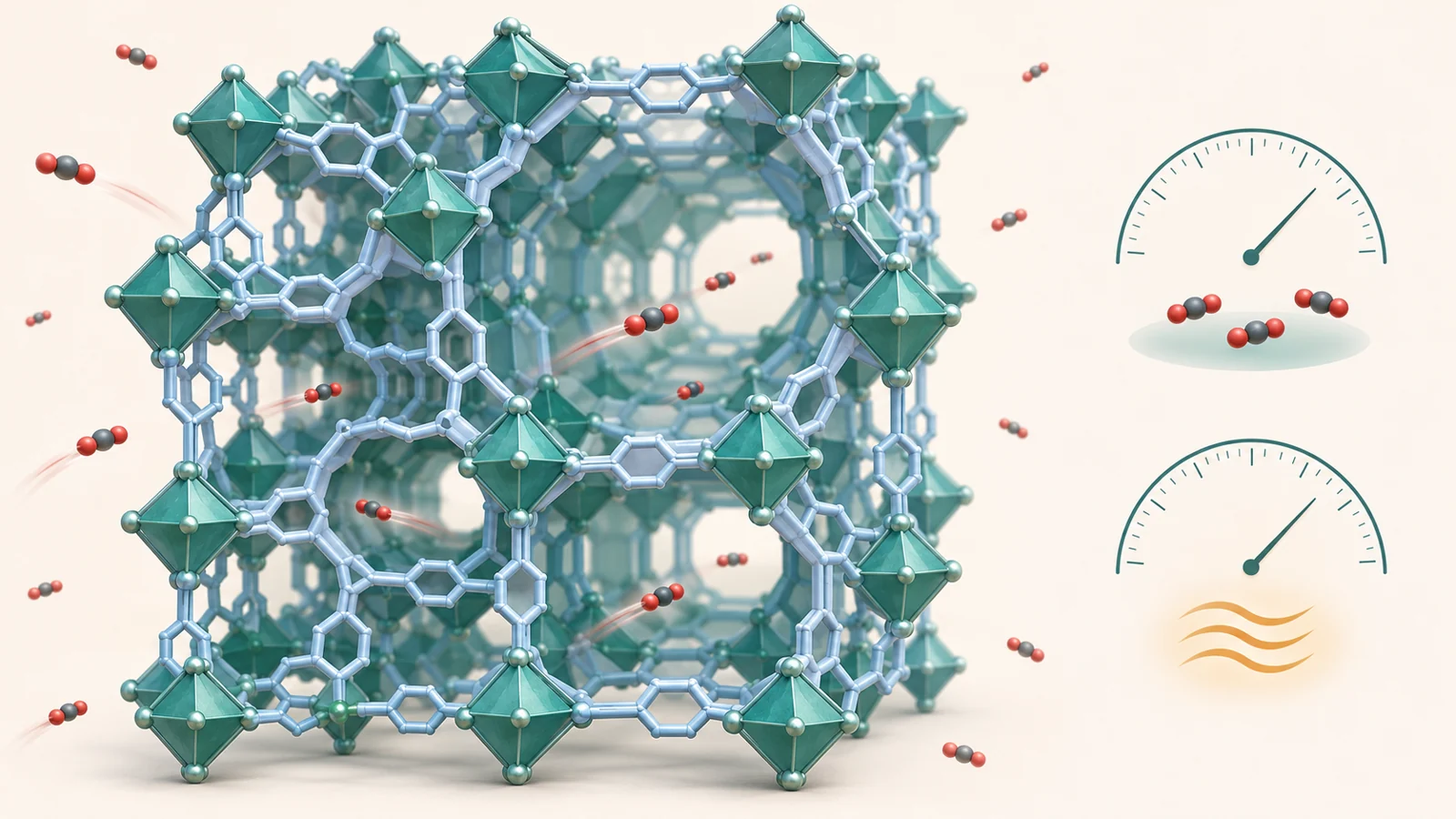
The researchers studied metal-organic frameworks, or MOFs: crystalline materials built from metal-containing units connected by organic molecules, with pores whose sizes and shapes can vary. Their machine-learning model predicted both CO₂ uptake and adsorption heat over pressures from 0 to 50 bars. They then fitted simpler descriptors—relationships that use accessible pore information and uptake—to connect these properties with heat and with the shape of an adsorption curve.
The work is computational and remains a preprint. Its results point to a way of screening materials with more than capacity in view, while the differences in performance across pressures and frameworks show why the shortcut still needs careful testing.
Two kinds of information enter the model
The model combines two graph-based neural networks, methods that represent a material as connected parts and learn patterns from those connections. A crystal graph convolutional neural network, or CGCNN, processes the local atomic structure: which atoms are connected and how their arrangements vary. A graph attention network, or GAT, helps the model weigh information across those connections. The researchers also included broader textural features describing the material’s pore structure.
This combination was intended to capture both local chemistry and larger-scale features of the pore network. The team compared the combined model with versions using only one of the network approaches or a different combination. In their reported analysis, the GAT-CGCNN setup performed better than those alternatives.
The model predicted uptake—the amount of CO₂ held by the material at a given pressure—and heat of adsorption, the heat associated with gas binding. Predictions were compared with values from grand canonical Monte Carlo (GCMC) simulations, a computational method for estimating gas adsorption in materials. These comparisons test how closely the model can reproduce simulation results; they are not measurements of a working capture system.
Pressure changed the uptake scores
At 0.5 bar, uptake predictions had a Pearson correlation coefficient (PCC) of 0.730; at 50 bars, it was 0.954. Correlation describes how well predicted and reference values rise and fall together across materials. It does not tell whether the predictions are close in absolute terms. On that measure, mean absolute error—the average size of the prediction error—rose from 15.95 grams per kilogram at 0.5 bar to 109.95 grams per kilogram at 50 bars.
So at higher pressure the model more consistently distinguished materials with higher or lower uptake, even as the typical gap between predicted and simulated amounts became larger. The authors also found that textural-property trends in uptake became clearer with pressure. At low pressure, pore information alone was not enough to represent uptake well, pointing to the value of other structural features in the model.
Heat predictions followed a different pattern. Their reported correlations were 0.850 at 0.5 bar, 0.881 at 5 bars, and 0.761 at 50 bars. Unlike uptake, the reported heat-prediction correlations did not increase steadily with pressure, and performance varied across material types. The paper also describes weaker predictions for some isotherm categories, including underestimation patterns for certain materials and conditions.
An isotherm is the curve showing how much gas a material holds as pressure changes. Its shape can indicate whether uptake rises steeply at low pressure, continues increasing gradually, or changes more sharply over part of the range. The researchers classified simulated uptake curves into types, then examined how those types related to structure and adsorption heat. This let them connect capacity, binding heat, and curve shape in one analysis rather than treating each property as an isolated target.
A compact estimate links pore features to binding heat
The proposed descriptors are fitted relationships between readily calculated textural properties, one uptake value, and adsorption behavior. In practical terms, the researchers asked whether a material’s pore characteristics and a single measure of how much CO₂ it holds could help estimate the heat of adsorption and identify its isotherm type. If useful beyond the studied data, such descriptors could make heat estimates easier to obtain than a full set of uptake measurements at multiple temperatures, which is used in the Clausius–Clapeyron approach discussed in the paper.
The paper presents two descriptor sets. Their relative performance depended on pressure. For UiO-66, the authors compared descriptor estimates with previously published experimental heat values of about 22.9–24.3 kJ/mol over the cited pressure range. At 1 bar, descriptor 1 estimated 19.856 kJ/mol, an error of −13.29%; descriptor 2 estimated 23.538 kJ/mol, an error of +2.78%. Both classified the material’s isotherm as Type I, consistent with the authors’ classification from its Langmuir fit.
That example shows both the promise and the variation in the approach. Descriptor 2 was closer to the cited experimental heat for UiO-66, while the two estimates did not perform equally well in every other comparison. For MIL-101 (Cr), which has a very large channel volume, prediction quality declined, even though descriptor 2 classified the tested materials’ isotherm types correctly. A result that weakens for a material with especially large channels matters because pore features are central inputs to the proposed shortcut: its reach cannot be assumed from performance on more typical cases.
Tests on unseen materials add evidence, with limits
The authors tested the descriptors on an unseen set from the CoRE MOF 2019 database, separate from their comparisons with previously published experimental measurements for named frameworks. They evaluated different numbers of materials at each pressure: 322 at 5 bars, 1,426 at 10 bars, 1,416 at 30 bars, and 616 at 50 bars. For heat estimates, descriptor 2 had lower values on the paper’s reported mean-squared-error measure than descriptor 1 at 5 bars (5.65 versus 23.11) and 10 bars (9.57 versus 26.79). The gap narrowed at 30 bars (12.92 versus 16.57), and the values were closer at 50 bars (8.71 versus 9.57). The preprint gives kJ/mol for this squared-error measure, so its unit needs clarification.
The consistency between this unseen-database test and results on the authors’ main dataset supports the descriptors under the conditions they studied. It does not establish that the estimates will be accurate for every MOF, pressure range, or newly synthesized material. The computational comparisons, the named-framework checks, and the unseen-database evaluation each offer a different kind of evidence, and none demonstrates performance in an operating carbon capture process. The work also does not show that using these estimates would reduce energy use, cost, emissions, or improve material cycling.
How this could shape the future
A team choosing porous crystals for a particular operating pressure could eventually compare candidates by both how much CO₂ they hold and how strongly they bind it. Capacity-only screening leaves the heat question open; if the descriptor approach proves reliable across more materials, it could add that missing estimate earlier in the search and help researchers focus direct testing on promising candidates. That could support more informed choices of materials for capture systems, but only if predictions hold up against measurements under relevant process conditions.
A useful next milestone would be prospective testing: measure uptake and adsorption heat across pressures for newly synthesized frameworks, including materials with large channels, and compare those results with predictions made before the measurements. Such tests would show whether the shortcut transfers to new materials and identify where pore features or uptake alone are not enough.
Key Sources
- Primary source: Unified physio-thermodynamic descriptors via learned CO2 adsorption properties in metal-organic frameworks
DOI or Journal Page · Preprint · 2024-10-17
Keep exploring