
Research Signal – Source date 2025-10-27
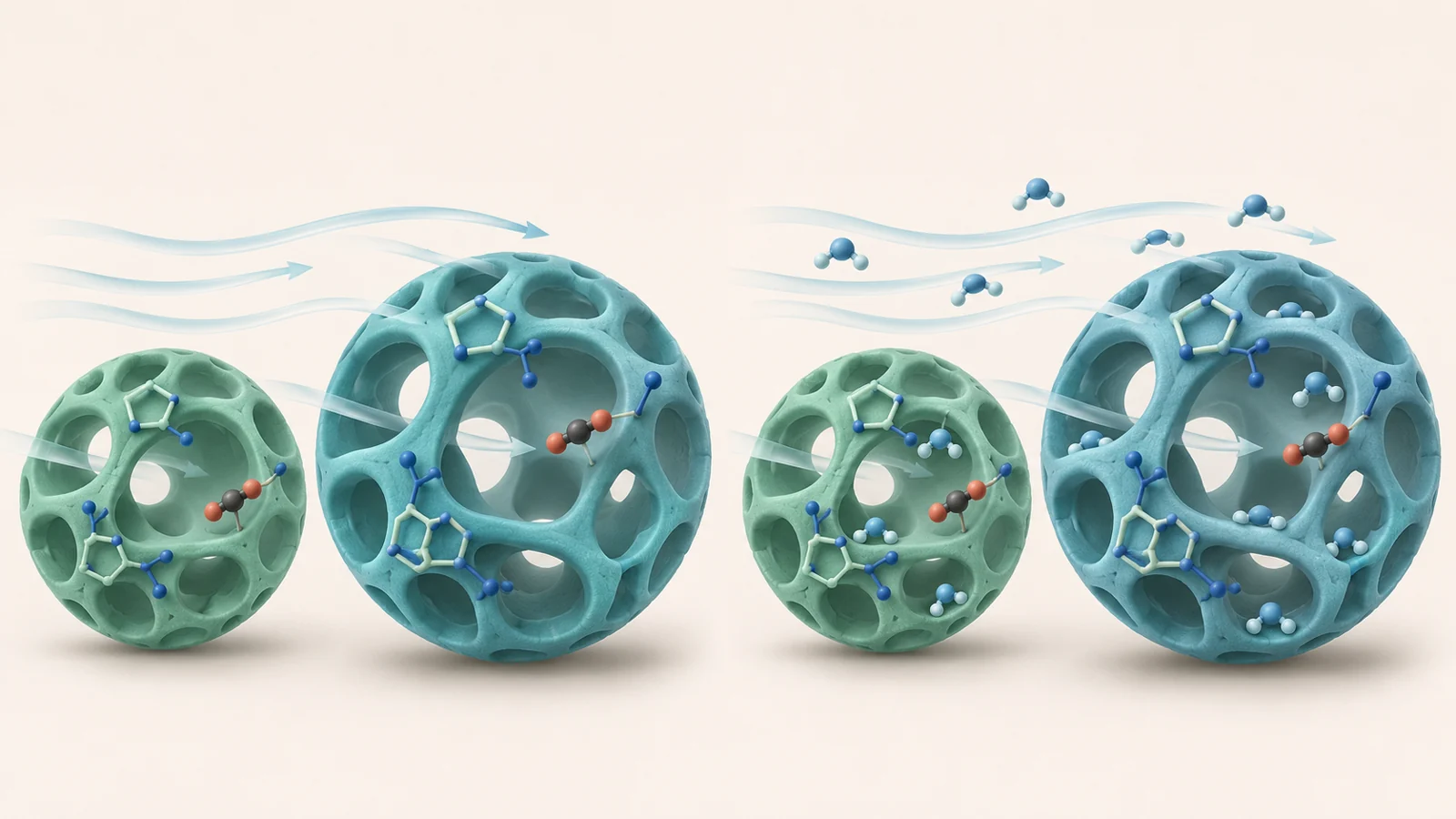
A porous polymer built to bind carbon dioxide showed strong uptake even though its measured surface area was only moderate. The researchers reported up to 2.5 millimoles of CO₂ per gram and selectivity for CO₂ over nitrogen at low CO₂ pressures. But adding water to the air did not help every version of the material equally: a more water-loving design took up so much water that its humid-condition performance was limited.
The results, published on October 27, 2025, point to a practical design challenge. Moisture can change how CO₂ binds, while excess water can burden the material. Which effect dominates depends partly on how the polymer is built.
Binding CO₂ at low pressure
The material belongs to a family called poly(ionic liquid)s, or PILs. In this study, the researchers made porous versions from imidazolium-based building blocks and added amine groups, which can interact chemically with CO₂. The authors describe their synthesis method as reproducible and scalable.
Amines matter because CO₂ can form chemical binding products with them. That differs from physisorption, in which gas molecules are held more weakly on a material’s surface. A large surface area can provide many places for gas to collect, but surface area alone does not tell whether a sorbent will bind CO₂ effectively when the gas is dilute.
To help distinguish those behaviors, the authors introduced a screening measure called Low-Pressure Uptake Efficiency, or LPUE. Their aminated porous polymers had reported LPUE values of 58–66%, which they interpret as indicating that chemisorption—chemical binding—played the primary role. The metric is presented as a way to compare how uptake occurs; the reported values do not, on their own, establish performance in a complete capture system.
The maximum reported uptake of 2.5 mmol per gram and the low-pressure CO₂/N₂ selectivity are separate observations. They show why the materials attracted attention, but the abstract does not establish that the maximum applies to outdoor air. The low-pressure measurements are relevant to dilute-CO₂ capture, while a specific result under flowing humid conditions comes from a different experiment.
Water changes the binding products
The team used solid-state nuclear magnetic resonance, or ssNMR, on samples exposed to carbon-13-labeled CO₂. This technique helped identify the chemical forms produced when CO₂ interacted with the polymer. Under dry conditions, the researchers identified carbamate-ammonium and carbamic acid species. With water present, they observed carbamate and also found that bicarbonate could form.
Those measurements offer a molecular view of how water changes the binding chemistry. They are distinct from the breakthrough experiments, which tested CO₂ uptake as a gas mixture flowed through the material. In those flow tests, humid conditions enhanced uptake. The spectroscopy helps explain possible binding products; the breakthrough results show how the materials behaved under humid flow. Neither measurement by itself establishes long-term operation through repeated capture and release.
A water-loving design can take up too much
The researchers compared polymers made with different cross-linkers, components that help connect and shape the polymer network. A hydrophilic, or water-attracting, cross-linker took up excessive water, limiting performance under humid conditions. A more hydrophobic cross-linker, divinylbenzene (DVB), was compared with it. The authors report that adding a water-repelling counteranion, a negatively charged component of this ionic polymer, helped mitigate the water-loading problem.
This helps resolve the apparent contradiction. Humidity can support different CO₂-binding chemistry and improve uptake in a humid breakthrough test; that does not mean more water is always better. The amount of water the polymer retains also matters. A design that holds too much can lose performance even when water has a useful role in the binding chemistry.
The comparison makes material composition part of the humidity question. Cross-linker and counteranion choices can affect the balance between CO₂ uptake and water loading. The reported results suggest a way to tune that balance, rather than a general rule that all water-attracting sorbents will perform poorly.
What the tests leave open
Each experiment answers a different question. Uptake measurements quantify how much CO₂ the material holds under the measured conditions, and selectivity compares its preference for CO₂ over nitrogen. LPUE is the authors’ screening metric for the contribution of chemical binding at low pressure. Labeled-CO₂ ssNMR identifies binding products, while breakthrough tests measure uptake during humid gas flow.
Together, these are laboratory results for synthesized materials, including a promising humid-flow observation. The supplied evidence does not establish how well the polymers would perform across repeated capture-and-release cycles, what regeneration would require, or how an installed system would work. The authors’ description of a scalable synthesis also does not by itself establish industrial-scale manufacture. Cost and net climate benefit remain unresolved as well.
Where this research could lead
A direct air capture unit must handle outdoor air, where CO₂ is dilute and humidity can vary. If these material results hold up in further testing, a sorbent designed to bind dilute CO₂ while tolerating water could give such a unit a more dependable material choice. The path toward that possibility runs through the reported low-pressure binding, improved uptake in humid flow, and the finding that excessive water loading can limit one design. Direct air capture itself is not new; the potential contribution here is a way to select and tune the material inside a future system.
That possibility depends on more than choosing a polymer. The material would also need to release its captured CO₂, retain performance over time, and work within the wider engineering of a capture system. A nearer milestone would be evidence that CO₂ uptake and selectivity persist through repeated capture-and-release cycles at low CO₂ pressure across defined humidity conditions.
Key Sources
- Primary source: Tailored Design of Mesoporous Aminated Imidazolium Poly(ionic liquid)s: Practical Chemisorption Metric and Detailed Insights into CO 2 Sorption Behavior.
DOI or Journal Page · Peer-Reviewed Paper · 2025-10-27
Keep exploring