
Research Signal – Source date 2021-01-29
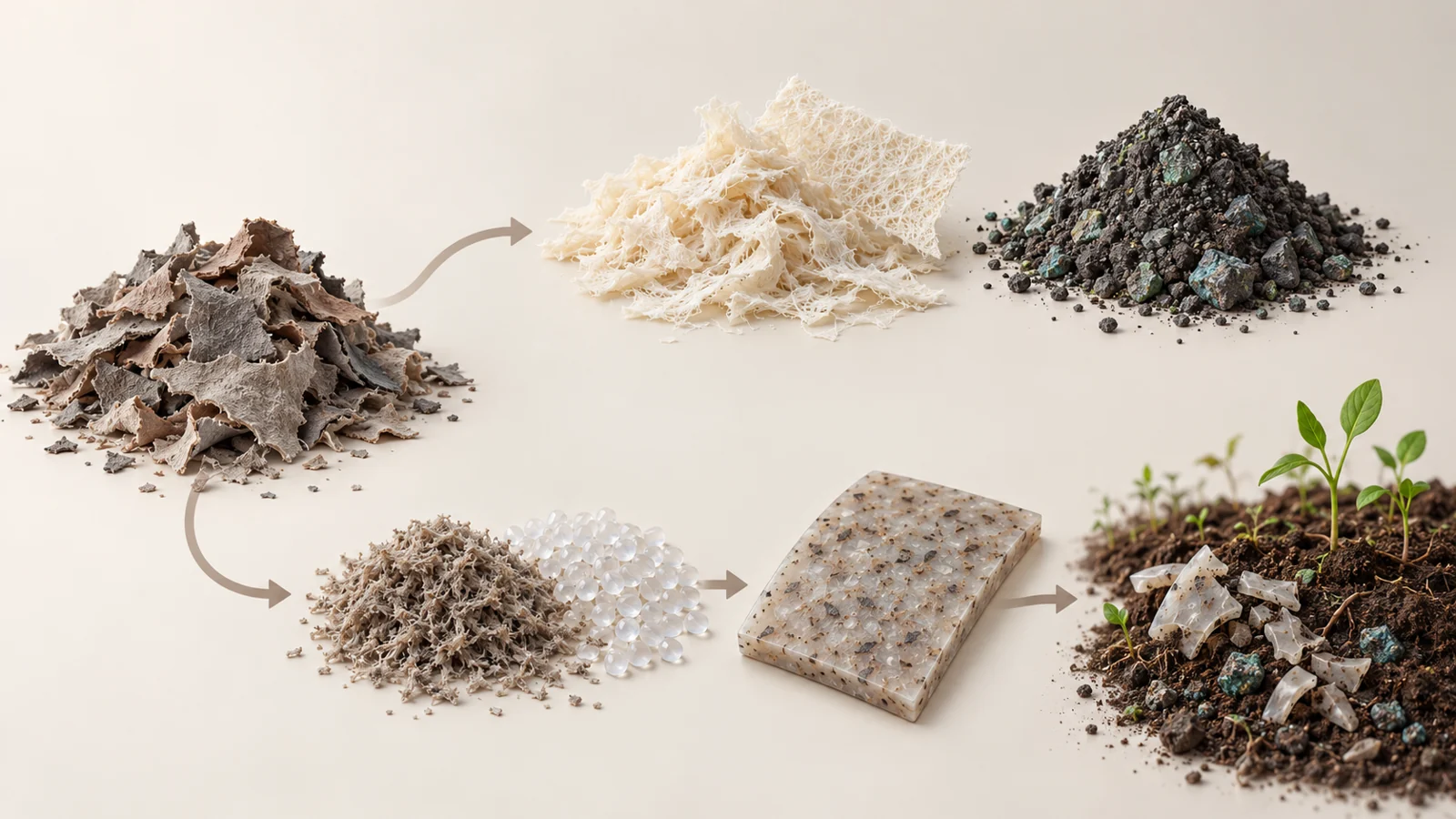
When a biodegradable plastic containing chrome-tanned leather fibers breaks down, the chromium in those fibers does not biodegrade with it. It can remain in the compost. That question matters alongside whether the material is strong, workable, or useful: a promising material property does not settle what happens to the chromium later.
A 2021 review in Polymers examines ways to reuse chrome-tanned leather waste, including recovering collagen and mixing ground leather into polymer composites. A composite is a material made by combining one material—in these examples, leather fibers—with a plastic or other binding material. The review gathers examples of how these materials performed and points to a practical gap: chromium in the finished composite can be difficult to measure reliably.
A large waste stream with two useful components
Making finished leather changes the structure of collagen, the main protein in animal skins and hides, so the material can be used for products such as shoes, bags, furniture, and clothing. The processing also uses substantial amounts of water and chemicals, including chromium salts in chrome tanning, and produces both solid and liquid waste.
The review cites estimates that producing 200 kilograms of finished leather can require 1,000 kilograms of salted hides and generate about 600 kilograms of solid waste. Processing one metric ton of skin can also produce around 50 cubic meters of wastewater. Leather scraps and shavings therefore contain a potentially useful fibrous material, but chrome-tanned waste also carries chromium that needs to be managed.
The review describes two distinct ways to make use of that material. One is to hydrolyze the leather: break down its collagen and separate it from a chromium-containing fraction. The other is to grind the tanned scraps and use the fibers directly as reinforcement in a polymer composite. Thermal treatment, including incineration, is another waste route for energy recovery, though the review notes concerns about emissions and the loss of leather’s material properties.
Recovering collagen leaves another fraction to handle
Hydrolysis can use acidic or alkaline conditions, or enzymes, to recover collagen as a protein hydrolysate such as gelatin. Separating the collagen does not make the chromium-containing fraction disappear. The review describes ways that fraction may be purified and returned to leather processing, as well as other uses, but it remains a separate material stream that needs a suitable destination.
One example of collagen’s potential use is in adhesives. The review reports that adding collagen hydrolysate to urea-formaldehyde and phenol-formaldehyde adhesive formulations improved binding properties and reduced free formaldehyde in the cured resin. It also describes collagen-based adhesives developed for woodworking. These examples show how recovered collagen might become an input to another product, while the chromium separated during recovery still requires its own management.
Fiber content changes what a composite can do
For direct reuse, leather scraps are ground into granules, dust, or fibers, then combined with a binder. Studies summarized in the review use different plastics, fiber sizes, and proportions, so their results are examples of particular formulations rather than a ranking of materials.
In one thermoplastic example, leather scraps were cut into fibers about 0.1 to 5 millimeters long and added to biodegradable plastics in proportions of 5% to 15%. The resulting materials had a uniform structure, and the review reports that adding up to 15% fibers did not affect the polymer’s thermal stability. A separate packaging example used polyvinyl alcohol: composites with 5% leather fiber were easier to process, resisted pulling apart better, stretched farther before breaking, and showed better stability when heated.
A panel made with polyester resin shows a different balance. In the reviewed study, panels with 30% leather fibers were stronger when pulled and stiffer than the other tested formulations; the review links this to better fiber distribution and adhesion in the resin. In one rubber formulation, leather particles improved resistance to tearing before and after heat aging. The rubber composites also had lower strength when pulled and stretched less before breaking. The fibers appeared to slow crack growth while limiting the rubber’s ability to stretch.
These results make the formulation question concrete. The type of polymer, the amount and size of leather fiber, and how the materials are mixed can affect different properties in different ways. A stronger tear resistance, for example, does not imply an improvement in tensile strength, and the reported examples do not show that leather filler improves every polymer or every measure of performance.
Testing chromium inside plastic is difficult
The end-of-life question becomes especially important when the binder is biodegradable. As the polymer breaks down, chromium and other metals in the leather fibers can remain in the compost. The review cites an industrial compostability limit of 50 milligrams of chromium per kilogram of biopolymer and notes that leather can contain substantially more. It cautions that only biocomposites with very low amounts of leather can be safely composted under that standard. The evidence summarized does not establish the chromium release or safety of every formulation.
Testing the finished composite presents a separate challenge. Common chromium(VI) tests measure the hexavalent form of chromium that can be extracted from a sample. In a polymer matrix, chromium may be less able to move out of the material, so an extraction test could understate how much chromium(VI) is actually present. Color-based tests can also be affected by plastic additives.
Heating during production raises another measurement concern. Many leather-polymer composites are made by melt mixing at temperatures often above 150°C. The review notes that heat can accelerate the conversion of chromium(III) to chromium(VI), the more toxic form. Breaking down a sample to measure its total chromium may also change chromium’s chemical form during testing. For these reasons, the review calls for a robust measurement procedure designed specifically for leather-polymer composites, so that results better reflect the chromium in the finished material.
What safer leather composites could make possible
If manufacturers can match leather fibers to polymers that deliver useful performance and can be efficiently recycled, chrome-tanned scraps could become durable materials for products such as footwear, accessories, or building components, while avoiding the compost route that can leave chromium behind. That possibility depends on choosing suitable formulations and accounting for chromium in the finished product and its eventual disposal. The review presents promising material examples, but it does not establish broad commercial adoption or an overall environmental advantage compared with other options.
Key Sources
- Primary source: Recycling of Chrome-Tanned Leather and Its Utilization as Polymeric Materials and in Polymer-Based Composites: A Review.
DOI or Journal Page · Review or Meta-Analysis · 2021-01-29
Keep exploring