
Research Signal – Source date 2024-08-06
Measuring chlorpromazine, a medicine used to treat psychiatric disorders, is the focus of an August 2024 study of a new electrode coating. The researchers combined a cobalt-containing framework material with tiny carbon tubes and reported both detection at low concentrations and encouraging measurements in urine and serum. The contribution is a materials-based approach to drug analysis, with several distinct measures of how well it works.
Building a more responsive electrode
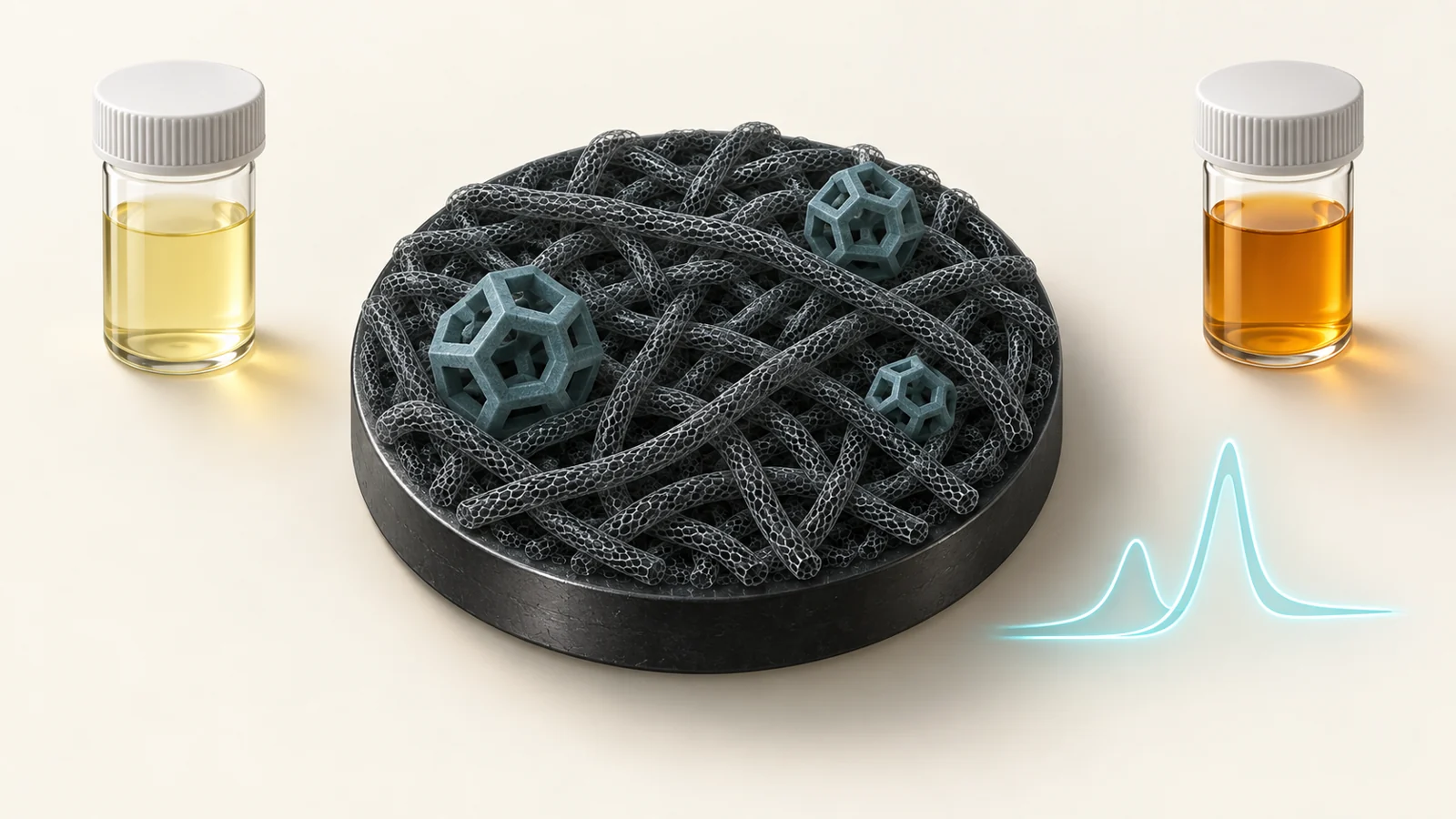
The researchers synthesized a new two-dimensional metal-organic framework called Co-TMPA. Such a framework joins metal centers with organic building blocks; this one contains cobalt and is based on a compound called thiacalix[4]arene. They made it under solvothermal conditions, using a heated solvent environment.
They then combined Co-TMPA with conductive carbon materials to create a series of electrode modifiers. The best-performing formulation in their comparison paired the framework with multiwalled carbon nanotubes—tiny tubes consisting of multiple nested carbon walls—on a glassy carbon electrode. The authors identify that formulation as Co-TMPA/MWCNT-2@GCE.
The electrode provides the surface for electrochemical measurement, which uses an electrical response to detect and quantify the drug. Here, changing the coating changed the reported sensing performance. The authors attribute the leading composite’s performance to synergy between the nanotubes and Co-TMPA. That is their explanation for the combination’s behavior; the abstract does not let us separate each component’s contribution or establish the detailed mechanism behind it.
Detecting a trace and measuring an amount
The headline detection limit was 8 nanomolar, or 8 nM. A detection limit describes how small a concentration can produce a signal distinguishable from background under the test conditions. It does not, by itself, show that the instrument can assign an equally reliable concentration value at that level.
For quantitative measurement, the researchers reported a linear concentration range of 0.05–1350 micromolar, or μM. Within a linear range, changes in concentration correspond to proportional changes in the measured response, allowing calibration to connect an electrical reading to a concentration.
Putting both figures in the same units makes the distinction clearer. The lower end of the reported linear range, 0.05 μM, is 50 nM—above the 8 nM detection limit. The study therefore reports a lower threshold for detecting the drug than the starting concentration of its stated linear measurement range. Readers should not extend that range downward simply because a signal can be detected there.
Together, the figures describe a sensor able to register small amounts and respond across a broad concentration span in the reported experiments. Neither number defines a therapeutic or toxic threshold for a patient.
What the urine and serum results mean
The researchers also used the sensor to analyze chlorpromazine in urine and serum. They reported recoveries of 98.87–102.17% and relative standard deviations of 1.44–3.80% across those analyses.
Recovery compares the amount measured with the reference amount used in the analytical test. A result near 100% indicates close agreement. A recovery slightly above 100% means the measurement exceeded that reference amount; it does not mean the sensor found extra drug that had somehow appeared in the sample. The reported values fall close to the reference amounts on either side.
Relative standard deviation describes the spread of measurements relative to their mean. The reported percentages indicate a modest spread within the tested sets of measurements. They are not percentages of patients correctly diagnosed, nor are they a direct measure of treatment success.
These two statistics answer complementary questions about sample analysis: how closely the measured amount matched the reference, and how much the measurements varied. The authors also report checking the electrochemical detection accuracy using ultraviolet-visible spectroscopy, a technique based on light absorption. That adds a comparison using a different measurement approach.
What remains uncertain
The numerical results are more informative than the abstract’s broad descriptions of excellent stability, selectivity, and reproducibility. Those properties concern whether performance persists, whether other substances interfere, and whether results can be reproduced. Assessing their practical strength requires the underlying test conditions and quantitative results.
This account is limited to the paper’s abstract. It does not provide enough detail to assess sample preparation, sample provenance and counts, calibration structure, or which recovery values belong to urine versus serum. Those details matter when judging how broadly the results might apply. The abstract also leaves the size and design of the spectroscopy comparison unresolved.
Evidence that a sensor measures a drug in biological samples is only part of the case needed for clinical use. Guiding care would require validation for the intended patient population and clinical decision, including how measurement errors affect that decision. The results available here do not establish dosing utility, diagnostic performance, or improved health outcomes. They also do not support claims that this approach is cheaper, faster, or superior to existing clinical methods.
What this could change
If the composite’s reported performance holds up in validation for routine biological-sample workflows, laboratories could gain another electrochemical method for quantifying chlorpromazine in urine and serum. The proposed path is concrete: use the combined framework-and-nanotube coating to obtain a measurable electrical response, then use a validated calibration to determine drug concentration in prepared samples.
The downstream benefit would be an additional usable analytical option for laboratories working with this medicine. Connecting those measurements to patient monitoring or treatment decisions would require separate clinical validation.
Key Sources
- Primary source: Efficient Electrochemical Sensing of Chlorpromazine with a Composite of Multiwalled Carbon Nanotubes and a Thiacalix[4]arene-Based Metal-Organic Framework.
DOI or Journal Page · Peer-Reviewed Paper · 2024-08-06
Keep exploring