
Research Signal – Source date 2022-02-01
Why chemotherapy raised a PD-L1 question
The February 2022 publication began with a problem in cancer treatment. The authors described regular chemotherapy as being followed by increased expression of programmed death ligand 1, or PD-L1, in almost all kinds of cancers. PD-L1 is a protein involved in suppressing T-cell attack, so more of it could make it harder for immune cells to kill tumor cells.
The researchers investigated chitosan oligosaccharide, or COS. These are short sugar chains derived from chitin through chitosan, a biomaterial produced from chitin by chemical deacetylation. COS has been studied for biological activity, but the authors said its anticancer mechanism was not well understood. Their question was whether COS could alter the immune-suppressing signal that chemotherapy may leave behind.
How COS changed the reported signaling
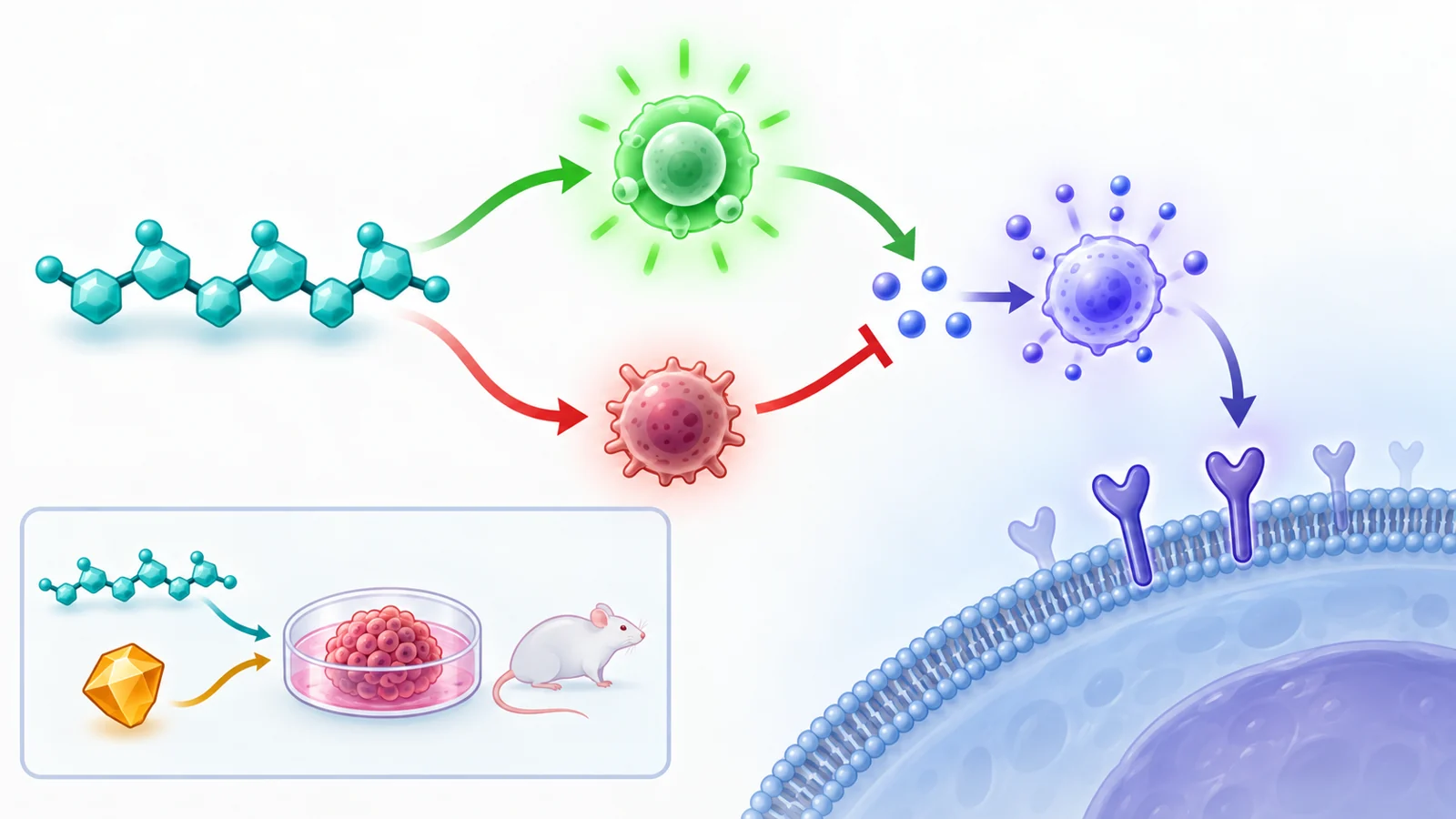
The experimental trigger was interferon gamma, or IFN-γ. In the tumor settings described by the paper, IFN-γ increased PD-L1 expression. COS inhibited that increase through two reported signaling changes: activation of AMP-activated protein kinase, known as AMPK, and inhibition of STAT1.
This gives the finding a more specific explanation than the broad idea that COS might simply “boost immunity.” The reported mechanism connects the sugar fragments to a pathway involving AMPK and STAT1, then to reduced IFN-γ-induced PD-L1 expression. Lower PD-L1 could, in principle, leave T cells less restrained when they encounter a tumor.
The available account supports this paired pathway description. It does not establish that the two changes represent pharmacological synergy, or that the mechanism would behave the same way in people receiving treatment.
What happened in the tumor experiments
The paper then moved from signaling to tumor findings. COS alone reportedly restricted the growth of CT26 tumors and enhanced T-cell infiltration in those tumors. These are separate observations: one concerns tumor growth, while the other concerns the presence of immune cells within the tumor environment.
The authors also combined COS with gemcitabine, a chemotherapy drug. They reported a more pronounced tumor response with the combination, although the supplied abstract does not identify the comparison underlying that description. The result supports interest in COS as a possible companion to chemotherapy, but a stronger reported response is not by itself proof of pharmacological synergy.
The available evidence does not provide numerical tumor reductions, response rates, survival results or durability measures for this signal. It identifies the direction of the findings and the endpoints the authors highlighted.
What the February 2022 evidence leaves open
This account supports a research hypothesis linking COS, AMPK activation, STAT1 inhibition, PD-L1 regulation and tumor immune activity. It does not establish treatment efficacy or safety in people. The material available here also does not allow a reader to assess dosing, administration route, sample sizes, species, detailed controls, effect magnitude or durability.
Those limits matter because a molecular explanation and a tumor-model result are different kinds of evidence. The findings can justify further investigation without showing that COS is ready to use alongside chemotherapy. The supplied evidence also does not demonstrate lower cost, lower toxicity or superiority compared with PD-L1 antibodies, even though the paper presents those antibody limitations as part of the motivation for exploring small-molecule regulation of PD-L1.
What this could mean for chemotherapy
For people receiving chemotherapy, the potential benefit would be an additional treatment approach that reduces tumor immune suppression while chemotherapy attacks the cancer. If the reported AMPK–STAT1–PD-L1 relationship and the COS-plus-gemcitabine response can be reproduced, shown safe and translated into human treatment, COS could help chemotherapy produce a stronger antitumor response.
From the February 2022 perspective, that remains a conditional possibility rather than a demonstrated patient benefit. The study makes the combination worth investigating because it connects a defined immune-signaling change with a reported tumor outcome, while leaving the practical and clinical questions unresolved.
Key Sources
- Primary source: Chitosan oligosaccharide regulates AMPK and STAT1 pathways synergistically to mediate PD-L1 expression for cancer chemoimmunotherapy.
DOI or Journal Page · Peer-Reviewed Paper · 2022-02-01
Keep exploring