
Research Signal – Source date 2021-02-01
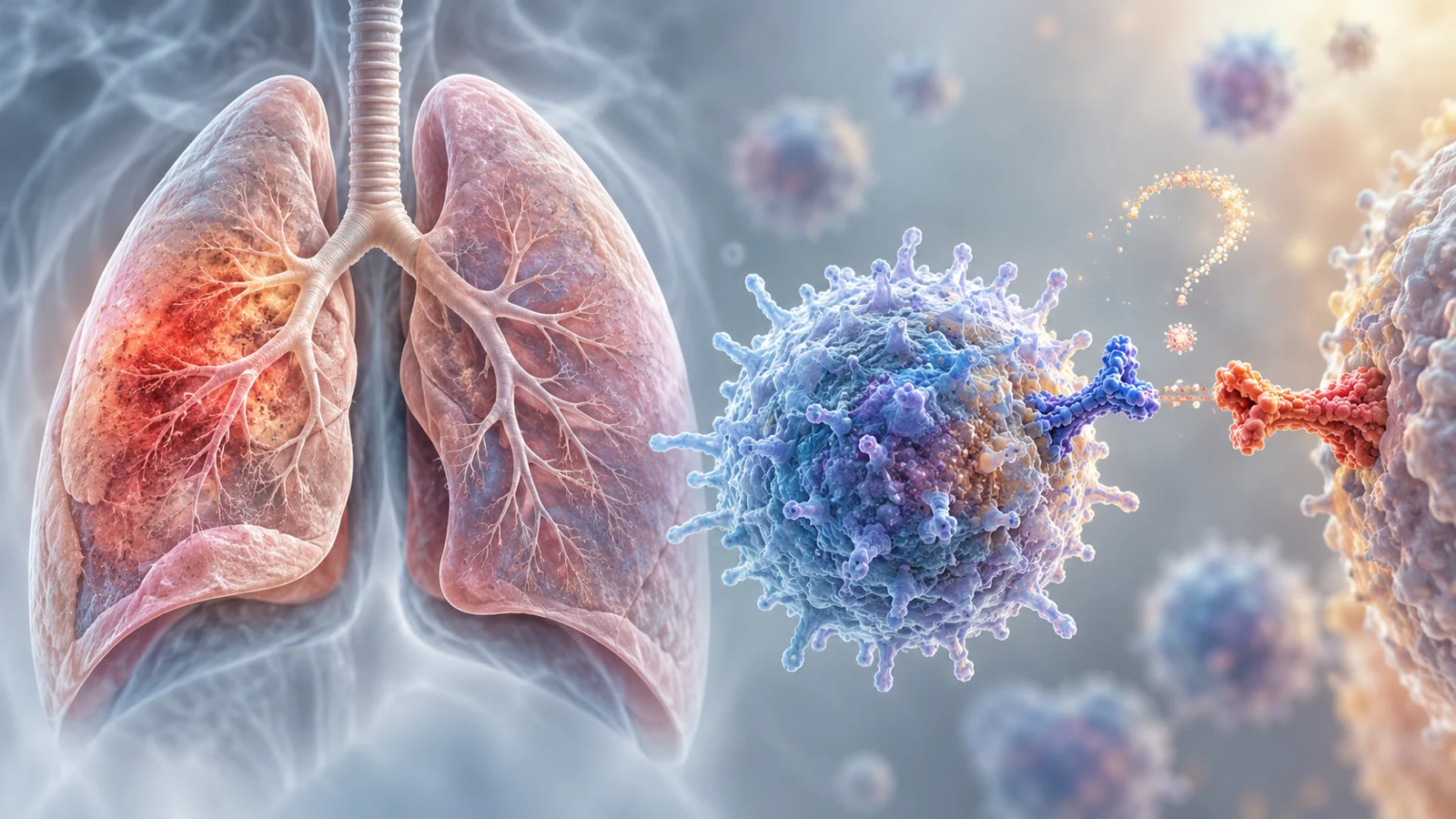
Severe COVID-19 can involve two immune problems at once: inflammation that damages lung tissue, and antiviral T cells that have become less able to fight the infection. That combination raises a difficult treatment question. Could a cancer drug that releases an immune brake restore useful antiviral activity, or might it add to inflammation that is already harming the lungs?
A February 2021 review in the International Journal of Oncology explored that possibility. It drew on observations in people with COVID-19, cancer treatment experience, and research into other viral infections. The proposed treatment was still a hypothesis, and the COVID-19 studies described in the review were designed to investigate it rather than report whether it worked.
Lung inflammation and weaker T-cell defenses can coexist
The immune response to SARS-CoV-2, the virus that causes COVID-19, does not follow one simple pattern. The review describes severe and critical cases in which immune activity in the lungs can become damaging. Inflammation attracts more immune cells and increases the local release of inflammatory signals, worsening injury to the tissue involved in breathing. In some patients, this process can contribute to acute respiratory distress syndrome, or ARDS, a serious form of lung failure.
At the same time, the review describes low numbers of T cells in the blood, particularly CD8 T cells, which can kill infected cells. In severe disease, these cells may shift from early activation toward exhaustion. In plain terms, an exhausted T cell has become less capable of carrying out its job. The review discusses signs of this impaired state alongside signs of activation; the immune picture can include both, and it may differ from patient to patient.
That overlap matters because a treatment aimed at turning up one part of the immune response could affect a disease in which another part is already too active. The central question is not simply whether T cells appear exhausted, but whether restoring their activity in a particular patient would help control the virus without worsening inflammatory injury.
PD-1 is a brake signal, not a treatment verdict
One inhibitory signal highlighted in the review is programmed cell death protein 1, or PD-1. It acts as a brake on immune-cell activity. Antibodies that block PD-1, or its partner PD-L1, are called immune-checkpoint inhibitors. In cancer care, these drugs can help T cells recover activity against tumors by interrupting inhibitory signaling.
The COVID-19 rationale starts with observations that some patients with severe disease have T cells displaying PD-1 and other markers associated with exhaustion. Those markers help describe the cells’ state. Their presence alone does not show that PD-1 is the cause of the problem, that the impairment can be reversed in a useful way, or that a person carrying the marker would benefit from checkpoint treatment.
The review’s proposal was that blocking PD-1 might restore some T-cell function and help the body clear SARS-CoV-2. That idea had a biological rationale, but it required direct testing in people with COVID-19. It also raised a timing and selection challenge: the same intervention could have different consequences depending on a patient’s immune state and disease course.
The hypothesis came from cancer and other infections
Cancer treatment offered one part of the rationale. Checkpoint inhibitors were already used to reactivate immune responses against cancer, and the review described observations suggesting that some cancer patients receiving these drugs could retain immune competence during infections such as HIV, hepatitis B, or hepatitis C. Those observations concern cancer treatment and other infections; they do not establish that checkpoint inhibitors treat COVID-19.
Research on other viral infections supplied another part. In mice chronically infected with lymphocytic choriomeningitis virus, blocking PD-1/PD-L1 was associated with stronger viral control and renewed activity among virus-specific CD8 T cells. The review also cited work in people with HIV in which PD-1-blocking antibodies were associated with restored T-cell abundance and function. These findings made the pathway worth investigating, but the infection models and clinical settings were different from COVID-19.
The transfer of the idea therefore had limits. Cancer experience showed that checkpoint blockade could alter T-cell activity in people; other-virus research suggested that the same pathway could matter during persistent infection. Neither established that changing it during severe COVID-19 would improve outcomes. The COVID-19 studies were needed to test that question directly.
COVID-19 studies were set up to answer different questions
The review described studies involving patients with cancer as well as people without cancer. One French phase II study, NCT04333914, was designed for patients with advanced or metastatic cancer who had COVID-19 and were not eligible for ICU transfer. It compared nivolumab, an anti-PD-1 antibody, alongside standard care with standard care alone. The comparison was intended to assess whether adding the antibody changed the ability to eradicate SARS-CoV-2 in that group. The review described the study as having enrolled 384 patients; that enrollment detail is not an efficacy result.
For people without cancer, the review described a Chinese randomized phase II study, NCT04268537, planned for patients with COVID-19 pneumonia and lymphocytopenia, or low lymphocyte counts. It was designed to examine anti-PD-1 treatment alongside standard care. A separate Hong Kong pilot study, NCT04356508, was described as an open-label, controlled study in 15 adults. It aimed to assess both virus clearance and treatment safety when nivolumab was given with supportive care.
These designs addressed related but distinct parts of the question. A comparison with standard care could help test whether adding anti-PD-1 was associated with a different clinical course. A safety assessment could identify harms that matter when altering immune activity during an illness marked by lung inflammation. The study descriptions in the review tell readers what investigators planned to examine, not what the treatments achieved.
Lung inflammation makes safety central
Releasing an immune brake is not automatically beneficial in a condition where immune activity can injure the lungs. The review notes that checkpoint inhibitors can, in rare cases, cause immune-related lung problems, including pneumonia. That risk is particularly relevant when considering the drugs in people who already have COVID-19-related lung disease.
The review also discusses cancer-patient observations that offered context, but not a safety guarantee for this proposed use. Analyses it cited did not find an increased overall COVID-19 mortality associated with immunotherapy in the groups described. Cancer status, other health conditions, and the differences between treating cancer and treating COVID-19 limit what those observations can say about administering checkpoint drugs specifically for the viral illness.
The review considered pairing PD-1 blockade with treatment aimed at inflammatory pathways such as IL-6. The proposed logic was to address excessive inflammatory activity while trying to restore antiviral T-cell function. That was a treatment rationale, not evidence that a combination would work or reliably balance the two effects. Patient selection, immune-state differences, and the possibility of lung-related adverse effects all mattered to the question the studies needed to resolve.
Where checkpoint therapy could fit in COVID-19 care
If controlled COVID-19 studies showed benefit with acceptable lung and inflammatory risks, clinicians could gain an additional way to restore antiviral T-cell activity in appropriately selected patients and potentially reduce serious complications. The February 2021 review laid out why that possibility merited investigation; it did not establish a treatment benefit. For this strategy to become useful, evidence would need to show that changing the immune response helps patients, rather than merely changing markers associated with exhaustion.
Key Sources
- Primary source: Immune-checkpoint inhibitors from cancer to COVID‑19: A promising avenue for the treatment of patients with COVID‑19 (Review).
DOI or Journal Page · Review or Meta-Analysis · 2021-02-01
Keep exploring