
Research Signal – Source date 2022-06-25
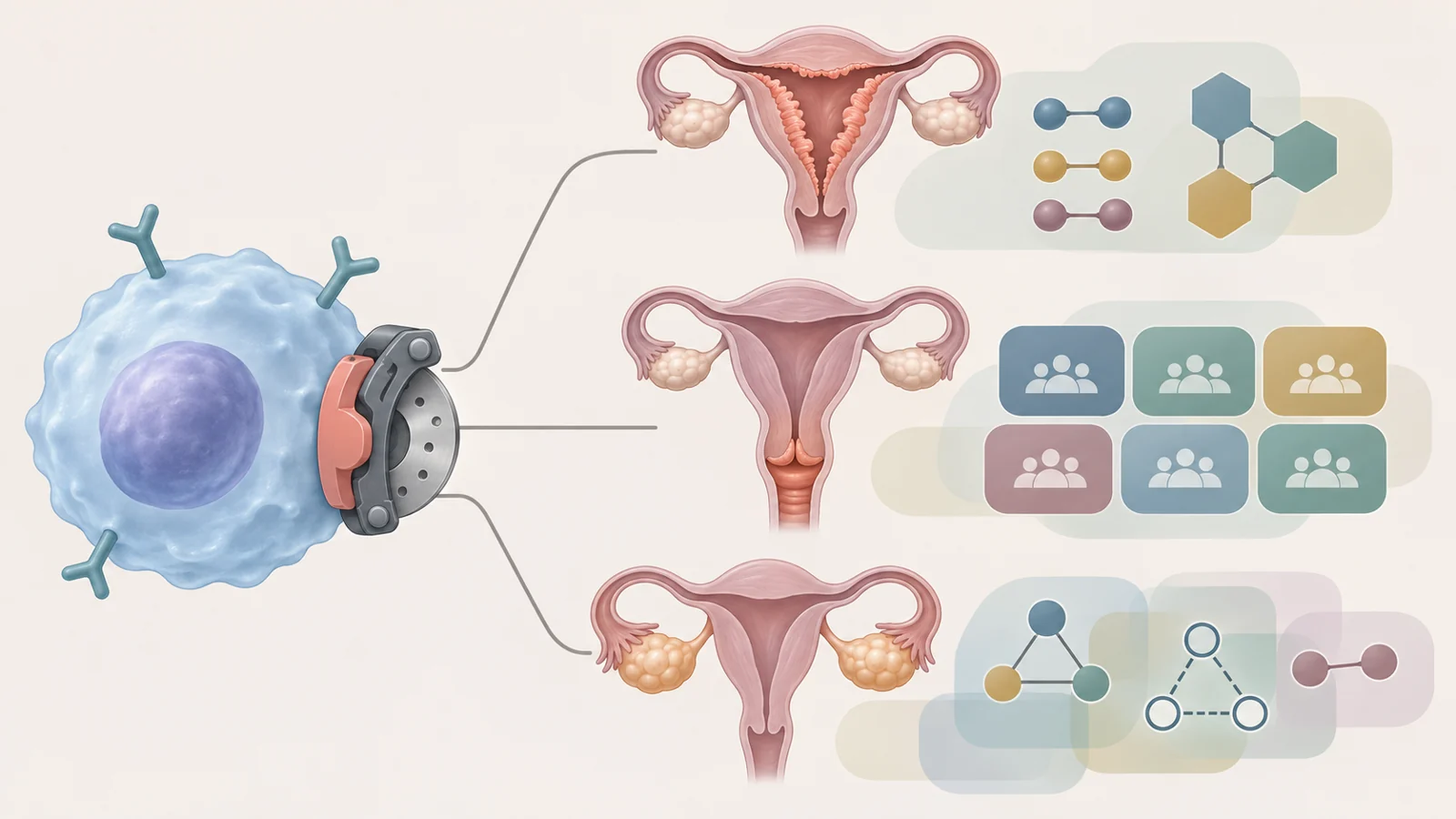
In one cervical cancer trial, adding pembrolizumab—an immune checkpoint drug that releases a brake on immune cells—was linked to higher two-year survival. In a major ovarian cancer trial, adding another checkpoint drug did not produce a persuasive gain in the time patients lived without their cancer worsening. Those results came from separate trials, with different patients and treatments. They are not a direct comparison of the cancers.
The contrast is the central puzzle in a review published June 25, 2022, which gathered clinical-trial evidence on immune checkpoint blockade in gynecological cancers. The authors reported six phase III trials with primary outcomes and 25 completed phase II trials. Their searches covered published reports and ClinicalTrials.gov records through February 28, 2022. The review describes results available by that cutoff; it is not a new trial, and trials still in progress do not yet answer the same questions as completed ones.
Releasing a brake depends on the tumor
Immune cells can recognize and attack cancer, but checkpoint signals can restrain that activity. One such signal involves PD-1, a receptor on immune cells, and PD-L1, a molecule that can be present on tumor cells. Drugs that block this pathway aim to remove some of that restraint. Another checkpoint, CTLA-4, also limits immune-cell activation and is targeted by a different class of drug.
The idea offers a reason to test these treatments, not a guarantee that they will work. The review describes different outcomes across tumor types and patient groups, making the characteristics used to select patients part of the story.
That is especially clear in endometrial cancer. Some tumors have deficient mismatch repair, or dMMR, a problem in a system that normally corrects DNA-copying errors. The review describes evidence that checkpoint drugs can have activity in tumors with dMMR or the closely related high microsatellite instability (MSI-H) pattern. These features helped define a group for treatment studies; they do not predict an individual patient’s response with certainty.
The review reports activity for pembrolizumab in patients with MSI-H or dMMR solid tumors, including endometrial cancer. It also describes the GARNET trial, in which dostarlimab was studied in people with recurrent or advanced dMMR endometrial cancer whose disease had progressed during or after platinum-containing chemotherapy. The confirmed response rate was 42.3%; 12.7% had a complete response and 29.6% a partial response. These are results in a defined trial population, not a rate that can be applied to all endometrial cancers.
A different treatment question was tested in KEYNOTE-775. For advanced endometrial cancer that was not MSI-H or dMMR, pembrolizumab was combined with lenvatinib, a multikinase inhibitor, after chemotherapy. Compared with chemotherapy alone, the combination was associated with 2.8 months longer progression-free survival, 5.4 months longer overall survival, and a higher objective response rate. Progression-free survival is the time before cancer worsens; overall survival is time alive. A response rate counts patients whose tumors shrank partially or completely.
The biomarker-defined checkpoint studies and the pembrolizumab–lenvatinib study should not be collapsed into one result. One addresses treatment activity in tumors with a particular DNA-repair pattern; the other tests a two-drug regimen in advanced disease after chemotherapy. The review reports evidence for both approaches, but each applies to its own patients and treatment setting.
A survival difference in cervical cancer
KEYNOTE-826 tested pembrolizumab added to chemotherapy, with or without bevacizumab, in persistent, recurrent, or metastatic cervical cancer. In the PD-L1-positive population, progression-free survival was 2.2 months longer in the pembrolizumab group than in the comparison group. At 24 months, overall survival was 53.0% with pembrolizumab and 41.7% without it. The review also reports significant gains in progression-free and overall survival among all patients assigned treatment in the trial, whether or not their tumors tested positive for PD-L1.
The trial also reported results for patients whose tumors tested positive for PD-L1. A laboratory score called CPS was used to identify that group; it did not guarantee that any one patient would benefit. The result gives a specific example of an added drug improving outcomes within a defined treatment trial, rather than evidence that checkpoint blockade works uniformly across gynecological cancers.
Cemiplimab provides a separate cervical cancer comparison. In the phase III EMPOWER-Cervical 1 trial, patients with recurrent cervical cancer whose disease had progressed after first-line chemotherapy received cemiplimab or chemotherapy. The review reports that overall survival was 3.5 months longer with cemiplimab, with a 31% lower risk of death in the overall study population. This finding belongs to that drug, trial, and treatment setting; it should not be merged with the pembrolizumab results as if they were one experiment.
Ovarian trials fell short of hoped-for benefit
The review’s ovarian findings help explain why the broad promise of checkpoint drugs did not translate into convincing late-stage results. In IMagyn050, a phase III trial in newly diagnosed advanced ovarian cancer, atezolizumab was added to chemotherapy and bevacizumab. Median progression-free survival was 19.5 months with atezolizumab and 18.4 months without it; the difference was not statistically persuasive (p = 0.28). The trial did not support adding atezolizumab in that setting.
Another large study, JAVELIN Ovarian 100, tested avelumab alongside chemotherapy and then as continuing treatment in previously untreated disease. It was stopped because the regimen was unlikely to show the hoped-for benefit. JAVELIN Ovarian 200 studied recurrent disease that resisted platinum-based chemotherapy. It compared avelumab alone, avelumab with another chemotherapy drug, and that chemotherapy drug alone; the study did not meet its main goal. Across these trials, drugs blocking the PD-L1 checkpoint had not delivered the hoped-for benefit in large ovarian studies.
Earlier ovarian studies offered reasons to keep investigating combinations, but their evidence had a different weight. A phase II study of pembrolizumab with niraparib reported preliminary activity in recurrent ovarian cancer. A small phase II study of nivolumab with bevacizumab reported an objective response rate of 28.9%. A phase II trial combining nivolumab with ipilimumab reported a higher response rate and longer progression-free survival than nivolumab alone. These results can justify further testing; they do not establish that a combination extends survival in a definitive comparison.
Ovarian cancer combinations also raise a safety question. The review discusses immune-related reactions affecting tissues such as skin, gut, lungs, and liver. In the evidence it summarizes, severe adverse events were reported in 55% of patients receiving combined anti-CTLA-4 and anti-PD-1 treatment, and about one-third discontinued treatment. Combining checkpoint drugs may increase activity in some studies, but greater toxicity can narrow the practical value of any benefit. The small or earlier trials do not settle the balance for a future regimen.
Where this research could lead
A more reliable way to identify which tumors are likely to respond could make checkpoint treatment more useful in gynecological cancer: clinicians could match a treatment to a better-defined group, while avoiding exposure to combinations whose added toxicity is not justified by demonstrated benefit. The evidence bridge is visible in the review’s contrast between biomarker-defined endometrial results, cervical trial survival gains, and ovarian phase III setbacks. A meaningful milestone would be larger, controlled trials showing that a marker or combination predicts durable patient benefit and an acceptable safety profile in the specific cancer setting. As of the review’s evidence cutoff, that work remained unfinished.
Key Sources
- Primary source: Immune checkpoint blockades in gynecological cancers: A review of clinical trials.
DOI or Journal Page · Review or Meta-Analysis · 2022-06-25
Keep exploring