
Research Signal – Source date 2022-02-26
For someone whose high-risk bladder cancer has not responded to treatment, the most relevant question is not simply whether another drug showed activity. It is whether the people studied had also experienced treatment failure. A 2022 scoping review identified 13 clinical trials of immune checkpoint inhibitors, with five involving people who had not received Bacillus Calmette-Guérin (BCG), a bladder cancer immune treatment, and eight involving people with a poor response after BCG. Those groups address different moments in care, so combining them could blur what the findings mean for someone considering bladder removal after BCG fails.
The review, published on February 26, 2022, surveyed a developing trial landscape. It pointed to early signs of activity in two studies, but it did not establish checkpoint treatment as a reliable way to preserve the bladder or replace radical cystectomy, surgery to remove it.
Two treatment histories, two research questions
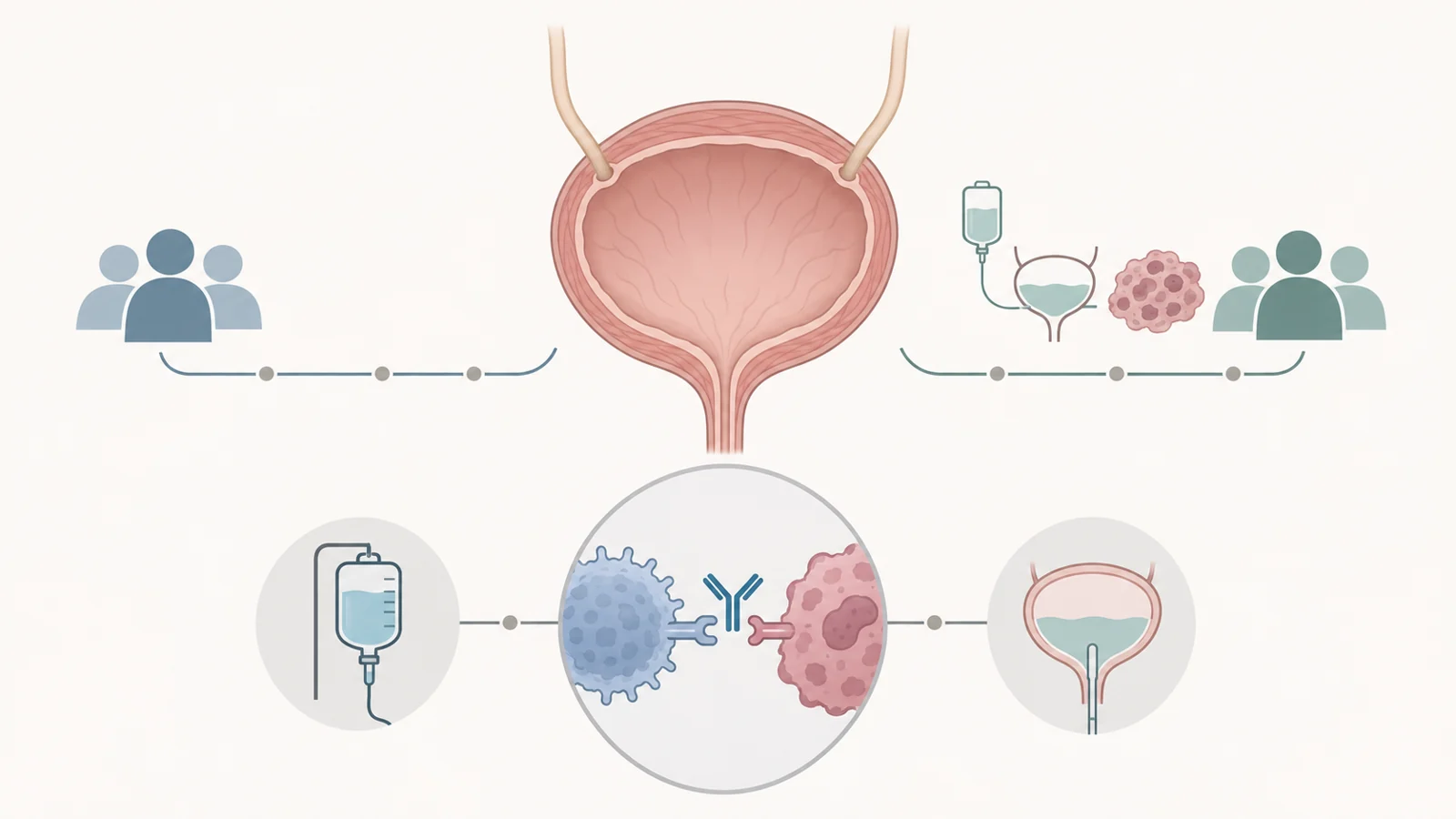
BCG is used as an immune treatment for bladder cancer. Checkpoint inhibitors are another immune-directed approach: they release brakes that can limit immune-cell activity. Researchers were testing these drugs alone, alongside BCG, or by different routes. Some were given intravenously, while others were administered into the bladder.
Each choice creates a distinct question. A study in people who have not yet received BCG asks about using checkpoint treatment earlier in care. A study in people whose cancer persists or returns despite BCG asks whether another approach may help after that treatment has not worked well enough. Route and combination matter too: results from a drug given through a vein do not automatically answer what to expect from treatment placed in the bladder or combined with BCG.
The authors searched medical literature databases and clinical-trial registries and found 13 trials in development. Five included people without prior BCG; the other eight involved people described as having persistent, refractory, or unresponsive disease after BCG. The review also discussed patients who did not accept radical cystectomy, a context that makes the question of alternatives especially consequential. The groups were not presented as a head-to-head comparison, and the abstract does not provide a basis for ranking routes or treatment histories.
Early activity centered on carcinoma in situ
The review highlighted preliminary findings from SWOG S1605, describing encouraging antitumor activity and lasting responses among patients with carcinoma in situ, with or without papillary disease. It also cited KEYNOTE-057, in which pembrolizumab alone was described as tolerable and as showing promising activity in people with BCG-unresponsive non-muscle-invasive bladder cancer after 36 months of follow-up.
These are reasons the approach drew attention, but the review’s complete-response discussion was limited to patients with carcinoma in situ. It does not support extending that response claim to every high-risk bladder tumor. Nor does the abstract give a response percentage that can be used to estimate an individual person’s chance of benefit.
What the safety wording can and cannot tell a patient
For a person weighing another treatment against bladder removal, tumor response is only part of the decision. The review’s abstract describes adverse effects as mild, but it does not give their severity details or information about intervention-related deaths. That wording cannot establish that serious harms were absent, or show how likely benefits and harms would balance for a particular patient.
The review therefore captured a possible treatment direction and an early response signal, not a settled choice between checkpoint therapy and surgery. Its findings were drawn from a developing clinical-trial landscape, and the abstract does not show that checkpoint drugs can reliably preserve the bladder after BCG failure.
What this could make possible
If future evidence confirms durable responses and clearly reports harms for people with high-risk carcinoma in situ that persists after BCG, a patient could discuss checkpoint treatment with more dependable information while weighing bladder removal. The possible advance is a clearer basis for that decision, not the arrival of either treatment: BCG and checkpoint drugs already existed when this review was published.
A nearer milestone would be trial results that describe how long responses last and how severe adverse events are specifically for people with BCG-unresponsive carcinoma in situ. This review offers an early reason to ask those questions, but it does not establish that checkpoint treatment will become a dependable alternative to surgery.
Key Sources
- Primary source: Immune checkpoints inhibitors in the management of high-risk non-muscle-invasive bladder cancer. A scoping review.
DOI or Journal Page · Review or Meta-Analysis · 2022-02-26
Keep exploring