
Research Signal – Source date 2025-10-01
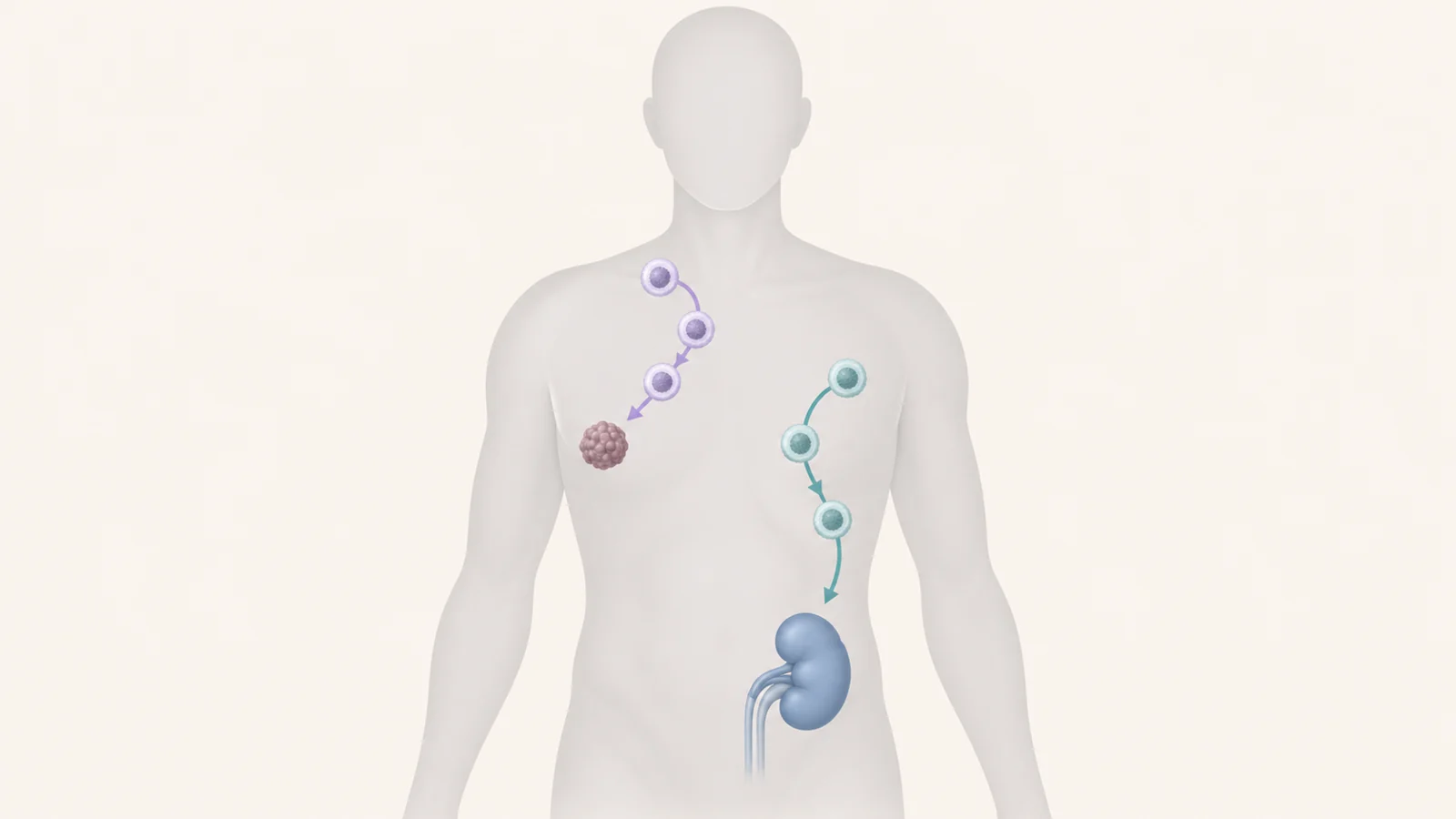
For someone with an advanced cancer and a transplanted organ, a treatment that helps the immune system attack a tumor could also put the transplant at risk. Immune checkpoint inhibitors—cancer drugs that release some of the immune system’s restraints—raise this difficult question because those restraints help keep immune activity in check.
A systematic review and individual participant data meta-analysis published in October 2025 pooled information on 343 solid organ transplant recipients treated with these drugs. The estimated chance of an objective tumor response by one year was about one in three overall, but it varied substantially by cancer type. Acute rejection was also common, and most cases appeared early after treatment began. These are separate outcomes across the pooled group; they do not describe a single subgroup of people who both responded and experienced rejection.
Tumor response depended on the cancer type
At one year, the estimated objective response rate was 31.6% overall. The rate was highest for cutaneous squamous cell carcinoma, a type of skin cancer, at 61.0%. It was 48.5% for melanoma and 26.9% for other solid organ cancers. The confidence intervals around these estimates were wide, especially for melanoma and the other cancers, so the percentages should be read as estimates rather than precise forecasts for an individual.
“Objective response” means that a tumor shrank enough to meet standardized response criteria. It is not the same as living longer. The review separately estimated that 52.8% of participants died from cancer within three years of starting treatment. That figure covers a different outcome and a different time window; it cannot be directly compared with the one-year response rates as if one were the inverse of the other.
Cancer type also tracked with differences in cancer-related death. Compared with recipients who had cutaneous squamous cell carcinoma, those with melanoma had a higher rate of cancer-related death in the adjusted analysis, as did those with other solid organ cancers. These comparisons reflect the people and reports included in the analysis, not proof that cancer type alone caused the differences.
Rejection often came early, but graft loss was a separate outcome
The estimated incidence of acute rejection was 33.7% within six months of starting an immune checkpoint inhibitor and 36.2% by one year. In other words, much of the observed rejection occurred in the first half-year. Among people with rejection, about two-thirds had a biopsy confirming it. The review also found a higher rejection rate for melanoma than for cutaneous squamous cell carcinoma in its adjusted comparison.
Rejection does not always mean that the transplanted organ is permanently lost. The estimated incidence of graft loss was 16.5% by six months and 18.4% by one year. Among the 75 people whose grafts were lost, more than 90% of those losses were attributed to rejection. The estimates make clear why both outcomes matter: rejection is an immune event, while graft loss is the more consequential outcome of losing the transplanted organ.
The timing makes the findings clinically important, but the pooled analysis cannot tell a particular recipient what will happen. It does not provide a validated personal prediction of tumor response or graft loss, and its kidney-heavy sample offers less detailed evidence for people with other transplanted organs.
Maintenance treatment was linked to different graft risks
Transplant recipients take medicines to reduce the chance that their immune system will reject the transplanted organ. In the adjusted analysis, recipients taking mTOR inhibitors (medicines that dampen immune activity) with steroids had lower hazards of acute rejection and graft loss than recipients taking other maintenance regimens. The hazard of rejection was lower by an estimated 70% (hazard ratio 0.30), and the hazard of graft loss by an estimated 88% (hazard ratio 0.12).
A hazard ratio compares the rate at which an event occurred over follow-up; it is not the same as a person’s absolute chance of that event. Nor does this association establish that the drug combination caused better outcomes. People were not randomly assigned to maintenance regimens, and their cancer, transplant and treatment circumstances could have differed in ways the analysis could not fully account for.
The authors proposed that mTOR inhibitors may help preserve immune tolerance to the transplanted organ while allowing anticancer activity, and that steroids may contribute to reducing rejection. This offers a possible explanation for the association, not a proven protective recipe. Adjusting transplant medicines may also affect cancer treatment, which makes the balance difficult to resolve from observational reports alone.
What the pooled evidence can and cannot settle
The researchers searched medical databases and trial registries through June 2024. Of 140 studies in the review, 128 contributed individual participant data for the analysis of 343 recipients. The underlying literature was made up largely of case reports and case series, alongside observational studies and small single-arm trials. Most participants had kidney transplants, and nearly nine in ten had metastatic cancer.
Combining individual participant information made it possible to compare outcomes by cancer type, transplant type and maintenance treatment. The researchers also tested whether different statistical methods and missing information changed the estimates; the results were similar. Those checks support the stability of the estimates within the available data, but they cannot remove selection bias, uneven reporting or confounding in the original studies.
The figures therefore describe outcomes among reported recipients who received checkpoint inhibitors, not a controlled comparison with transplant recipients who received another treatment. They show meaningful differences by cancer type and a regimen association worth investigating. They do not establish that checkpoint inhibitors improve survival for an individual transplant recipient or that one maintenance regimen reliably protects every graft.
How this could shape the future
A person with advanced skin cancer and a transplanted kidney could one day face this decision with dependable estimates that bring both sides of treatment into view: the likelihood of tumor response and the risk of rejection or graft loss, tailored to cancer type and maintenance treatment. The cancer drugs and transplant care already exist; the advance would be having trustworthy joint estimates to guide decisions. This review offers pieces such estimates would need—cancer-specific response differences, an early pattern of graft risk and an association with one maintenance regimen—but stronger comparative evidence is still needed before those pieces can support reliable predictions.
A nearer measurable milestone would be a prospective, multicenter study that reports tumor response alongside biopsy-confirmed rejection and graft loss, with results separated by cancer type and maintenance regimen. Such evidence could clarify how these outcomes relate in the same patients and whether the observed regimen association holds up. It would be a step toward more dependable decisions, not proof in advance that treatment can be made safer.
Key Sources
- Primary source: Outcomes of Solid Organ Transplant Recipients With Advanced Cancers Receiving Immune Checkpoint Inhibitors: A Systematic Review and Individual Participant Data Meta-Analysis.
DOI or Journal Page · Review or Meta-Analysis · 2025-10-01
Keep exploring