
Research Signal – Source date 2022-04-01
A missing group in cancer trials
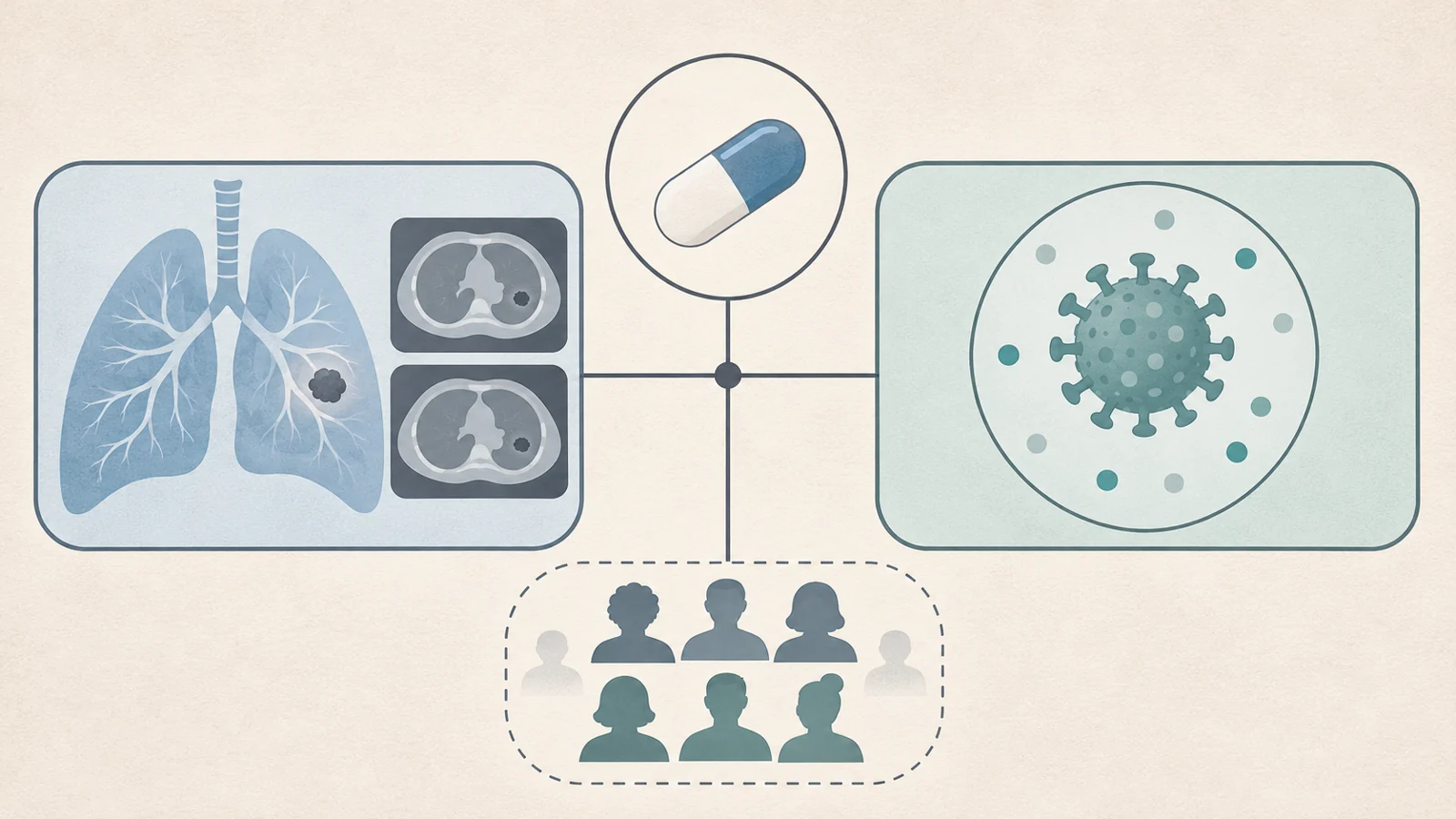
People living with HIV have often been excluded from clinical trials of immune checkpoint inhibitors, drugs that help the immune system recognize and attack cancer. That leaves a practical evidence gap: results from the broader cancer population may not fully answer how treatment works, or affects HIV, in people who have both conditions.
A systematic review searched PubMed for reports on checkpoint treatment in people with HIV and advanced cancer. It identified 130 patients. The number offers a useful clinical glimpse, though it draws on reported cases across several cancers and treatments rather than a single, directly comparable group.
Lung cancer made up the largest share
Non-small cell lung cancer accounted for 43.1% of the patients, making it the most common cancer in the review. The most frequently used drugs were nivolumab, given to 48.5% of patients, and pembrolizumab, given to 36.9%.
These figures show where much of the available experience lay: lung cancer and two checkpoint drugs. They do not tell us that every cancer type or drug was equally represented, or that the findings apply in the same way across the whole group.
A comparison that offers reassurance, with limits
For people with HIV and advanced non-small cell lung cancer, the authors said the cancer-control rates were consistent with those reported in the general population. This is an encouraging indication that tumor control was not obviously out of step with broader reports.
“Consistent with” is a comparison between reported results, not proof that treatment works equally well or is equally safe in the two populations. The review combined patients with different cancers and treatments, and its abstract does not supply the detail needed to establish comparative equivalence. The finding is best read as a clinical signal that merits direct study.
Severe adverse events and HIV control are separate questions
The review counted grade 3 or higher adverse events in 15 of the 130 patients, or 11.5%. This category captures severe events, but the supplied summary does not give further detail about their types or how they varied across patients and treatments.
Separately, the authors reported no harmful effect on HIV virologic control in their analysis: the reports did not show HIV becoming harder to keep in check. This is a different outcome from tumor control, and the severe-event count alone cannot answer it.
A reservoir finding is not a cure finding
The review also described a role for checkpoint inhibitors in decreasing the HIV reservoir—the pool of HIV that remains in the body. This is a different line of interest from treating a tumor or maintaining virologic control.
The abstract does not establish the size or durability of any reservoir change. A reported decrease should not be read as HIV cure or lasting remission. It raises a biological question alongside the review’s clinical observations, rather than resolving it.
Where this research could lead
A patient with HIV and advanced lung cancer could one day weigh a checkpoint drug using results gathered directly from people in the same situation, rather than relying mainly on cancer trials that usually excluded them. The review offers a starting point for that possibility: observed tumor-control rates consistent with general-population reports, a count of severe adverse events, and an analysis that found no harmful effect on HIV virologic control. Dependable decisions would still require further direct studies.
A useful nearer milestone would be a prospective study enrolling people with HIV and advanced lung cancer and reporting three outcomes separately: tumor control, severe adverse events, and HIV virologic control. Seeing those measures together in a defined group would make the evidence more useful for weighing cancer treatment while monitoring HIV.
Key Sources
- Primary source: Immune checkpoint inhibitor therapy for cancer patients infected with HIV: A systematic review.
DOI or Journal Page · Review or Meta-Analysis · 2022-04-01
Keep exploring