
Research Signal – Source date 2022-06-08
Cellulose is the material that gives familiar plant fibers, including cotton and wood fibers, much of their structure. Turn it into part of a water-holding polymer network—a hydrogel—and researchers can explore uses far removed from cloth or paper. Some experimental gels register small movements. Others carry medication or help conduct externally supplied electricity at a wound.
A review published on June 8, 2022, brings together several such approaches. It describes a family of materials with different ingredients, structures and intended jobs. Its biomedical examples offer a useful way to understand how a soft, wet material might work against living tissue, and why demonstrating a function is only part of making it dependable.
The starting point is the network inside the gel. How its long molecular chains connect helps determine whether it stretches, resists tearing, swells in response to acidity or remains useful under mechanical stress.
What holds a wet network together
Cellulose consists of long chains of linked sugar units. Its source and processing affect its structure, while chemical modification can change the groups available to interact with water and neighboring chains. These differences matter before a gel ever reaches a sensor or dressing.
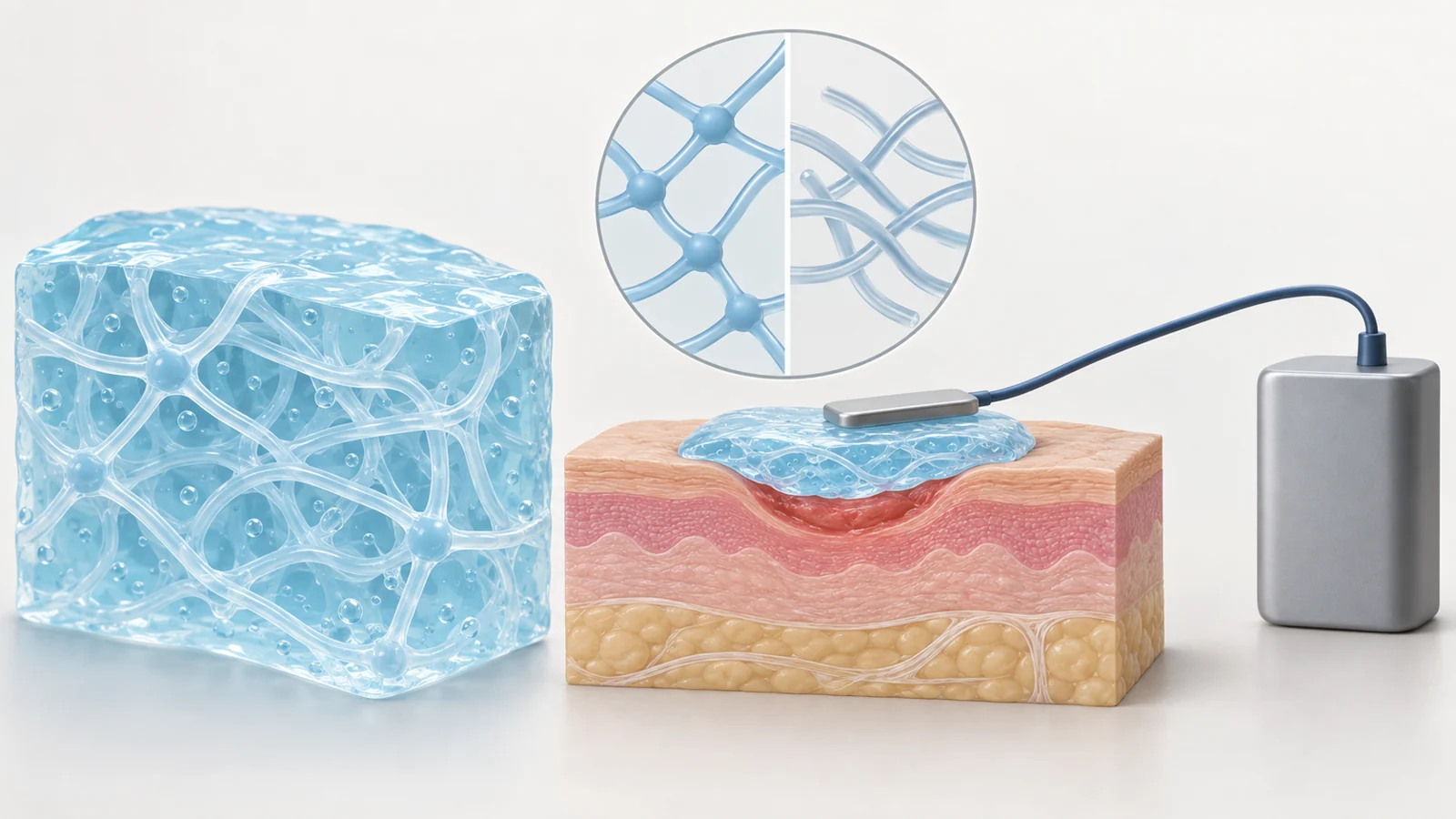
To make a hydrogel, researchers connect polymer chains into a network that holds water. These connections are called cross-links. Physical connections can arise from chain entanglement and attractions such as hydrogen bonding. Chemical cross-linking creates covalent bonds between chains. Both approaches help keep the network together, but they respond differently when the material is pulled or compressed.
Combining them can give a gel more than one way to handle force. A chemically connected network can maintain continuity as the gel deforms. Physical contacts can break and rearrange, dissipating some of the energy imposed on the material. That energy dissipation helps explain toughness—the ability to absorb energy before breaking—which is distinct from simply withstanding a large force.
One study described in the review used chemical cross-linking followed by physical cross-linking to produce cellulose gels that were transparent, foldable, elastic and quick to recover after deformation. Their mechanical behavior improved relative to the study’s gels made using either cross-linking approach alone. The authors connected that behavior to covalent bonds, hydrogen bonding and entanglement within the network.
This is a concrete construction lesson. Connections that preserve the overall structure can work alongside contacts that yield under stress. For a soft material expected to bend with the body, that combination offers a way to accommodate movement while resisting damage.
Turning movement into a readable signal
A wearable sensor needs a further step between deformation and information. Pressure or stretching must produce a measurable change that an instrument can record. The review describes cellulose-containing gels that carry electrical signals, including ionic conductors in which dissolved charged particles move through the water-rich material.
In a pressure or strain sensor, deformation changes the gel’s electrical response. Recording that response provides a way to follow movement. One example combined very fine cellulose fibers with polyvinyl alcohol, another polymer, in a transparent conductive gel used for pressure sensing and human-motion detection. Another used a modified cellulose gel formed through the directional diffusion of an aluminum chloride solution and packaged it as a sensor for small body movements.
These examples connect a physical event to an observable output. A bend or press deforms the sensing material; its electrical response changes; the readout represents the movement. Mechanical resilience matters because the sensing element must accommodate the motion it measures. Signal stability matters because an easily stretched gel is of limited use if its electrical output becomes unreliable.
The review also describes a different route to sensing. In some cellulose gels, deformation changes the orientation of the internal structure and therefore its optical behavior. Here, the detectable response involves light. Electrical and optical examples demonstrate different ways to read a force acting on a soft network.
Releasing a drug and keeping it in place
For a drug carrier, the surrounding fluid becomes part of the material’s operating conditions. The review explains how acidity can affect gels containing chemical groups that gain or lose protons as pH changes. This alters their charge and the attractions or repulsions between them.
Changes in charge can change how much the gel swells. Differences in ion concentration inside and outside the network also affect water uptake, while changes to hydrogen bonding can alter the network’s connections. Together, these processes provide mechanisms through which local acidity can influence a carrier’s structure and drug release.
The review discusses pH-responsive delivery designs, including an experimental approach intended for oral insulin administration. That example illustrates the proposed use of an environmental response to control delivery. It does not establish that swallowing such a carrier provides a dependable substitute for injected insulin.
Local treatment inside the mouth brings a separate requirement into focus. Saliva continually passes over the oral lining. A carrier intended to keep medication near a lesion must remain attached there while exposed to that flow. A useful release response cannot compensate for losing contact with the intended site.
The authors describe a system using hydroxypropyl cellulose, a cellulose derivative, with a backing layer to deliver the anti-inflammatory drug triamcinolone acetonide for aphthous ulcers, commonly called canker sores. The example makes adhesion a functional part of delivery. Swelling and network structure influence release; attachment helps determine where that release occurs. Those are different jobs, and both matter to maintaining local exposure.
A conductive dressing works with an external stimulus
The wound-care discussion includes a cellulose composite containing polydopamine and reduced graphene oxide. The review describes this material through two distinct kinds of biological evidence.
In the cell comparison, muscle precursor cells grown on the conductive composite showed greater proliferation activity and more adhesion sites than cells on a pure cellulose gel, without electrical stimulation. Those observations concern how cells behaved on the two surfaces.
Separately, the review describes an in-vivo diabetic-wound experiment that combined the conductive gel with external electrical stimulation and reported promoted repair. The dressing provided a material through which the stimulation could be delivered. The electricity came from a separate source.
Keeping these accounts distinct preserves what each can teach. The cell comparison concerns the material surface under unstimulated conditions. The wound account concerns a combined treatment. It cannot, on its own, assign the reported repair effect to the gel independently of the applied electrical stimulus.
What dependable use still requires
At publication, the review’s authors described most functional cellulose hydrogels as experimental and identified technical immaturity as a barrier to industrial production. Their list of practical problems included sensor signal loss, poor performance at freezing temperatures, foreign-body reactions and loss of function.
These problems affect different parts of the proposed use. A sensor must maintain a meaningful relationship between movement and its output. A material placed against tissue must retain its function while interacting acceptably with that tissue. The oral-delivery example adds the demand of staying at the intended site despite fluid flow. Success in one of these tasks does not settle the others.
Cellulose’s natural origin does not establish the safety or degradation behavior of every finished gel. Chemical modifications and added polymers or conductive components make the complete formulation the relevant material for evaluation. Favorable cell behavior is useful evidence, but it does not establish dependable clinical benefit across patients or applications.
Even mechanical results require care when comparing candidates. The review notes that cellulose crystal structure, crystallinity, direction-dependent behavior and measurement methods can affect reported properties. A high strength value for one structure and a large stretch value for another do not create a common ranking when the materials and tests differ. Nor do the separate sensing, delivery and wound examples establish a single formulation that performs all those functions together.
The June 2022 picture is therefore one of specific working demonstrations alongside unresolved demands at the material–tissue interface. The gap involves maintaining the intended behavior under the conditions of use, as well as establishing an acceptable biological response.
What this could change
If suitable formulations can establish tissue compatibility, retention and stable function, clinicians could gain new ways to deliver treatment where it is needed. A conductive cellulose dressing could support externally applied electrical treatment at a wound while providing a soft interface with the tissue. An adhesive drug carrier could keep medication near an oral lesion despite the movement of saliva.
The potential benefit to patients lies in that local access. The dressing would help couple an external treatment to its intended site; the carrier would help maintain medication close to the tissue being treated. The review’s examples make those capabilities plausible research goals, with dependable material behavior providing the necessary connection between a laboratory demonstration and a useful medical tool.
Key Sources
- Primary source: Advances in Cellulose-Based Hydrogels for Biomedical Engineering: A Review Summary.
DOI or Journal Page · Peer-Reviewed Paper · 2022-06-08
Keep exploring