
Research Signal – Source date 2021-03-18
A cellulose gel can take up water and capture pollutants, yet its performance depends on the chemistry of both the material and the water around it. A review published on 18 March 2021 brings together earlier studies of cellulose-based hydrogels for removing dyes and metal ions. Its central lesson is that a gel’s impressive result in one test describes a particular material in particular water—not a universal filter.
The distinction matters because wastewater contains more than its most visible contaminant. Acidity, dissolved salts and other ions can change which substances reach and attach to the gel. The gel itself also has to remain intact while it swells and holds pollutants. Understanding those competing demands helps explain both the promise of cellulose materials and the limits of laboratory removal figures.
A water-holding network with places to bind pollutants
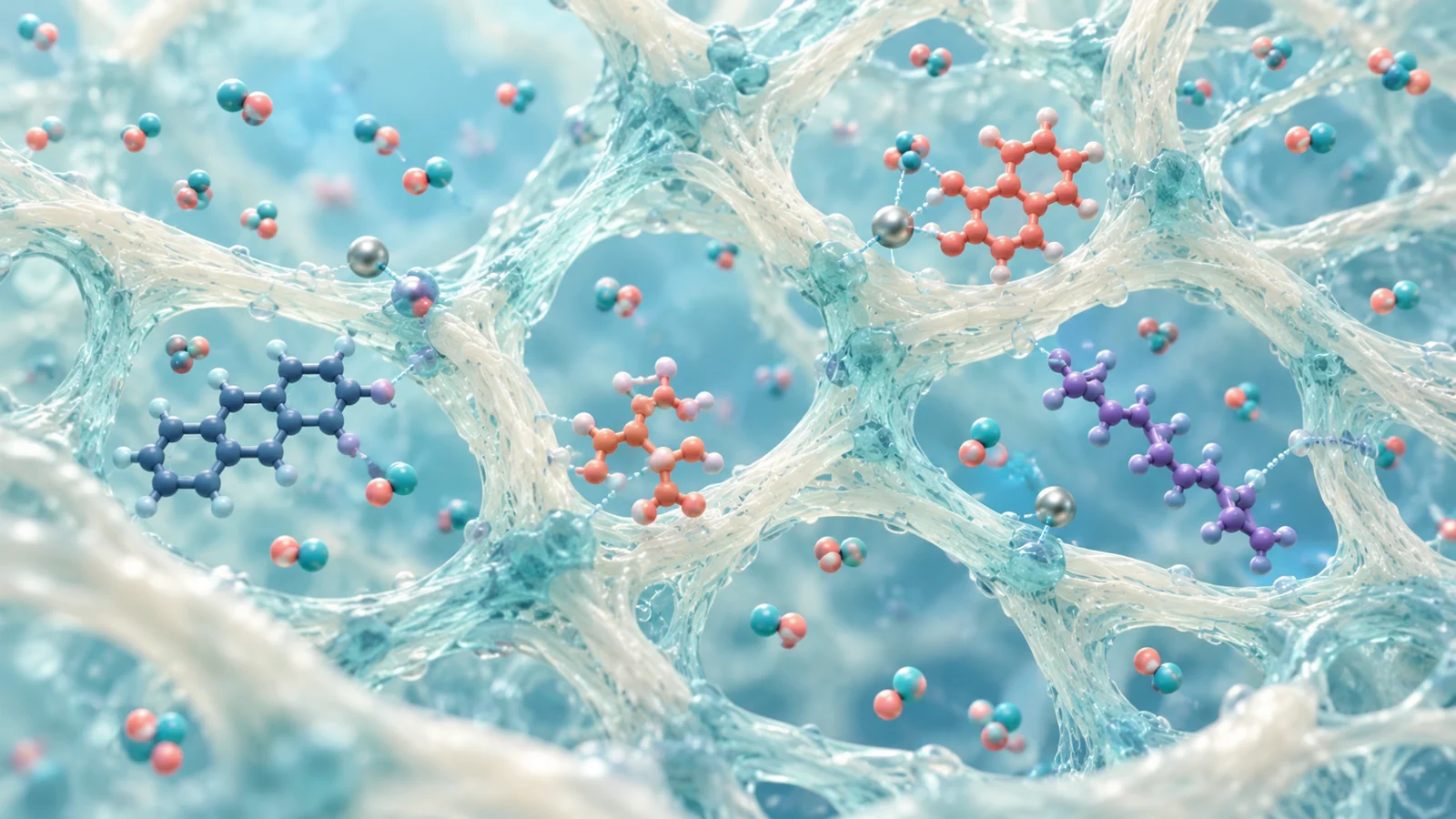
Hydrogels are networks of polymer chains that can absorb and retain substantial water. In a cellulose-based hydrogel, the chains are connected, or crosslinked, so the swollen material holds together instead of dissolving. Cellulose’s hydroxyl groups and other functional groups in a formulation can provide sites that interact with pollutants.
Those connections can be physical, involving relatively weak forces such as hydrogen bonds or ionic attractions, or chemical, involving stronger bonds formed with crosslinking agents. The choice affects more than whether the gel stays in one piece. A more open network can leave binding sites easier to reach and make room for water, while a tightly connected structure can restrict swelling and access. Physical crosslinking can offer porosity and easier regeneration, but may leave the material mechanically weaker. Chemical crosslinking can add strength while consuming some binding sites or making the network more rigid.
Once water and pollutants enter the network, adsorption occurs: molecules or ions attach to sites on the material. The review describes electrostatic attraction as a common mechanism. In simple terms, oppositely charged surfaces attract. Other interactions can contribute too, depending on the gel’s functional groups, the pollutant and test conditions.
Acidity can change which way the surface pulls
The charge on a gel’s surface can shift as water becomes more acidic or more basic. At lower pH, some groups gain hydrogen ions and become positively charged; at higher pH, groups such as carboxyls can lose hydrogen ions and become negatively charged. The resulting surface may attract anionic dyes in one condition and positively charged metal ions in another. The details depend on the groups present and the pH at which they change charge.
For metal removal, a higher pH can sometimes favor adsorption by making the gel more negatively charged. But the interpretation becomes complicated if the water is too basic: metal ions can react with hydroxide in the water and form precipitates. A measured drop in dissolved metal therefore may not mean that all of the metal attached to the gel. The review describes pH values around 5 to 6 as typical for optimizing metal adsorption on the materials it covers, while emphasizing that the useful range varies by metal and formulation.
Dissolved salts bring competitors
A target pollutant does not encounter an empty gel in real wastewater. Dissolved salts add ions that can compete for binding sites or weaken the attraction between a charged pollutant and the gel. In studies summarized by the review, increasing sodium chloride reduced dye removal for one cellulose-based hydrogel. The salt ions competed with dye molecules around charged groups and could also shield the attraction between the dye and the material.
Other metals can compete directly. In a cited comparison of lead adsorption, adding another metal ion in a two-ion system reduced lead adsorption by 5.27%; in a three-ion system, the reduction was 11.1%. Those percentages describe that comparison and its tested conditions. They show why a gel’s performance against one metal in clean water may change when other ions share the same binding sites.
A reported bead result has two different measures
One example in the review used beads made from sodium alginate and hydroxypropyl cellulose. The beads adsorbed lead at a reported capacity of 47.72 milligrams per gram, with 95.45% adsorption reported for the test. Capacity and percentage answer different questions. Capacity describes the mass of lead taken up per mass of adsorbent; percentage describes the share removed from the tested solution.
Neither number stands alone as a prediction for another wastewater. The percentage can depend on how much lead the water started with and how much gel was used, while capacity also changes with pollutant concentration and accessible binding sites. Salt, other ions, pH and formulation can shift the result as well. The bead figures demonstrate what that specific material achieved in its reported test, not a common benchmark across cellulose gels or a guarantee for mixed industrial effluent.
Could cellulose gels help treat industrial wastewater?
Cellulose-derived adsorbents could give facilities another way to remove dyes and metals while reducing reliance on treatment materials that are not biodegradable. That possibility depends on gels working in the actual mixtures found in industrial wastewater, retaining enough strength to be handled and used, and having a responsible route for managing the pollutant-loaded material afterward.
The studies gathered in the 2021 review show how cellulose networks can be designed to bind contaminants, but the reported examples vary in composition and test conditions. A plant-derived starting material alone does not establish the environmental impact of every finished gel or its disposal. The practical promise rests on the complete material and treatment process performing reliably together.
Key Sources
- Primary source: Cellulose-Based Hydrogels for Wastewater Treatment: A Concise Review.
DOI or Journal Page · Review or Meta-Analysis · 2021-03-18
Keep exploring