
Research Signal – Source date 2023-02-04
Plant-derived cellulose can reinforce a polymer material, yet its tendency to absorb moisture can complicate that role. A review published on February 4, 2023, brings these two features together, discussing how researchers prepare cellulose composites and modify their surfaces to make the combination more useful.
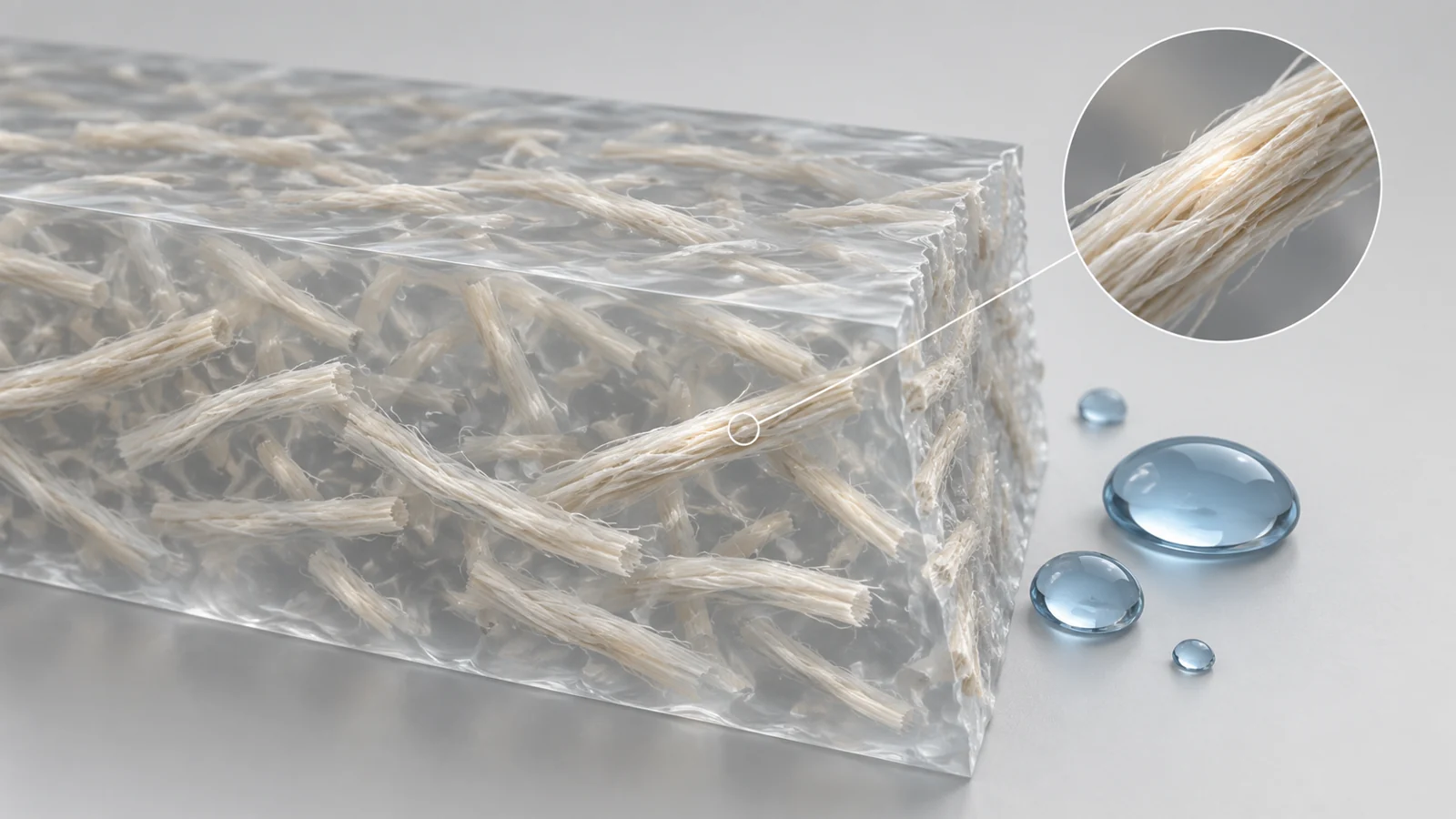
A composite combines materials with different roles. Here, the polymer forms the surrounding matrix, with cellulose incorporated as reinforcement. The review points to mechanical characterization showing a reinforcing effect. That makes cellulose interesting as a functional ingredient, beyond its appeal as an abundant plant-derived resource.
The resource argument is a separate motivation. Researchers are exploring agricultural by-products as sources for useful composites, while also seeking alternatives to conventional reinforcing fibers and their costs. Whether that interest translates into a better finished material depends on the particular combination and how it is made.
Why moisture changes the design problem
A reinforcing ingredient has to work within the surrounding material and under the conditions in which the composite will be used. The review identifies moisture absorption associated with natural fibers as a problem for composite performance. A material’s reinforcing contribution therefore cannot be judged solely from its behavior under one set of conditions.
This is where the cellulose surface becomes an engineering target. It is the point of contact between the reinforcement and its surroundings. The review states that appropriate chemical surface treatment could diminish the adverse effect associated with moisture absorption. In plain language, researchers can modify the surface of the cellulose ingredient as part of designing the composite.
That statement supports a possible mitigation route. It does not establish that treatment makes the material waterproof or that any improvement persists through repeated exposure. For a particular use, the practical question would be how the selected formulation behaves over the relevant exposure time and conditions. The available abstract does not resolve that material-specific question.
Making the surrounding polymer
Surface treatment and composite preparation address different parts of the design. Treatment modifies the cellulose surface; preparation determines how the ingredients are brought together into a material.
The review identifies in-situ polymerization as the most common preparation method within its account. This means forming the polymer within the developing composite, with the reinforcing ingredient present. The abstract associates this approach with improvements in mechanical properties and thermal stability. It offers a qualitative reason to investigate the route, without supplying a transferable recipe or a performance figure for every cellulose–polymer combination.
From a reinforcing effect to a usable material
The distinction between a research direction and a material specification matters here. Evidence that cellulose can reinforce a polymer does not tell a manufacturer how much cellulose to use, which matrix to select, or what performance to expect against a particular alternative. Those decisions require results tied to a defined formulation and a defined comparison.
This account rests on the review’s abstract. It supports an explanation of reinforcement, surface treatment, and preparation, but cannot support a study-by-study comparison or an assessment of how consistently different formulations perform. The review covers potential applications including packaging, aerogels, hydrogels, and fibers; that breadth should not be read as proof that one formulation meets all their requirements.
Environmental claims need a separate assessment as well. Using an agricultural residue identifies the origin of an ingredient. It does not by itself establish the lifecycle benefit, biodegradability, or cost of the finished composite. The surrounding polymer, processing steps, useful lifetime, and eventual disposal would also matter. Likewise, cellulose’s described low toxicity cannot establish the safety of every material containing it.
What this could change
From the perspective of February 2023, the practical prospect is an additional route from agricultural by-products to useful manufacturing inputs. If those resources can supply consistent cellulose reinforcement, and the resulting composites meet the demands of their intended uses, manufacturers could gain another ingredient for designing polymer materials.
Agricultural processors could, in turn, gain an additional outlet for residues. The causal link runs through reliable material performance: a residue becomes more useful to manufacturing when it can be converted into an ingredient with predictable properties. The review describes research directed toward that possibility, with surface modification and preparation methods helping researchers explore how to achieve it.
Key Sources
- Primary source: Challenges associated with cellulose composite material: Facet engineering and prospective.
DOI or Journal Page · Review or Meta-Analysis · 2023-02-04
Keep exploring