
Research Signal – Source date 2025-05-20
A packaging material can be promising because of the problem it has to solve. Carboxymethyl cellulose (CMC), a modified form of cellulose, is bio-based and biodegradable, but it is sensitive to water. Chitosan is also bio-based and biodegradable, yet it dissolves only in acidic systems, and its flow properties limit its food-packaging applications. A review published May 20, 2025, examines how researchers bring these two imperfect ingredients together in films intended for food packaging.
The idea is not that either material already makes an ideal wrapper. It is that their different limitations and useful properties give researchers a reason to combine them. The review surveys how the polymers can form a composite film, how preparation choices shape that material, and what further modifications are being explored. That is a materials-design story, rather than evidence that a particular wrap is ready for use.
The pairing starts with opposite charges
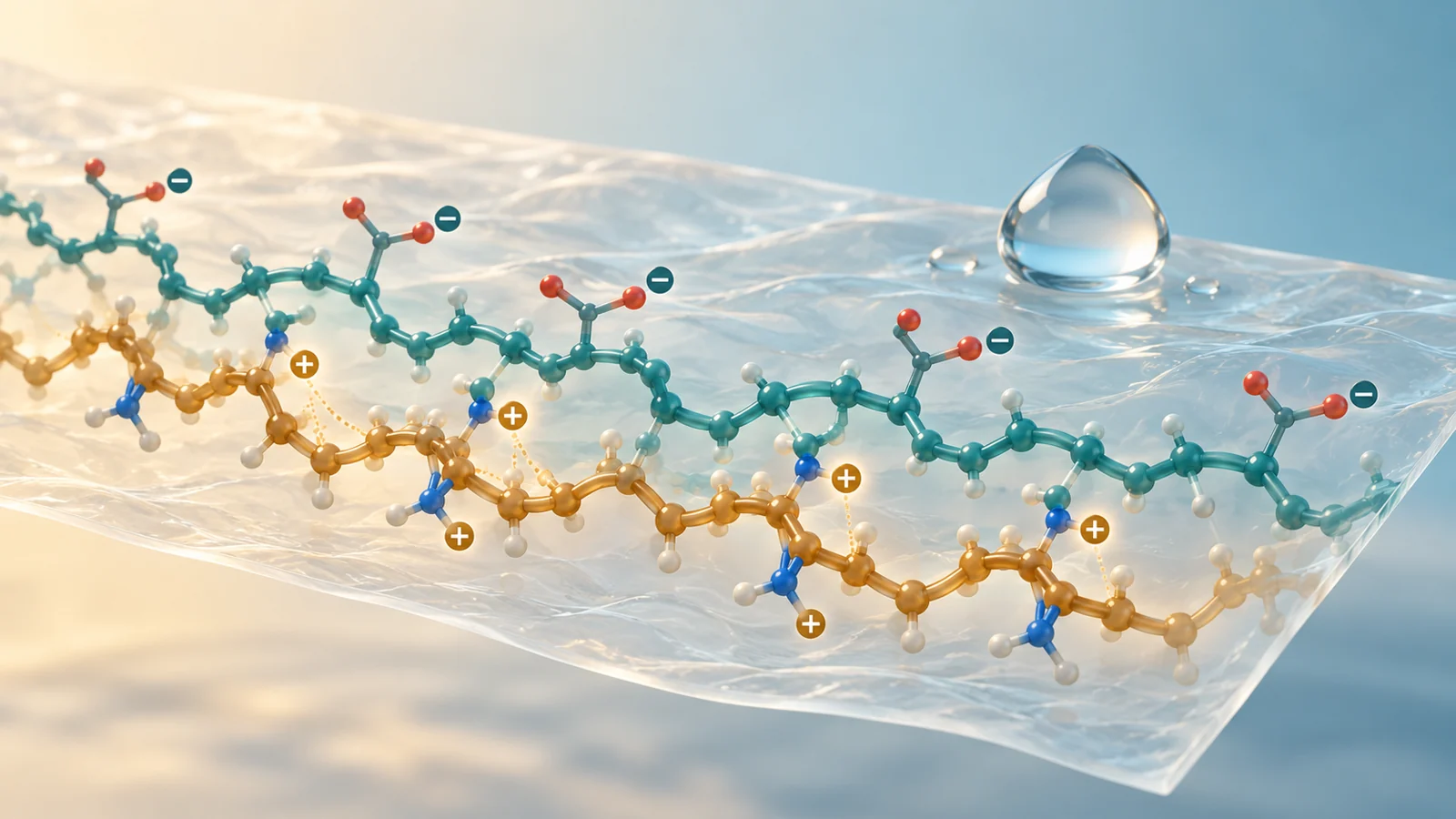
Sodium CMC carries a negative charge, while chitosan carries a positive one. Opposite charges attract, so the polymers can associate through electrostatic interaction. When combined in a film, the resulting material is called a polyelectrolyte composite film: a film formed from polymers with opposite electrical charges.
This interaction offers a route to combine the ingredients rather than treating their drawbacks in isolation. The review presents the pairing as a way to address limitations of each polymer while drawing on their respective strengths. But the charge-based explanation is a design rationale; by itself, it does not tell us how a finished film will behave in contact with a particular food or amount of moisture.
A film depends on how it is made
The review describes solution casting, in which a film is formed from a polymer solution, and identifies the proportions of the raw materials as an important preparation condition. Those choices matter because the film is made from a formulation, not from the names of two ingredients alone. Changing the preparation method or the balance between CMC and chitosan means changing what is being evaluated.
The review’s discussion is not a universal recipe. The supplied evidence does not identify one ratio as best or give a quantitative comparison showing that a specific composite outperforms either ingredient by itself. Instead, preparation and proportions are part of the set of variables researchers consider when designing these films.
The film can be modified beyond the polymer pairing
The base film comes from combining the oppositely charged polymers. The review also surveys ways to modify the films: adding active agents such as essential oils, adding inorganic fillers, using crosslinking agents such as glutaraldehyde to link polymer chains, or using molecular grafting to attach chemical groups to a polymer.
These are distinct formulation approaches, not interchangeable ingredients in a single proven recipe. Their presence in the review shows why a two-polymer pairing is only the starting point: researchers can explore additional components or molecular changes as they develop candidate films. The supplied summary does not establish which approach works best, what measurable effect each produces, or whether a particular combination is suitable for a commercial package.
A promising design still needs package-specific evidence
The review brings together preparation approaches, optimization strategies, and potential food-packaging applications. It supports the conclusion that CMC and chitosan are being studied as a renewable, biodegradable, bio-based film combination, and explains why their charge interaction makes that combination worth exploring.
That account is not a product-performance test. To judge a specific formulation, it would need to be compared with the individual ingredients under conditions relevant to its intended use, including moisture and food contact. Food-contact suitability, manufacturing readiness, and the environmental performance of the finished composite also require their own assessment. The biodegradability described for the starting materials does not, on its own, settle the end-of-life impact of a completed package.
What this could change
One possible payoff is a dependable bio-based film option for food producers, including uses where a package encounters moisture. The review’s account of charge-driven film formation and adjustable formulations gives a plausible design path toward that option. Whether it becomes dependable in practice would also require reproducible performance testing, food-contact suitability, manufacturing capability, and a clear assessment of how the finished material is handled at end of life.
One meaningful sign of progress would be reproducible, head-to-head tests of specified composite formulations against CMC and chitosan individually under relevant moisture and food-contact conditions. Such results could show whether the pairing offers a practical advantage for a defined use. They would mark progress toward another usable bio-based packaging choice, not establish that the broader possibility has already been achieved.
Key Sources
- Primary source: Preparation, optimizations, and applications of (carboxymethyl cellulose)-chitosan polyelectrolyte composite films in food packaging: a review.
DOI or Journal Page · Review or Meta-Analysis · 2025-05-20
Keep exploring