
Research Signal – Source date 2021-02-25
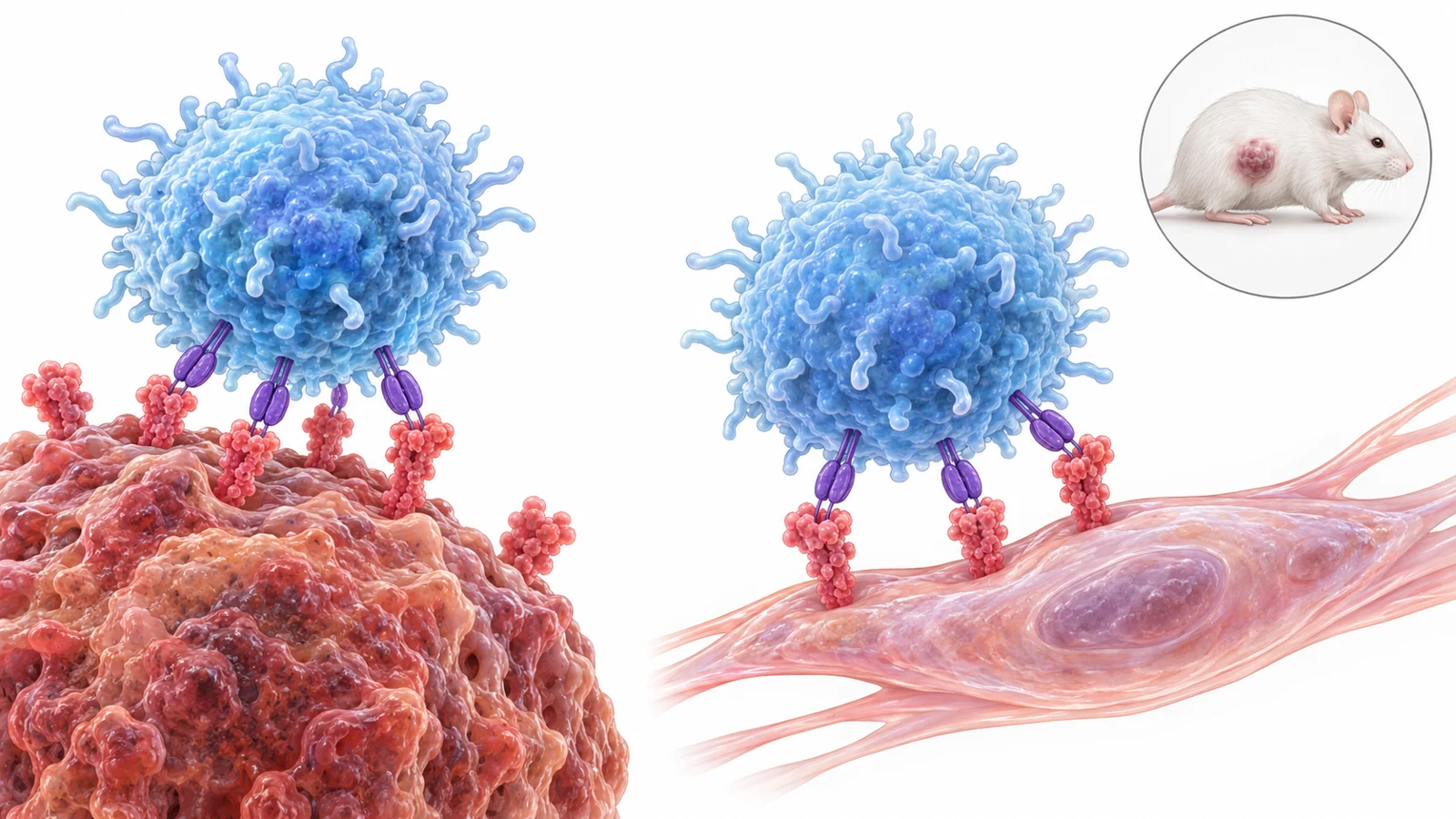
In laboratory tests, engineered immune cells attacked liver-cancer cells with abundant CD105, a surface marker, and also attacked CD105-positive cells that line blood vessels. In two mouse models of liver tumors, the treatment slowed tumor growth. The same overlap that made the approach interesting also raises a selectivity question: CD105 appears on some normal blood vessels, too.
The study, published on February 25, 2021, tested human T cells carrying a receptor designed to recognize CD105. The findings establish activity in cell assays and transplanted tumors in mice. They do not show how the treatment would work or affect healthy tissues in people.
One marker appeared on tumor cells and vessel cells
CD105, also called endoglin, is found on some cancer cells and on endothelial cells, which line blood vessels. The researchers measured CD105 on several liver-cancer cell lines, as well as on human umbilical vein endothelial cells (HUVECs), a laboratory-grown vessel-cell type. The tested Bel7404, HepG2 and SMMC7721 cancer cells had high CD105 levels. MHCC97H cells had little, while 293T cells had none detected in the study’s test. HUVECs also had high levels.
That pattern let the researchers ask whether the engineered T cells’ response tracked the marker. It also meant the experiment was not a test of tumor cells alone: a CD105-positive vessel-lining cell was another target. Because CD105 is present to varying degrees on normal blood vessels, a receptor that recognizes it could have effects beyond cancer cells. The cell panel could reveal which tested cells were vulnerable, but not how the many blood vessels in a person would respond.
A compact binding domain gave T cells a CD105 sensor
A chimeric antigen receptor, or CAR, gives a T cell an added sensor for a chosen target. In this study, the sensor’s binding part was a nanobody, a compact antibody-derived domain. The researchers generated one that recognized CD105, then linked it to the internal signaling parts of a CAR. When the sensor bound its target, those signaling parts could activate the T cell.
They used CRISPR/Cas9 gene editing to insert the CAR gene into AAVS1, a selected site in the human T-cell genome. The construct also included a fluorescent marker to help identify cells that had received it. A cell-by-cell measurement found the added receptor on 41.3% of the tested T cells after insertion, so the engineered batch included cells without detectable receptor. The design combined a CD105-recognition component with T-cell signaling; the experiments then tested whether the resulting cells behaved differently around targets with different amounts of CD105.
The cell assays tied the response to CD105
When exposed to CD105-positive target cells, the engineered T cells showed signs of activation and produced inflammatory signaling molecules. They also multiplied in response to the targets; under the reported culture conditions, their numbers rose about 200-fold over 11 days. These observations show that target contact could do more than trigger a brief reaction in the dish: the cells became activated and expanded during the experiment.
The killing tests made the target pattern more concrete. After 16 hours, anti-CD105 CAR-T cells killed the CD105-rich Bel7404, HepG2 and SMMC7721 liver-cancer cells, as well as CD105-positive HUVECs. They showed little killing of the CD105-low MHCC97H cells and no killing of CD105-negative 293T cells in the assay. Unmodified T cells, mock-engineered cells and T cells carrying a different CAR directed at CD19 showed little or no killing of the tested liver-cancer cells.
A blocking experiment strengthened the link to the intended target. The researchers pretreated the engineered cells with CD105 protein, which reduced their killing of target cells. Together, the differing responses across the cell panel, the comparator groups and the blocking test support CD105-dependent activity in these experiments. They do not establish that CD105 alone determines what would happen in a living person, where healthy tissues and other conditions are involved.
Tumor growth slowed in two mouse settings
The first animal test used NOD/SCID mice, whose impaired immune systems allow human tumor cells and human T cells to be studied together. Researchers implanted Bel7404 liver-cancer cells under the skin. Once tumors reached about 100 cubic millimeters, they randomized the mice into groups, including controls and a group given anti-CD105 CAR-T cells. The treatment was delivered intravenously twice, at 2 million cells per dose.
Compared with the reported control groups, mice given the CD105-targeting cells had smaller tumors, lower tumor weights and longer survival. Examination of the tumors found more human T cells in the treated group, less CD105 staining, more signs of cell death and fewer cells staining for Ki67, a marker used to identify dividing cells. These tissue findings help describe what accompanied the reduced tumor growth in the implants; they do not demonstrate the same process or outcome in a person.
A second experiment used patient-derived xenografts. The researchers transplanted pieces of liver tumors removed from patients into immunodeficient mice and reported similar histology in the original and transplanted tissue. In this model, mice treated twice with CD105 CAR-T cells showed greater tumor suppression than mice given CD19 CAR-T cells. The patient tissue was studied in mice; the patients whose tumors supplied the tissue were not receiving this treatment.
The researchers also monitored tolerability in these mice. They reported that the animals continued eating and drinking, their body temperatures remained normal, and body weight did not change significantly. They also reported no significant rise in measured serum IL-6 and no visible bleeding at autopsy. These observations are limited to the animal models and monitoring described. They cannot establish the range of possible toxicities or clinical tolerability in people, particularly given that the engineered cells also killed a tested vessel-lining cell type.
The insertion method changed the experimental comparison
The target and the gene-insertion method are separate parts of the design. In an additional comparison, the researchers tested CD105 CAR-T cells with the CAR inserted at AAVS1 against cells carrying the same receptor introduced with a lentiviral method. In the reported experiments, the AAVS1-inserted cells had lower measured exhaustion-marker expression, stronger antitumor activity and more T-cell accumulation in tumors than the lentiviral group.
This comparison suggests that how the receptor was installed may have influenced the cells’ behavior in these models. It does not establish that genome editing is clinically safer, less costly or more consistent to manufacture. Those are separate questions from whether the CD105 receptor recognized its target and whether the cells slowed implanted tumors.
The vessel finding remains central to interpreting the results. CD105 was abundant on the HUVECs, and the engineered T cells killed them in vitro. The paper also describes CD105 at varying levels in normal vasculature. The mouse observations offer only a narrow view of tolerability: immunodeficient animals, transplanted human tumors and the reported monitoring cannot show how normal human blood vessels or other tissues would fare.
What a shared tumor and blood-vessel target could change
If CD105-directed cells can control tumors while avoiding unacceptable injury to normal vessels, one engineered T-cell approach could act on both cancer cells and the blood-vessel cells within a tumor environment. That possibility could broaden how solid tumors are targeted, especially where CD105 is present on more than one relevant cell type. The experiments provide an early basis for that idea in cell cultures and mouse implants; whether the balance between tumor attack and healthy-tissue effects can hold in people remains unresolved.
Key Sources
- Primary source: Nanobody-based chimeric antigen receptor T cells designed by CRISPR/Cas9 technology for solid tumor immunotherapy.
DOI or Journal Page · Peer-Reviewed Paper · 2021-02-25
Keep exploring