
Research Signal – Source date 2021-03-26
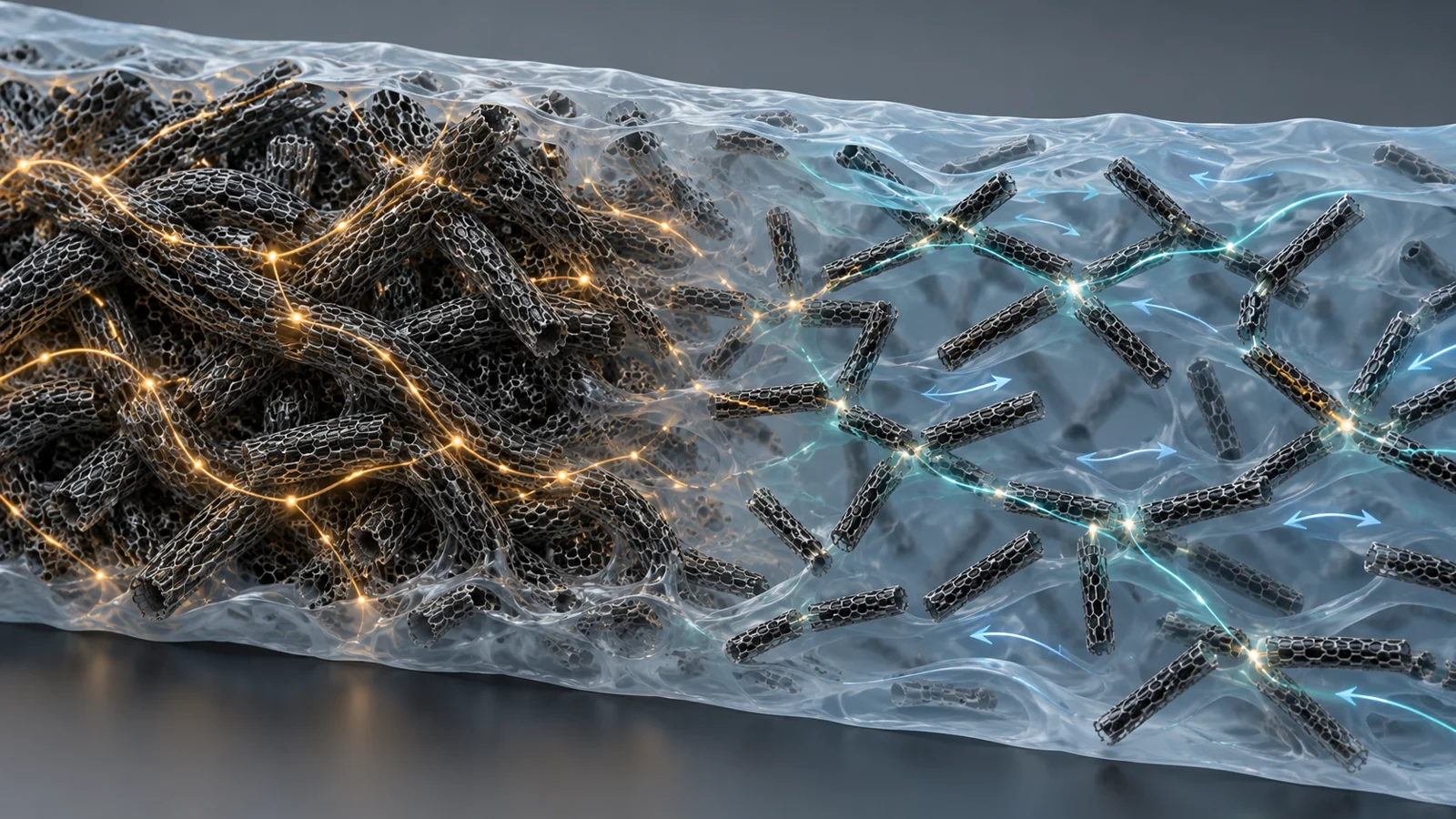
In one epoxy study discussed in a 2021 overview, amino-coated carbon nanotubes formed a conductive network at 0.13% of the composite’s weight. Untreated nanotubes needed 0.51%. A conductive network is a set of connected paths through which current can travel. In that specific comparison, coating the tubes helped those paths form with less added material.
The result points to a central challenge in making nanotube composites: the tubes’ properties matter, but so does how they meet one another and the surrounding plastic. The overview brings together earlier studies of fabrication, surface treatments, and mechanical and electrical behavior. Its examples show why a promising result in one formulation does not automatically carry over to another.
Why the tubes tend to clump
A carbon nanotube is a very small, hollow tube made from carbon atoms arranged in a sheet-like structure. A single-wall nanotube has one such wall; a multiwall nanotube has additional tubes around an inner core. Both can be far longer than they are wide, a shape that helps them form extended pathways through a material.
But pristine nanotubes strongly attract one another. They gather into bundles and tangled clumps, making it harder to distribute individual tubes through a polymer. A clump leaves some regions with many tubes and others with few. The hoped-for properties of separate nanotubes may then be lost, and the composite can behave differently from predictions based on isolated tubes.
The amino-coated epoxy example addressed this obstacle at the tube surface. The review reports thresholds of 0.13 wt.% for amino-coated multiwall nanotubes and 0.51 wt.% for pristine ones. In this formulation, the amino groups improved dispersion and bonded with epoxy groups, helping the tubes form conductive connections at a lower loading. These values describe one reported material and test; they are not a general recipe for every polymer or nanotube.
A surface treatment can help—and change the tube
Surface treatments aim to make nanotubes interact more usefully with a polymer. Covalent functionalization attaches chemical groups to the nanotube through chemical bonds. In the approaches discussed by the overview, oxidation can add carboxyl groups that provide sites for further coupling. Chemical attachment may strengthen the interface between tube and polymer, helping the surrounding material transfer force into the nanotubes.
That treatment has a cost to weigh. Strong oxidation can alter the nanotube’s carbon structure and introduce defects. A tube modified to bond more readily may therefore no longer retain all the properties of an unmodified tube.
Non-covalent functionalization instead adsorbs or wraps molecules around the nanotube through interactions such as hydrogen bonding or attraction between molecular surfaces. It can help create an interface while leaving the tube’s structure largely intact. The amino coating in the epoxy example is described as non-covalent functionalization of the nanotube, although its amino groups then bonded with epoxy groups in the composite. The different bonds at the coating–tube and coating–polymer interfaces help explain how a treatment can preserve the tube while improving its connection to the matrix.
Mixing at scale brings its own trade-offs
Melt mixing blends nanotubes into a softened thermoplastic using equipment such as an extruder or high-shear mixer. It can handle bulk polymer without relying on solvents, which makes it an industrially appealing route. Heat and shear help break apart bundles, but excessive force or temperature can also shorten nanotubes or damage polymer chains.
Solution mixing uses a solvent to help disperse tubes before they are combined with a polymer and the solvent is removed. Stirring or sonication, a vigorous mixing method, can help separate bundles. Yet stronger or longer sonication is not automatically better: the review notes that excessive treatment can reduce nanotube length relative to width, weakening the ability to build extended networks. That can undermine both the electrical pathways and the resistance to heat-related degradation discussed in the overview.
The amount of nanotube also affects whether a composite can be made and shaped. The review describes typical mechanical-property studies as using less than 10 wt.% to avoid rising viscosity and poorer processability. That is not a universal cutoff, but it illustrates the balancing act: the material must contain enough well-connected tubes to deliver a function and remain workable during fabrication.
Strength and conductivity rely on different connections
For mechanical reinforcement, the interface must transfer force from the polymer into the nanotubes. If that connection is weak, a tube may not carry much of the load placed on the surrounding matrix. Surface bonding, dispersion, and tube orientation all influence this transfer.
Electrical conduction depends on paths through the nanotubes. Current can move through tubes that touch, and electrons can also pass between nearby tubes by hopping or tunnelling. As the amount of filler increases, these connections can become numerous enough to create a continuous network. The concentration where conductivity rises sharply is called the percolation threshold. The amino-coated epoxy result is an example of a lower threshold in one formulation, not evidence that stronger mechanical bonding alone guarantees better conductivity.
Orientation adds another choice. Processing can align nanotubes, and the overview discusses examples where alignment improved stiffness and strength along a selected direction. That directional gain may not translate to a bulk component that needs similar performance in every direction. The useful arrangement depends on what the part must carry and how it will be manufactured.
Exposure depends on the material’s form
The overview also discusses safety findings that depend on nanotube form and exposure. In one mouse study it reviews, aspiration exposure to pristine single-wall nanotubes produced acute inflammation, progressive fibrosis, and granuloma formation. It also describes a separate comparison in which pristine multiwall nanotubes produced more severe acute inflammatory cell recruitment than acid-treated tubes; the discussion links particle properties such as size and surface area to potential effects.
These findings concern exposure to nanotubes as particles. They do not quantify risk from nanotubes embedded inside a finished polymer composite. The material’s form and the route of exposure matter when interpreting what an exposure study can say about a component.
What strong, conductive plastics could enable
A lightweight polymer part that also bears load and carries electrical signals could serve in sensors or structural systems, reducing the need to treat mechanical support and electrical function as entirely separate jobs. The reviewed studies make that possibility plausible, but useful components depend on reliably controlling tube networks, force transfer, and directionality while keeping fabrication workable. Exposure during production and use also needs to be understood for the material form involved. The overview describes a field working toward multifunctional composites; it does not report a newly tested commercial component or deployment.
Key Sources
- Primary source: Fabrication, Functionalization, and Application of Carbon Nanotube-Reinforced Polymer Composite: An Overview.
DOI or Journal Page · Review or Meta-Analysis · 2021-03-26
Keep exploring