
Research Signal – Source date 2023-12-30
Strengthening an existing concrete or wooden beam does not always mean making the structural member much larger. Thin sheets or fabrics containing strong fibers can be bonded to its surface, adding reinforcement where it can help carry the load. But choosing that reinforcement requires a more precise question than which fiber is strongest. A beam that bends less under a steady load and a material that absorbs more energy during a sudden impact are delivering different kinds of performance.
A review published on December 30, 2023, brings together earlier experiments on carbon fibers, Kevlar fibers, their composites and reinforced structural elements. Carbon offers high stiffness; Kevlar, a tough synthetic fiber in the aramid family, offers useful impact performance. Combining them is an attractive idea for strengthening buildings, but the route from a promising material specimen to a reinforced beam contains several important steps.
The clearest examples in the paper show why. Changing the fibers in a sandwich panel can increase the energy it absorbs during an impact while making it less stiff. Bonding carbon reinforcement beneath a concrete beam can increase the load it carries before failure. These findings answer different questions, and neither alone establishes how a beam strengthened with bonded carbon–Kevlar fabric will perform.
What the fibers contribute
A composite combines reinforcing fibers with a surrounding material, called the matrix. In the polymer composites discussed here, that matrix holds the fibers together and helps them function as a material. The resulting behavior depends on the fibers, the matrix and the connection between them, as well as how the reinforcement is arranged.
Stiffness describes resistance to deformation under load. Strength concerns the stress a material can withstand before failure. Impact energy absorption measures how much energy a specimen takes up during a collision. These properties are related, but they are not interchangeable. A high tensile strength—the ability to withstand pulling—does not by itself tell an engineer how far a reinforced beam will bend or how it will respond to a blow.
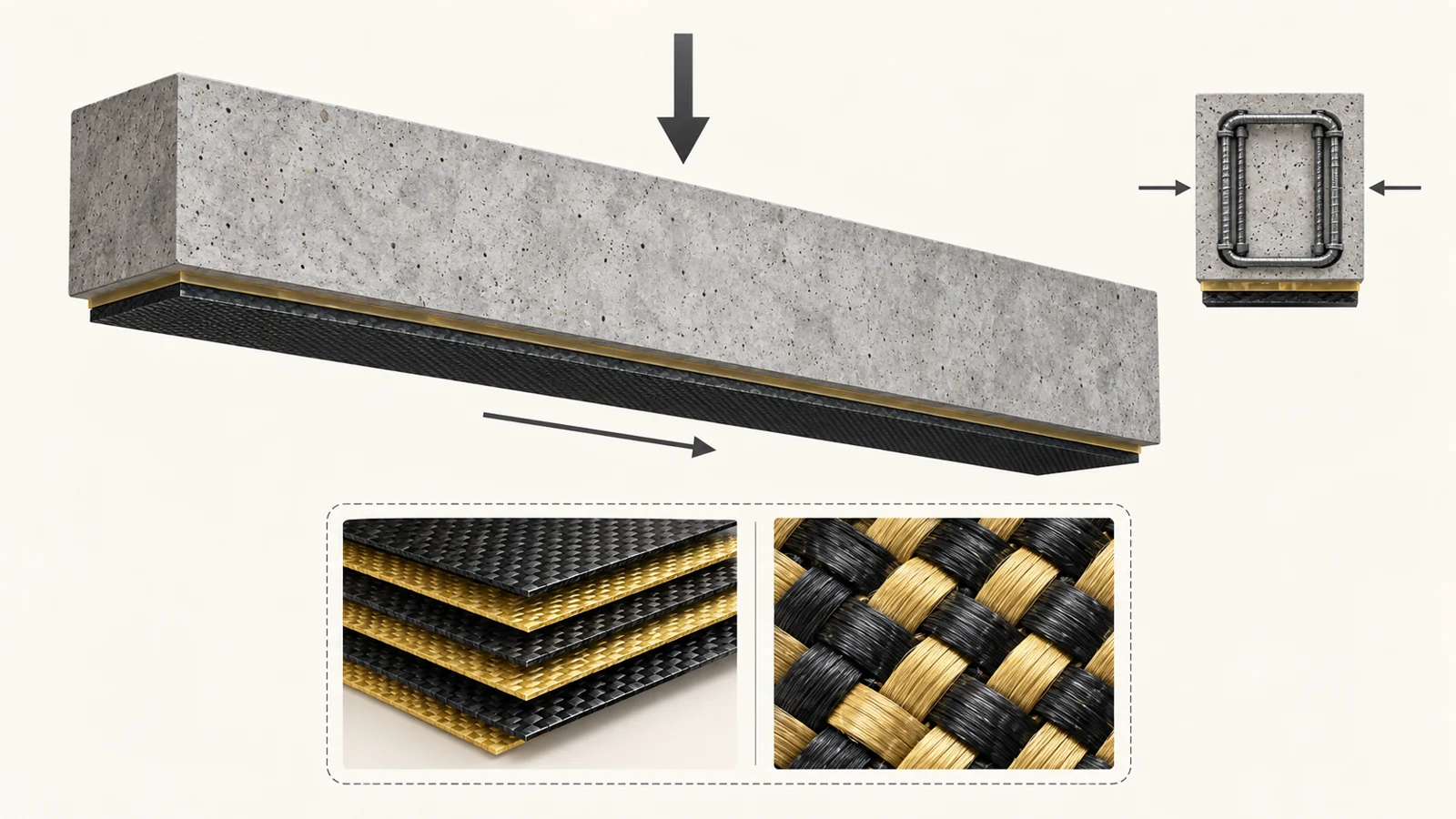
Both carbon and certain Kevlar grades have high tensile strength. Carbon generally provides the greater stiffness, while Kevlar contributes the capacity to absorb impact energy. The review describes two ways to combine them. A layered composite can alternate layers reinforced with one fiber type and layers reinforced with the other. Alternatively, a fabric can contain both carbon and Kevlar within the same layer. These are distinct physical arrangements, even though both are called hybrid composites, meaning materials that combine different reinforcing fibers.
More absorbed energy came with lower stiffness
One comparison summarized in the review used sandwich specimens with a paper-honeycomb core between upper and lower composite face sheets. The reference specimen had four carbon-fabric-reinforced layers in each face sheet. Researchers then replaced carbon layers in the upper face with layers reinforced by Kevlar 49 or by a fabric containing both Kevlar and carbon.
The reference specimens absorbed 31 joules in the impact tests. Relative to that reference, the Kevlar substitutions increased absorbed energy by up to 12.6%, while the mixed-fiber fabric substitutions increased it by up to 5.8%. At the same time, the elastic moduli—a measure of stiffness—decreased in the two directions corresponding to the fabric’s yarns.
That pairing is the useful result. The modified sandwich specimens absorbed more impact energy, but the reported elastic moduli in the two fabric directions decreased. Selecting a material solely for the higher energy figure would miss a change that could matter when limiting deflection is a priority.
These were paper-honeycomb sandwich specimens, not strengthened building beams. The absorbed-energy measurement also does not, by itself, establish less damage or greater load-carrying capacity after the impact. It describes one part of the specimen’s response under the reported test conditions.
On a beam, position changes the job
Once reinforcement is attached to an existing structural member, its location becomes central. For the downward bending configuration described in the review, the bottom of the beam is under tension: it is being stretched. Reinforcement bonded along that bottom face can help resist this pulling action. The adhesive connection allows the added material to participate in carrying the beam’s load.
Reinforcement running across the beam serves a different purpose. The review describes transverse arrangements used to improve shear capacity, addressing forces that tend to make neighboring parts slide relative to one another. Longitudinal reinforcement can help control cracks and deflection. Arrangements covering the bottom and sides can address more than one aspect of the beam’s response. A fiber’s laboratory properties therefore become useful through a specific placement and direction.
The review reports a concrete example from bending tests. Concrete beams strengthened with two or three carbon-fiber-reinforced polymer sheets bonded to their bottom surface showed increases in failure load of up to 38.4% and 51.1%, respectively, compared with an unstrengthened beam. These were carbon-reinforced specimens. The figures concern the load reached at failure in those tests; they are not general increases available to any beam receiving the same number of sheets.
This example establishes a structural outcome beyond a measurement on fibers alone. It also makes the role of placement tangible: the reinforcement was bonded to the surface subjected to tension. Replacing that carbon reinforcement with a carbon–Kevlar fabric would change the tested system, so the carbon-only gains cannot be assigned to the proposed hybrid version.
Water changes the starting material
A reinforcement considered for an existing building must also be understood after exposure to its environment. The review identifies moisture sensitivity as a concern for Kevlar. Water absorption changed the tensile properties of the fibers in the measurements it summarizes, and different Kevlar grades responded differently.
Across the reported fiber measurements, tensile strength after water absorption was 14.5–37.6% lower than before immersion. The changes in stiffness at water saturation varied even more between grades. Young’s modulus was 8.6% lower for Kevlar 29, compared with reductions of 48.3% for Kevlar 49 and 29.9% for Kevlar 149, each relative to its dry specimen.
The variation matters because “Kevlar” does not identify a single response to exposure. A dry-fiber property is an incomplete starting point for judging reinforcement that may encounter moisture. The authors accordingly identify protection against moisture absorption as a problem for further research.
Those percentages belong to fiber tests. They do not specify the loss of capacity or service life of a finished reinforced beam, where the fibers are part of a composite bonded to another material. Establishing that structural response requires evidence about the completed assembly and its exposure, rather than applying a fiber-level percentage directly to the beam.
The missing connection is a bonded hybrid beam
The paper brings together evidence at several scales: individual fibers, composite specimens, sandwich structures and strengthened structural members. Each scale reveals something different. Fiber measurements describe the reinforcement material; impact specimens show the response of a particular layered construction; beam tests show how an attached reinforcement works with a load-bearing member.
The authors identify a specific shortage of publications on beams strengthened by adhesively bonding carbon–Kevlar hybrid fabric and then testing them under bending or impact. They also point to water absorption effects in such structural elements as a direction for future work. This is a narrower and more useful gap than a general call for better composites. It concerns a particular rehabilitation method and the conditions under which it would have to function.
For that method, the relevant question is whether the selected fabric, adhesive connection and beam together deliver useful structural performance. The sandwich tests help motivate a candidate material, and the carbon-only beam tests demonstrate what a different bonded reinforcement achieved. Combining those observations does not supply the missing hybrid-beam result. Nor do they establish a fiber arrangement that is best across stiffness, strength, impact response and environmental exposure.
What this could change
If bonded carbon–Kevlar reinforcement delivers useful performance in beam tests and retains that performance under environmental exposure, engineers could gain another thin, lightweight way to strengthen existing concrete and wooden structural elements. The practical opportunity is to add reinforcement along the surfaces where it can improve load carrying and impact response, without relying only on a larger conventional member.
For building owners, that could broaden the options for rehabilitating structures already in use. For engineers, it could provide more scope to match surface reinforcement to the demands on an individual beam. The payoff would be a demonstrated strengthening capability for existing buildings, with the material, its attachment and the original structural member working together.
Key Sources
- Primary source: Characteristics of Carbon and Kevlar Fibres, Their Composites and Structural Applications in Civil Engineering-A Review.
DOI or Journal Page · Review or Meta-Analysis · 2023-12-30
Keep exploring