
Research Signal – Source date 2023-05-15
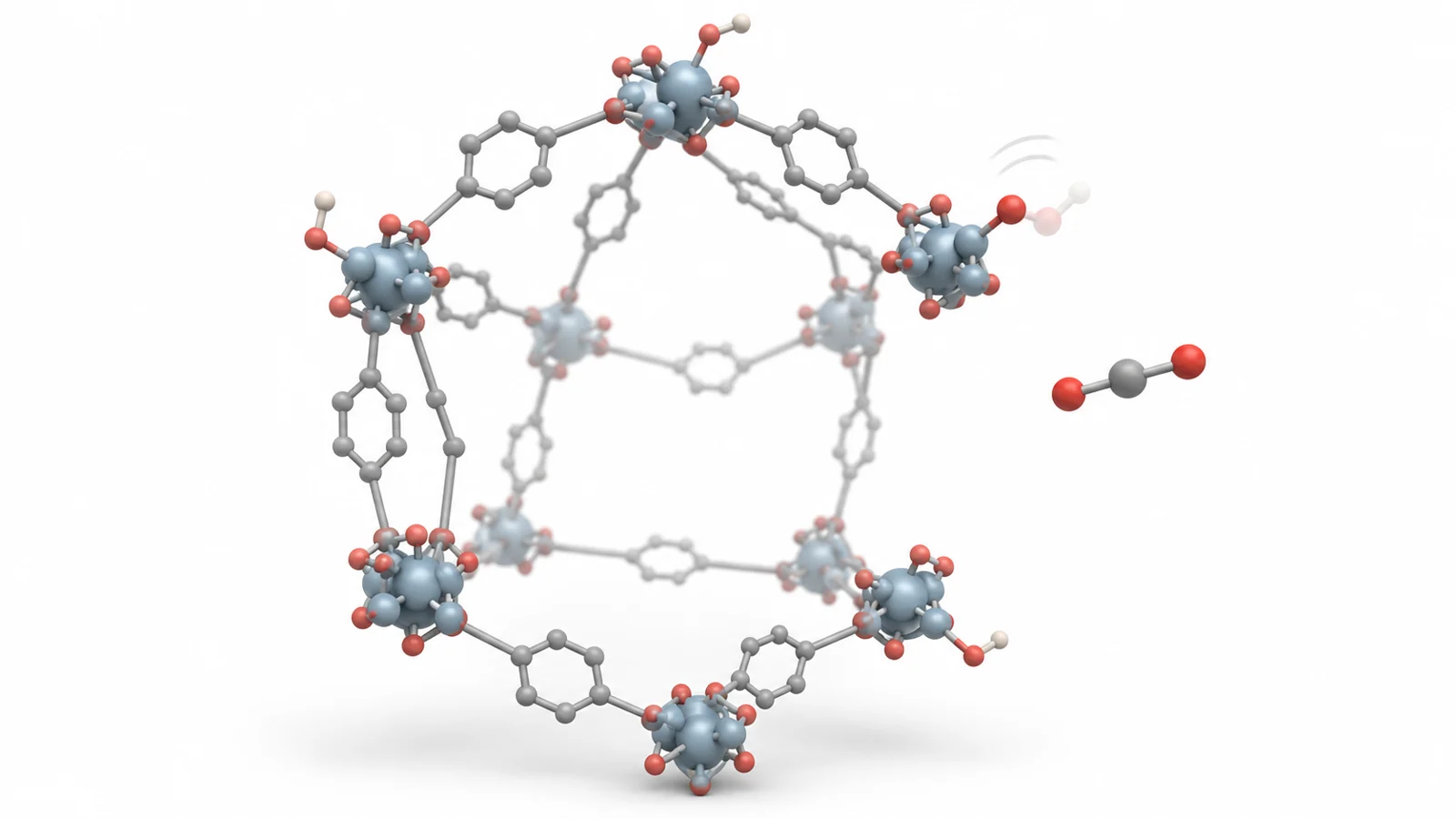
A porous material designed to trap carbon dioxide may have a less static interior than researchers once assumed. In a May 15, 2023 study of MOF-808, the chemical groups lining parts of its pores behaved dynamically as carbon dioxide entered. The finding points to an overlooked part of sorbent design: the pore’s surroundings may respond during binding, rather than simply provide a fixed surface.
Metal-organic frameworks, or MOFs, are crystalline materials with many small pores. Their internal surfaces can be adjusted by changing the groups attached to the framework’s metal nodes. Those groups help define the local environment where a gas molecule encounters the material. The researchers examined whether that environment stayed effectively unchanged during carbon dioxide adsorption—the process by which gas molecules attach to a material.
Three pore caps, with a notable difference
The team compared three MOF-808 variants, each with a different node-capping group: formate, acetate, or trifluoroacetate. These caps are small chemical groups attached at the framework’s nodes, the points where parts of the structure connect.
The trifluoroacetate-capped material stood out in the reported interaction pattern. It showed two carbon dioxide binding modes and a higher binding affinity for carbon dioxide. A binding mode describes a way a molecule interacts with a material; two modes indicate that the gas was associated with the pore environment in two distinct ways in this variant.
The comparison makes the cap chemistry relevant to how carbon dioxide interacts inside MOF-808. It does not, by itself, rank the three materials as practical capture options. Higher affinity describes how strongly the material binds carbon dioxide in the studied setting. Whether that helps capture from a real gas stream depends on other performance questions too.
Following the interaction as it happens
To investigate adsorption, the researchers used measurements taken while carbon dioxide was interacting with the materials. Infrared spectroscopy tracks how molecules absorb infrared light, producing clues about their chemical interactions. The team paired this method with multivariate analysis, which helps interpret patterns across complex measurements, and with powder X-ray diffraction, a way to examine the material’s crystal structure.
Computational analyses also supported the reported dynamic behavior. Together, these approaches led the authors to identify carbon dioxide interactions at the framework nodes and connect them with the changing behavior of the capping groups. The measurements and calculations support that interpretation for the MOF-808 variants examined; they do not show that every MOF pore behaves this way.
Affinity is one part of capture performance
A material that binds carbon dioxide strongly may seem promising, but binding affinity alone does not tell an engineer how much gas it will capture from an industrial stream, how it will perform alongside other gases, or how well it will work over repeated use. Those questions require comparative performance measurements under relevant conditions. The evidence described here supplies no numerical uptake, mixed-gas selectivity, regeneration, durability, cost, or emissions results, so those outcomes should remain open questions.
The useful takeaway is narrower and more specific: in this set of MOF-808 materials, the chemistry of the node caps was associated with distinct carbon dioxide interactions, and the trifluoroacetate variant showed two binding modes alongside higher affinity. That gives researchers a reason to examine whether responsive pore chemistry can be connected to useful capture behavior, without treating that connection as already demonstrated.
What this could make possible
If further work links capping-group behavior to reliable performance, designers of carbon capture systems could choose pore chemistry partly by how it responds as carbon dioxide enters. For an engineer selecting a sorbent for a particular industrial gas stream, that could eventually add measured responsive behavior to the design choices. The observed cap-associated dynamics and the two binding modes in MOF-808-TFA offer a starting point for that possibility, but dependable response-guided selection would require more development.
A nearer milestone is to test whether these capping-group behaviors track with comparative carbon dioxide uptake, selectivity among gases, and performance over repeated cycles under relevant gas conditions. Such results would show whether the molecular interactions identified here translate into practical advantages.
Key Sources
- Primary source: Unveiling Unexpected Modulator-CO 2 Dynamics within a Zirconium Metal-Organic Framework.
DOI or Journal Page · Peer-Reviewed Paper · 2023-05-15
Keep exploring