
Research Signal – Source date 2025-07-10
A material that captures carbon dioxide has to do more than catch it. To be reused, it must also release the captured gas. In a study published on July 10, 2025, researchers report that a porous material captured CO₂ under several combinations of temperature and humidity—but under hot, dry conditions, the chemistry shifted toward a form that held the carbon more stubbornly.
The material, called Rb₂CO₃ CD-MOF ST, belongs to a family of porous frameworks built using cyclodextrin, a ring-shaped sugar molecule. The study examines its behavior as a possible carbon-capture material for dilute gas streams, including streams relevant to natural-gas power-plant emissions and air. Its most useful insight is a reminder that capture and release are separate demands: conditions that let a material bind CO₂ can also change how readily it lets go.
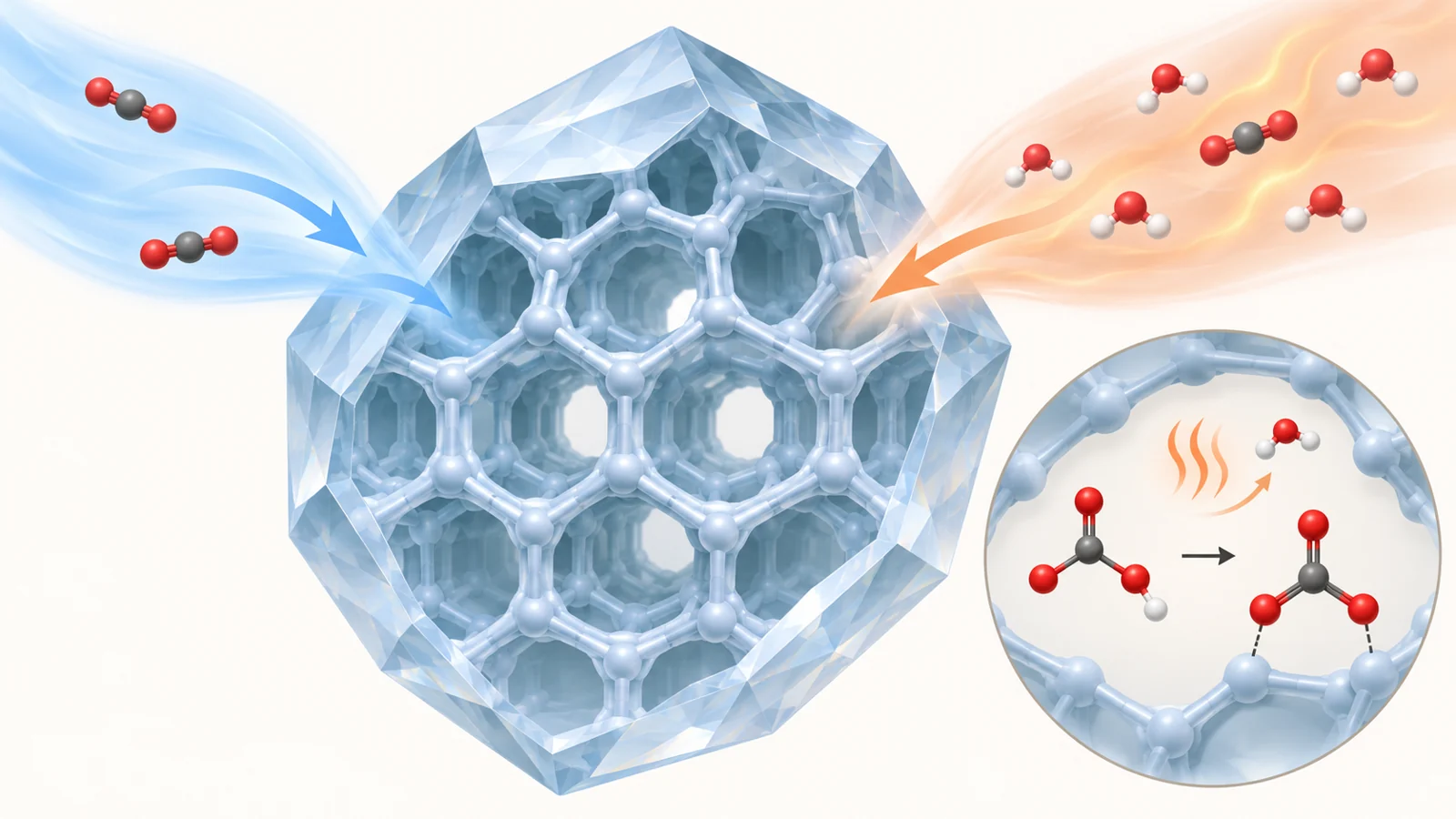
Temperature and moisture shaped the reported capture windows
The researchers report high CO₂ capacities in two different settings: dry, dilute gas at low temperatures, and humid gas at elevated temperatures. These results make temperature and water content part of the material’s operating picture, rather than minor background details. The study’s abstract does not supply numerical capacities, so the findings are best understood as reported behavior across those conditions, not as a quantified comparison of performance.
The material also captured CO₂ selectively in dynamic breakthrough experiments with mixed gases. In a breakthrough test, a gas mixture passes through a material and researchers observe which components are captured as the stream moves through. This matters because real emissions contain more than CO₂; a capture material must distinguish the target gas in a mixture.
A change in bound carbon helps explain the release problem
The unexpected result appeared when the material was exposed to hot, dry conditions. The researchers observed a shift from bicarbonate formation, which they describe as reversible, to carbonate formation, which they describe as irreversible. Both are chemical forms in which carbon is bound in the material. In this case, carbonate is the more stubborn form: once formed under the reported conditions, it was not reversibly released in the same way as bicarbonate.
That change could matter for reuse. A sorbent—the material that takes up a target gas—needs to release captured CO₂ if it is to cycle through capture again. If operating conditions favor a form that holds carbon irreversibly, capture alone does not tell us how much useful capacity will remain available over repeated use. The authors supported their interpretation with gas-sorption measurements, spectroscopy, which helps identify chemical species, and density functional theory calculations, a method for examining molecular interactions. The calculations support the proposed mechanism; they are not a separate test of an operating capture process.
Mixed-gas performance and stability are promising material-level findings
Oxygen exposure and repeated operation are relevant challenges for capture materials intended for air or oxygen-rich exhaust. The paper describes amine scrubbers, a leading capture technology, as having limited oxidative and thermal stability that can constrain long-term cycling in such streams. The authors report good thermal, oxidative, and cycling stability for this framework, alongside selective capture in mixed-gas breakthrough experiments.
Those reports are encouraging for a materials study, but they do not amount to a head-to-head demonstration that this framework outperforms amine scrubbers. Nor do the abstract-level results establish how a deployed process would perform as temperature, humidity, gas composition, and operating demands change. Capacity, release, durability, and the conditions that produce carbonate would all matter to a practical system; the supplied evidence does not provide numerical process performance, energy use, cost, or emissions impact.
How this could shape the future
A dependable capture material that works with oxygen-rich exhaust could eventually give operators another option for removing CO₂ from power-plant emissions or even from air. Reaching that point would require oxygen-based sorbents to capture selectively and release carbon reliably as heat and moisture vary. This study contributes a useful step toward that goal: it reports capture across distinct conditions and identifies a hot, dry chemical shift that could make captured carbon harder to recover.
A meaningful next milestone would be extended mixed-gas capture-and-release cycling across hot, dry and humid conditions, measuring whether carbonate buildup reduces recoverable capacity. If materials can be designed to avoid or manage that switch, the gap between a promising capture result and a reusable process could begin to narrow.
Key Sources
- Primary source: Carbon Capture from Natural Gas Flue Emissions and Air via (Bi)Carbonate Formation in a Cyclodextrin-Based Metal-Organic Framework.
DOI or Journal Page · Peer-Reviewed Paper · 2025-07-10
Keep exploring