
Evidence date · 2024-05-10 · Research note 2 of 3
1 2 3
See current Track status →
Since the previous research note · Partly supported
Track continuity
Since the previous research note: What did adding a checkpoint drug to CAR T therapy show in leukemia and lymphoma?
Previous expectation: A checkpoint add-on could become useful for a defined group if renewed CAR T activity led to durable responses beyond comparable CAR T treatment alone.
What this study adds: The 2024 review adds antigen-specific lymphoma and solid-tumor patient studies, including responses in a tiny neuroblastoma cohort without a significant cell-persistence difference and a lymphoma comparison with similar response rates. These findings develop the question but do not establish the predicted bridge to durable comparative benefit.
What changed in this study
CAR T cells have produced striking results in some blood cancers, but pairing them with a drug that blocks an immune brake has not made solid tumors an easy target. The reason is that the brake is only one part of the problem. Engineered T cells must also find their way into a tumor, recognize enough of its cells, and remain active there.
A 2024 review examined patient studies of CAR T cells combined with drugs that block PD-1, or with CAR T cells engineered to reduce PD-1 activity themselves. It describes encouraging responses in some small groups, alongside a lymphoma comparison where response rates were close between combination and control groups. The findings raise a practical question about the treatment strategy, but they do not establish a dependable advantage across cancers.
A useful strategy meets different tumor environments
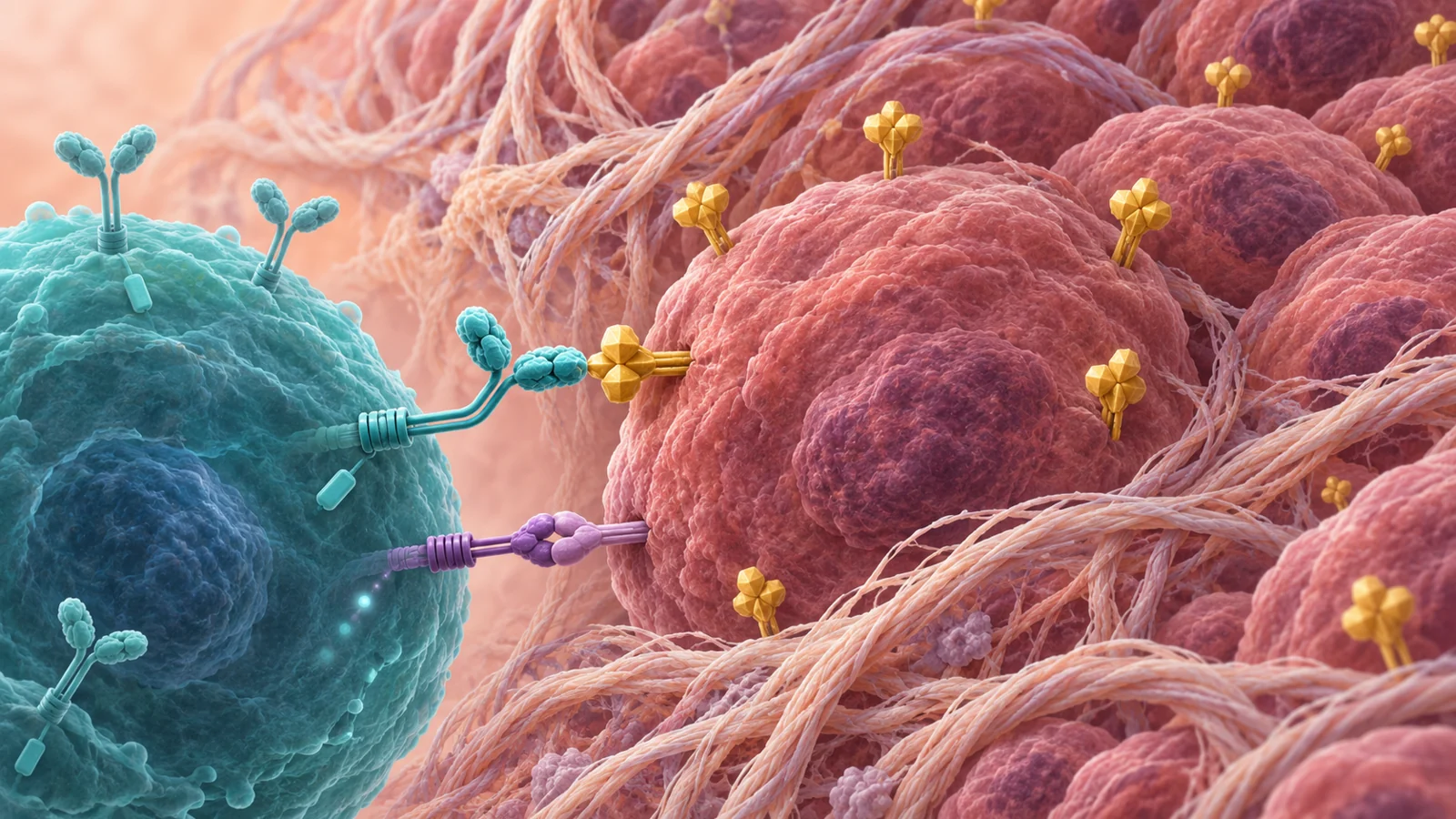
CAR T treatment starts with a person’s T cells, immune cells that can attack abnormal cells. Scientists add a specially designed receptor that lets those T cells recognize a chosen marker on a tumor cell. The modified cells can then be infused to seek out cells carrying that marker. CD19, for example, is a marker on B cells and has been used to direct CAR T treatment for some lymphomas and leukemias.
That approach has had clinical success in blood cancers. Solid tumors present a different setting: their surrounding tissue can make it difficult for CAR T cells to travel to the tumor, enter it, and persist. Their tumor markers can also vary. A treatment that recognizes a marker may therefore have trouble reaching or identifying all the relevant cancer cells.
PD-1 is a receptor that can dampen T-cell activation when it engages with PD-L1 or PD-L2, molecules that can be present in the tumor environment. That restraint helps regulate immune activity, but it can also limit the work of T cells trying to attack a tumor. Blocking PD-1 is intended to ease that inhibition. It may help a CAR T cell function once it encounters its target, while leaving the separate challenges of access and target recognition to be solved.
Two ways to change PD-1 activity
The reviewed studies used two broad approaches. In an external combination, a patient receives a PD-1-blocking drug alongside CAR T cells. The cell product and the checkpoint drug are separate treatments, so the drug can be administered on its own schedule. The review notes that this approach may be simpler to organize because PD-1-blocking medicines are already approved for some uses, while the doses and timing for a CAR T combination still need to be worked out.
In a cell-intrinsic approach, the CAR T cells are altered to reduce PD-1 activity. Some studies disrupted the gene that encodes PD-1. This changes the cell product itself rather than adding a separately dosed drug. It may avoid repeated checkpoint-drug dosing, but permanently removing an inhibitory signal also raises questions about immune regulation. The review describes potential concerns such as autoimmune effects, off-target gene edits, and the possibility that cells lacking PD-1 could become less functional over time.
These designs are not interchangeable versions of the same treatment. One combines two separately administered therapies; the other changes the engineered cells. The review does not determine that either approach is superior, and the best balance of activity, dosing and safety remains uncertain.
Small cohorts show promise, with different kinds of evidence
One example involved GD-2-directed CAR T cells for neuroblastoma. In the cohort that also received a PD-1 blocker, two of three patients had a complete response and one had a partial response. Those outcomes are encouraging, but three people cannot show how reliably the result would carry over to a larger group. The review also reports no significant difference in measured CAR T-cell persistence or expansion between patients who did and did not receive the checkpoint drug. A response in this tiny cohort therefore did not come with a corresponding difference in those cell measurements.
A lymphoma comparison gives a different kind of evidence. It included 44 people with relapsed or refractory diffuse large B-cell lymphoma: 26 received a PD-1 inhibitor with anti-CD19 CAR T cells, and 18 received CAR T cells without the inhibitor. In the combination group, 11 people had a complete response and six had a partial response, for an objective response rate of 65.39%. In the control group, seven had a complete response and four a partial response, for a rate of 61.11%.
The combination group’s reported rate was higher, but the difference between these groups was modest. This comparison does not show a clear, dependable improvement from adding the inhibitor. It also cannot answer whether responses lasted longer: the figures cited here are response rates assessed after treatment, not a demonstration of durable comparative benefit.
Releasing inhibition does not solve access or durability
The review describes a patient study of 15 people with different solid tumors who received mesothelin-directed CAR T cells with edits to disrupt both PD-1 and the T-cell receptor gene. Seven had stable disease at the first reported assessment, three to four weeks after infusion. At a later follow-up, eight to twelve weeks after infusion, stable disease continued in two of those patients. The report also gave a median overall survival of three months for the full group.
This was a small study of a particular engineered-cell design across several cancer types, so its results should not be read as a test of every CAR T and PD-1 combination. The review notes that disrupting the T-cell receptor may have affected CAR T-cell proliferation in this study. More broadly, it identifies tumor entry, variation in tumor markers, resistance and recurrence as obstacles that checkpoint inhibition alone may not overcome.
Safety and durability matter alongside early response. CAR T treatment can carry risks including cytokine release syndrome and neurotoxicity, and the review raises potential immune-related risks when PD-1 activity is genetically disrupted. It also describes the difficulty of judging late adverse effects and long-term effectiveness when follow-up is limited. A response at an early assessment is useful evidence, but it is not by itself proof that a treatment will keep controlling a cancer safely.
The review gathers unlike studies, not one uniform trial
The authors report a systematic search of Google Scholar and PubMed, with 16 patient-based papers included after screening. Those reports cover different cancers, target markers, CAR T designs and ways of combining treatment. The review brings their findings together, but the underlying studies are not a single standardized comparison. Small patient groups and differing approaches make it hard to turn the reported responses into one overall estimate of benefit.
The distinction between blood cancers and solid tumors remains central. Standalone CAR T therapies have shown success in some blood cancers, but those results cannot be transferred to combinations generally or taken as evidence that CAR T works broadly in solid tumors. The review’s examples support continued investigation of PD-1 blockade as one way to modify CAR T activity; they leave open whether that change can produce a lasting advantage for a clearly defined group of patients.
How this could shape the future
For someone with a solid tumor beyond today’s established CAR T uses, a future engineered-cell treatment might be able to recognize a well-defined tumor marker, reach the tumor tissue, and keep working despite inhibitory signals. The review supports investigating whether PD-1 blockade can help with that last part. Reliable access to tumor tissue, careful target selection, lasting activity and acceptable safety would still need to come together before that capability could become a dependable treatment option.
A meaningful nearer milestone would be a comparison in a defined group with a marker-positive solid tumor. It would need to show more durable patient responses with the combination than with CAR T alone, while also measuring whether the cells reached the tumor and what adverse events occurred. That kind of evidence could clarify whether easing PD-1 inhibition helps overcome a real treatment bottleneck, rather than producing an early response in a small, varied group.
Key Sources
- Primary source: The synergistic immunotherapeutic impact of engineered CAR-T cells with PD-1 blockade in lymphomas and solid tumors: a systematic review.
DOI or Journal Page · Review or Meta-Analysis · 2024-05-10