
Research Signal – Source date 2022-06-18
Engineering an immune cell to recognize a cancer target is only part of the challenge. In melanoma, cells must also reach tumor tissue, and a target that appears on healthy tissue could expose it to harm. A 2022 literature review considers adoptive cell therapy and chimeric antigen receptor T-cell therapy, or CAR-T, as approaches to melanoma, while identifying these as distinct obstacles rather than solved problems.
Two ways to prepare a patient’s immune cells
Adoptive cell therapy (ACT) involves collecting a patient’s lymphocytes, selecting and expanding them outside the body, and processing them to stimulate or activate them before infusion. CAR-T therapy also starts with a patient’s T cells, but genetically engineers them to recognize a chosen antigen, a molecule the immune response can target. The cells are then expanded in the laboratory and infused back into the patient.
Both approaches involve preparing immune cells outside the body. CAR-T adds a designed recognition target; that design still has to work in the complex setting of a tumor. The review also discusses immune checkpoint inhibitors, which are another approach to melanoma immunotherapy, but the supplied abstract does not give comparable outcome data for ranking these treatments against one another.
A target has to distinguish tumor from healthy tissue
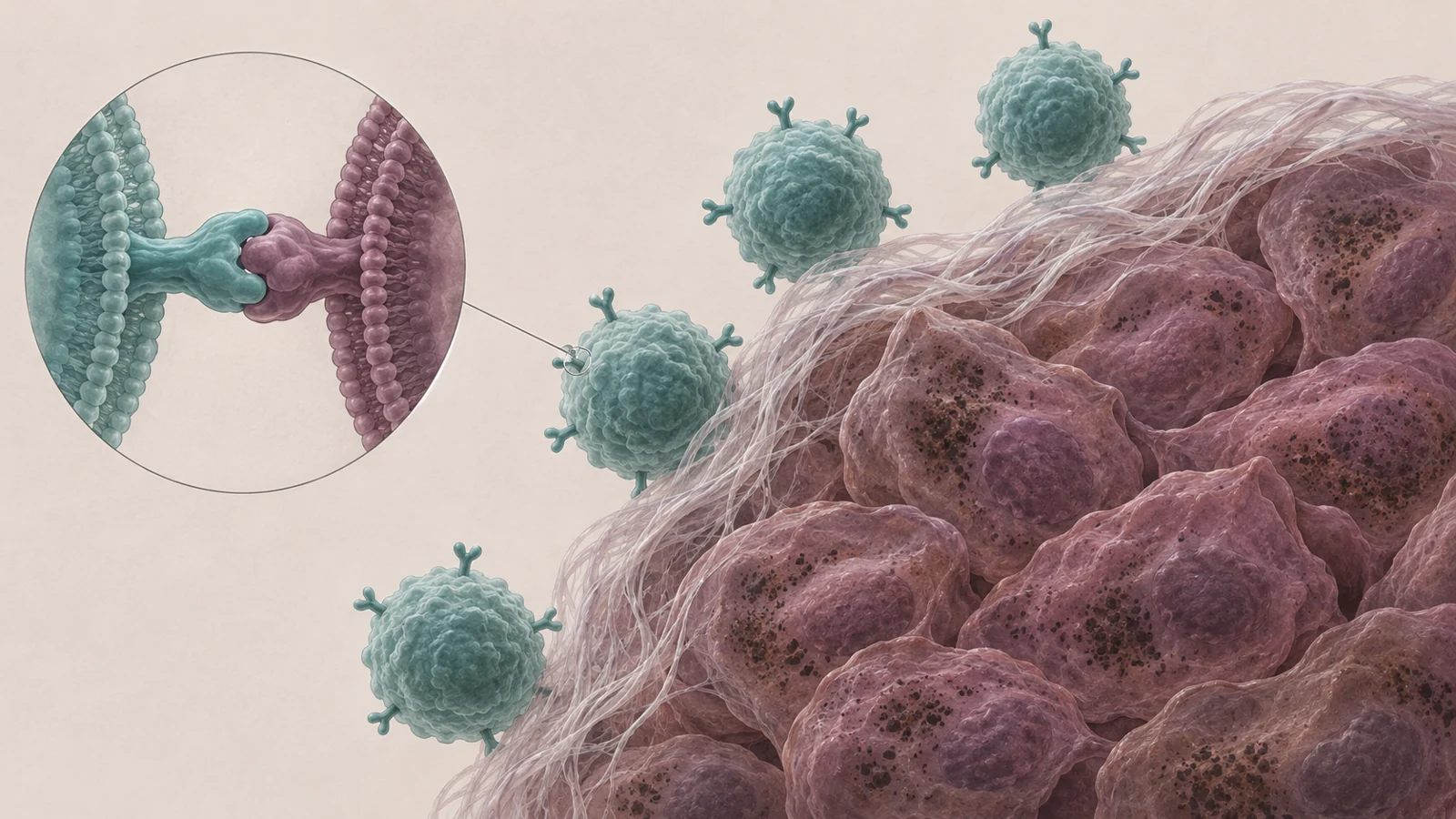
Choosing an antigen is not simply a matter of finding something a T cell can recognize. A target must be suitable for directing an immune response toward melanoma while limiting the risk that engineered cells will react to healthy tissue. The review identifies off-target toxicity as an obstacle for CAR-T approaches, making target selection a question of both recognition and safety.
The authors point to “surfaceome” analysis as a possible aid to future target selection. In plain terms, it means examining the molecules displayed on cell surfaces. That could help researchers identify and assess candidate targets, but the review presents it as a direction for further work, not as a demonstrated way to eliminate off-target harm in patients.
Even a carefully chosen target answers only what a cell might recognize. It does not ensure that the cell can enter melanoma tissue in sufficient numbers. The review names limited CAR-T tissue infiltration as another major challenge. Recognition and access are separate requirements: a cell can be engineered for a target and still struggle to reach the place where that target matters.
Activation and resistance raise different questions
The review discusses two cytokines, interleukin-2 (IL-2) and interleukin-7 (IL-7), which are signaling proteins linked in the abstract to T-cell activation and anti-melanoma activity. The supplied material does not show that using them helps T cells last longer, enter tumors or overcome resistance in patients.
Resistance is a further obstacle. The abstract also mentions other treatments used in resistant cases, but gives no results that would allow a comparison with ACT or CAR-T. It does not show that those treatments overcome resistance to cell therapy. Resistance remains a separate question for engineered T cells.
What this review can tell us about the options
The review evaluates ACT and CAR-T for melanoma and places them alongside immune checkpoint inhibitors in its account of immunotherapy. The available abstract describes processes, obstacles and proposed research directions, but provides no comparative effect sizes, response rates or safety estimates. It therefore supports a careful comparison of how these approaches work and what challenges they face, not a ranking of melanoma outcomes.
Nor does this review establish a new melanoma CAR-T treatment result. Its practical contribution in the supplied material is to frame a set of linked research needs: choose appropriate targets, improve access to tumor tissue, address resistance and assess safety. Progress on one would not automatically resolve the others.
How this could shape the future
A person with melanoma might eventually have an engineered-cell option designed to recognize an appropriate tumor target, reach tumor tissue and limit harm to other tissue. That possibility depends on solving the targeting, access and resistance challenges and establishing the approach through clinical validation; the review does not show that such a dependable option is already available.
A nearer milestone would be a melanoma study that clearly specifies its cell target and measures tumor infiltration alongside off-target effects. Evidence of that kind could help show whether cells are reaching tumors while making the safety question visible. If those pieces advance together and hold up in clinical testing, engineered cells could become a more credible option for melanoma care.
Key Sources
- Primary source: Opportunities and obstacles for the melanoma immunotherapy using T cell and chimeric antigen receptor T (CAR-T) applications: a literature review.
DOI or Journal Page · Review or Meta-Analysis · 2022-06-18
Keep exploring