
Research Signal – Source date 2026-04-07
CAR-T therapy has produced substantial efficacy in some blood cancers, and researchers are exploring whether it can help against solid tumors such as breast cancer. The question is open because a cell engineered to recognize cancer still has to find a useful target across a tumor, function in its environment, and be made and tested safely.
A review published April 7, 2026, examines CAR-T design, preclinical testing, manufacturing challenges and clinical studies across breast-cancer subtypes. It describes a field under investigation, not a new treatment result. The distinction matters: experience in blood cancers gives researchers a reason to explore CAR-T in breast cancer, but does not answer whether it benefits patients there.
Recognition begins with a target
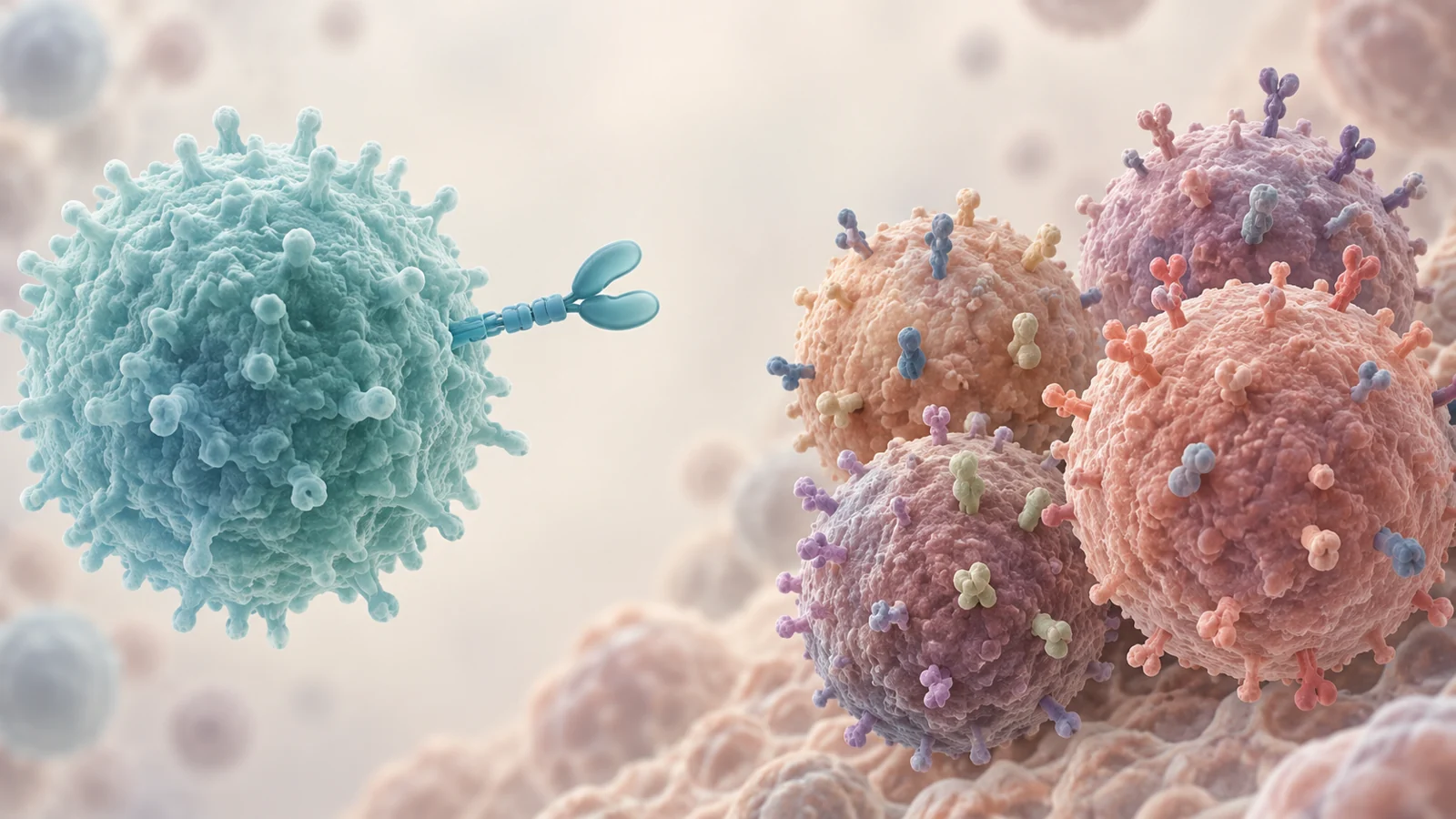
CAR-T begins with a patient’s T cells, immune cells altered to carry a receptor intended to recognize a marker on cancer cells. The receptor’s design, including its internal signaling components, is part of the effort to make recognition prompt an immune response. The review also discusses genetic engineering approaches such as CRISPR and TALENs.
Choosing the marker is a central decision. The review names HER2, MUC1 and EGFR as targets considered in breast-cancer CAR-T research. A target must be relevant to the cancer cells researchers hope to attack; the choice shapes what the engineered cells are designed to recognize. Naming a target, however, does not establish that a therapy built around it works in patients.
A tumor can complicate recognition
Breast tumors can vary in the antigens displayed by their cells. If the target is not shared consistently, a design aimed at one marker may not address every cancer cell. Antigen heterogeneity is one of the barriers the review identifies, and it makes target selection a biological challenge as well as an engineering choice.
The tumor environment adds another obstacle. CAR-T cells must operate in and around a solid tumor, where conditions differ from those in blood cancers. The review considers strategies such as next-generation CARs, combination therapies and approaches to modify the tumor environment. These are lines of investigation; the supplied evidence does not establish that any one strategy overcomes the barriers in breast cancer.
Making cells is part of the problem
A candidate therapy also has to be produced consistently. The review identifies large-scale manufacturing and quality control as hurdles, alongside the need for preclinical models to assess safety and efficacy. Those steps matter because a promising receptor design is not, on its own, a treatment that can be reliably prepared and evaluated.
Safety requires particular attention. The review names cytokine release syndrome among the concerns for CAR-T therapy. Its mention signals a risk that must be assessed; it is not a measure of how often the complication occurs in breast-cancer trials or how severe it is there.
What the clinical discussion can tell us
The review covers clinical data, trials and breast-cancer subtypes, but the available evidence for this article does not provide trial-level estimates or comparisons. It therefore cannot support a specific response rate, survival effect or toxicity estimate. Nor does the fact that trials are discussed establish clinical benefit in breast cancer.
The review points toward personalized CAR-T approaches, new target discovery and biomarker-guided patient selection as future directions. These ideas reflect the need to match a design to a patient’s tumor and to resolve practical and safety challenges. Whether they lead to better outcomes remains a clinical question.
What effective engineered T cells could offer breast cancer patients
For people whose breast cancer resists existing approaches, an effective CAR-T therapy could offer an additional treatment route. That possibility depends on finding targets that remain useful across a patient’s tumor, producing cells reliably, managing safety concerns and demonstrating benefit in clinical studies. The review describes why researchers are pursuing that possibility; the evidence here does not show that it has been achieved.
Key Sources
- Primary source: CAR-T cell therapy in breast cancer management: expanding horizon and overcoming challenges beyond hematologic cancers.
DOI or Journal Page · Review or Meta-Analysis · 2026-04-07
Keep exploring